
Podcast


Podcast: Chinese Ink Wash Painting: Mountains and Water
Listen to Jason & Amy discuss Chinese Ink Wash Painting: Mountains and Water
New here?
Xie He and the Six Principles of Painting
The theoretical foundation of Chinese painting was laid in the fifth century by the court portrait painter and critic Xie He, whose Six Principles of Painting (Huihua Liufa), set down around 490 CE in his "Record of the Classification of Old Painters" (Guhua Pinlu), became the most influential critical framework in the entire history of East Asian art. The six principles — spirit resonance (qi yun), bone method (gufa), correspondence to the object (yingwu), suitability to type (suilei), division and planning (jingying), and transmission by copying (chuanyi) — established a hierarchy of values that placed inner vitality above technical skill and structural planning above surface likeness. Of these principles, the first, qi yun sheng dong, or "spirit resonance generates life-movement," has been endlessly discussed, debated, and reinterpreted over fifteen centuries, yet its essential meaning remains consistent: the highest achievement in painting is to capture the living spirit of the subject, not merely its outward form (Acker, 1954, p. 4).
The concept of qi yun (spirit resonance) draws on deep currents in Chinese philosophy, particularly the Daoist understanding of qi as the vital energy that animates all things. A painting that possesses qi yun does not simply depict a mountain or a pine tree — it makes the viewer feel the mountain's weight, its age, the wind moving through its pines, the clouds gathering around its peaks. This quality cannot be achieved through technique alone; it requires what Chinese critics call xiongzhong qiuhe, "hills and valleys in the breast" — an inner landscape of feeling and understanding that the painter projects onto silk or paper. As Sullivan (1999) observed, the Six Principles made Chinese painting criticism fundamentally different from its Western counterpart: where European art theory focused primarily on mimesis and optical accuracy, Chinese theory was always oriented toward vitality, resonance, and the transmission of inner experience through outward form.
The remaining five principles address the practical and educational dimensions of painting but are always understood in relation to the supreme standard of spirit resonance. "Bone method" (gufa) refers to the structural strength of brushwork — the inner skeleton of a painting that gives it force and integrity. "Correspondence to the object" (yingwu) and "suitability to type" (suilei) concern the painter's fidelity to natural forms and appropriate use of color, but these are explicitly ranked below spirit resonance, establishing that literal accuracy is a necessary but insufficient condition for great art. "Division and planning" (jingying) refers to composition, while "transmission by copying" (chuanyi) affirms the centrality of learning from past masters — a principle that sustained the Chinese tradition of copying masterworks as a primary mode of artistic education. Together, these six principles created an evaluative framework that remained remarkably stable across fifteen centuries, providing a shared critical vocabulary that allowed painters, patrons, and scholars to discuss painting with precision and nuance (Bush & Shih, 2012, pp. 39–46).
Early Masters and the Tang Legacy
The earliest surviving Chinese paintings on silk date from the Warring States period, but it was during the Tang dynasty (618–907 CE) that painting emerged as a fully independent art form with its own professional hierarchies, critical traditions, and imperial patronage structures. The Tang court painter Wu Daozi, sometimes called the "Sage of Painting," was celebrated for a figure style of such power and dynamism that viewers reportedly felt his painted subjects might step off the wall. According to the art historian Zhang Yanyuan, writing in 847 CE, Wu Daozi could complete an entire mural in a single day, working with a speed and confidence that left spectators breathless. Though none of Wu's original works survive, his influence echoes through centuries of Chinese figure and religious painting, and his legendary status testifies to the Tang dynasty's conviction that painting was an art of the highest order (Barnhart, 1997, p. 56).
The emergence of landscape as the supreme genre of Chinese painting is traditionally traced to the late Tang and Five Dynasties period (roughly the ninth and tenth centuries), when the political fragmentation of the empire drove many scholar-officials into retreat in mountain hermitages. Jing Hao, a scholar who withdrew to the Taihang Mountains during the collapse of the Tang, wrote the influential treatise "Notes on Brushwork" (Bifa Ji), which established landscape painting as a vehicle for philosophical contemplation rather than mere scenic description. Jing Hao's distinction between "resemblance" (si) and "truth" (zhen) became a foundational concept in Chinese landscape theory: a painting that merely looks like a mountain achieves only resemblance, while a painting that captures the mountain's essential nature achieves truth. This philosophical framework elevated landscape painting above all other genres, positioning it as the pictorial equivalent of poetry and philosophy (Cahill, 1960, p. 22).
The monumental landscape tradition reached its first great peak during the Northern Song dynasty (960–1127) with masters such as Fan Kuan, Guo Xi, and Li Cheng. Fan Kuan's Travelers Among Mountains and Streams, widely regarded as the single greatest Chinese landscape painting, presents a towering mountain face that fills nearly the entire composition, dwarfing the tiny figures and mule train at its base. The painting communicates an overwhelming sense of nature's grandeur and humanity's smallness — a visual meditation on the Daoist theme of yielding to forces greater than oneself. Guo Xi, who served as court painter to Emperor Shenzong, articulated the theoretical underpinnings of the Northern Song landscape in his treatise "Lofty Message of Forest and Stream" (Linquan Gaozhi), which remains one of the most comprehensive statements of Chinese landscape aesthetics ever written. Guo Xi's concept of the "three distances" — high distance, deep distance, and level distance — provided a vocabulary for understanding spatial composition that influenced every subsequent generation of landscape painters (Fong, 1992, pp. 118–135).
"Take nature as your outward teacher; find the source within your heart."
Zhang Zao (Tang dynasty)The Northern and Southern Schools
One of the most influential and controversial ideas in Chinese painting history is the theory of the Northern and Southern Schools, articulated by the late Ming dynasty painter-critic Dong Qichang (1555–1636). Drawing an analogy with the Northern and Southern schools of Chan (Zen) Buddhism, Dong proposed that Chinese painting had divided into two fundamental lineages: a Northern School of professional painters who relied on meticulous technique and brilliant color, and a Southern School of amateur literati who favored ink monochrome, spontaneous brushwork, and personal expression over decorative finish. Dong explicitly championed the Southern School as the superior tradition, aligning it with the Chan Buddhist ideal of sudden enlightenment — a direct, intuitive grasp of reality unmediated by laborious method. The Northern School, associated with the court painters Ma Yuan and Xia Gui, was dismissed as skilled but spiritually shallow (Cahill, 1982, p. 89).
Dong Qichang's theory, while historically problematic — scholars have pointed out that the supposed lineages do not neatly correspond to actual artistic practice — had an enormous impact on the subsequent development of Chinese painting. By elevating the literati tradition above the professional tradition, Dong established a hierarchy that dominated Chinese painting criticism until the twentieth century. The Southern School lineage, as Dong constructed it, ran from the Tang dynasty poet-painter Wang Wei through the great Yuan dynasty masters Huang Gongwang, Wu Zhen, Ni Zan, and Wang Meng — the so-called Four Masters of the Yuan, who became the most intensively studied and copied painters in all of Chinese art. This canon-making act reshaped how painters and collectors understood the tradition, privileging certain artistic values — spontaneity, amateurism, personal expression — while marginalizing others equally valid and accomplished (Ho, 1992, pp. 201–215).
Modern art historians have extensively critiqued the Northern-Southern School theory, demonstrating that it tells us more about the cultural politics of the late Ming than about the actual history of Chinese painting. The distinction between "professional" and "amateur" was itself a social construction that served the interests of the literati elite, allowing wealthy scholar-officials to claim artistic authority over commercially successful painters of often equal or superior technical skill. Yet the theory's very artificiality reveals something important about the nature of Chinese painting discourse: in China, painting was never simply a visual art but always also a literary and philosophical practice, embedded in networks of social prestige, cultural capital, and ideological contestation. The Northern-Southern School theory, flawed as history, succeeded brilliantly as cultural criticism, articulating values — spontaneity, sincerity, learning, inner cultivation — that continue to shape Chinese aesthetic thought (Clunas, 1997, pp. 42–55).
Literati Painting and the Amateur Ideal
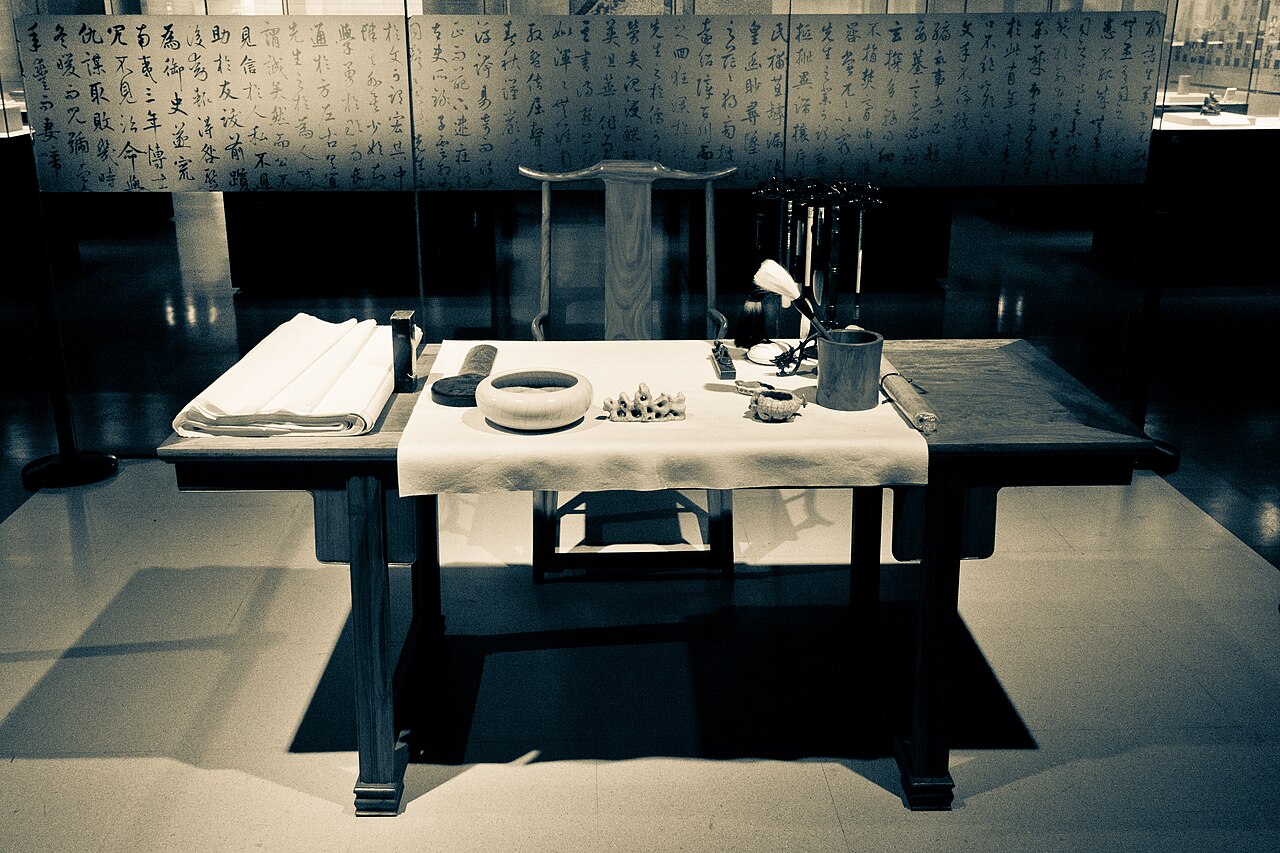
The concept of literati painting (wenrenhua) is one of the most distinctive contributions of Chinese civilization to world art history. Unlike the Western model, in which painting was traditionally a specialized profession requiring years of workshop training, the Chinese literati tradition held that the finest paintings were produced by scholar-amateurs — men (and occasionally women) of broad learning whose primary identities were as poets, philosophers, and government officials, and who painted not for money or public display but for personal expression and the exchange of gifts among friends. The great Song dynasty poet-painter Su Shi (Su Dongpo) articulated this ideal most forcefully, declaring that "to judge paintings by their formal likeness / shows an understanding close to that of a child." For Su Shi and his circle, painting was a branch of poetry — a means of expressing ideas and emotions that transcended the merely visual (Bush, 1971, p. 67).
The Yuan dynasty (1271–1368) is often regarded as the golden age of literati painting, partly because the Mongol conquest displaced Chinese scholars from government service, freeing them — or condemning them — to devote themselves to art. The Four Masters of the Yuan — Huang Gongwang, Wu Zhen, Ni Zan, and Wang Meng — developed radically individual styles that prioritized personal expression over naturalistic representation. Ni Zan's spare, austere landscapes, composed of a few skeletal trees, an empty pavilion, and vast stretches of blank space, became icons of scholarly detachment and spiritual purity. His famous declaration, "I paint only to express the untrammeled spirit in my breast," became a manifesto for the literati ideal. Wu Zhen, by contrast, brought a robust, earthy energy to his paintings of bamboo and fishermen, demonstrating that literati painting could encompass vigor as well as refinement. Together, these four masters established a repertoire of styles and attitudes that defined the literati tradition for the next six centuries (Cahill, 1976, pp. 90–145).
The literati ideal carried significant social implications that modern scholars have subjected to critical analysis. The insistence that true painting was the province of educated amateurs served to exclude professional painters — who were often of lower social status — from the highest ranks of artistic prestige. It also tended to exclude women, who were generally denied access to the classical education that was considered prerequisite for meaningful artistic expression. Yet within its own terms, the literati tradition produced works of extraordinary depth and subtlety. The best literati paintings reward sustained contemplation rather than immediate visual impact, revealing their qualities slowly through repeated viewing — a brushstroke that seems simple at first glance turns out to contain subtle variations in pressure, speed, and ink density; an apparently empty passage of blank paper vibrates with implied space and atmospheric light. This aesthetic of understatement and suggestion, in which what is left unsaid matters as much as what is expressed, represents one of the great achievements of the Chinese artistic imagination (Sullivan, 1999, pp. 185–200).
"In painting there is poetry; in poetry there is painting."
Su Shi on Wang WeiGuo Xi and the Vision of Early Spring
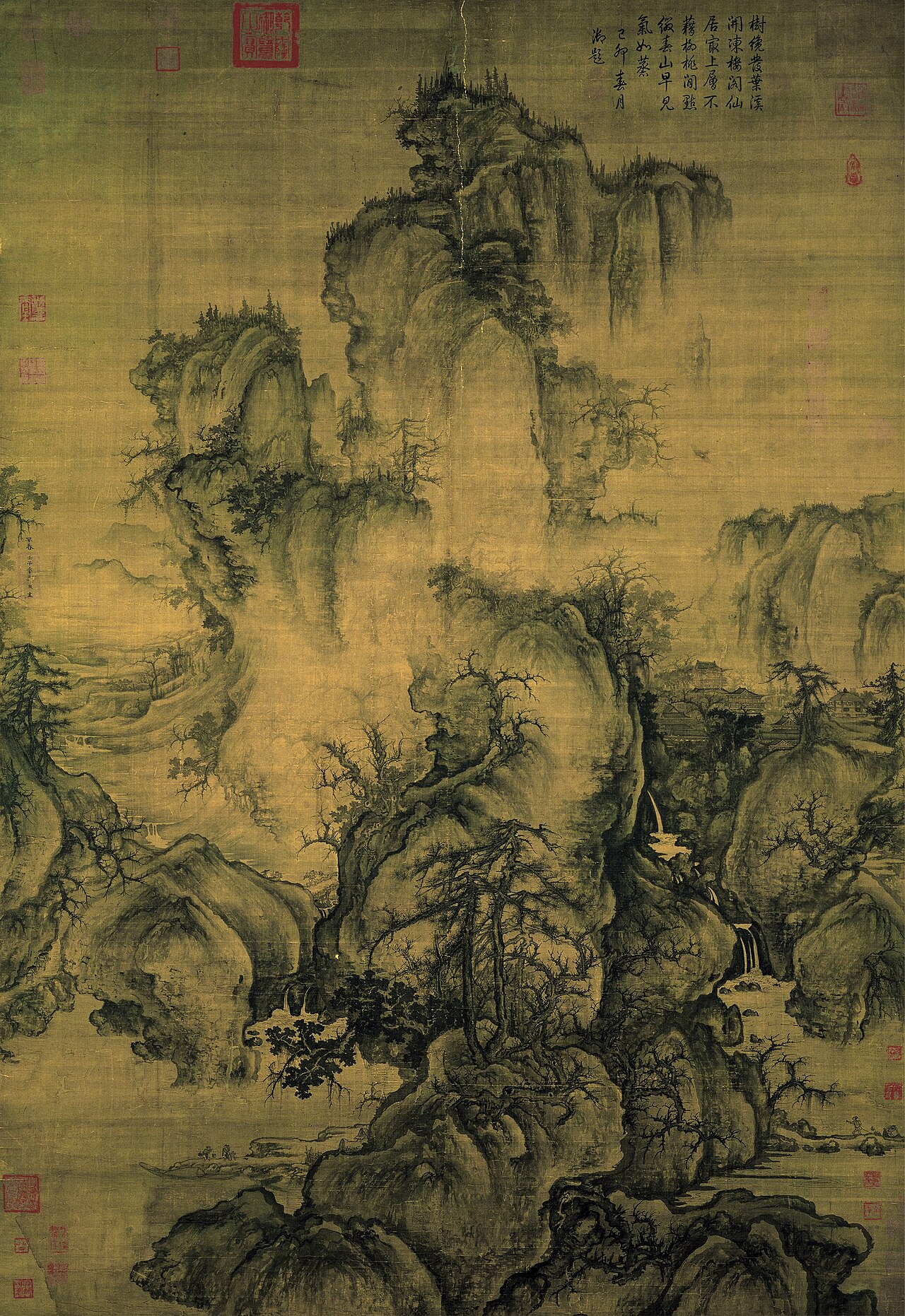
Guo Xi's Early Spring (Zao Chun Tu), painted in 1072 CE and now housed in the National Palace Museum in Taipei, stands as one of the supreme masterpieces of Chinese landscape painting and a summation of the monumental Northern Song tradition. The painting presents a towering mountain landscape emerging from winter mists, its peaks dissolving into clouds while waterfalls thread down its slopes and gnarled pines cling to rocky ledges. Tiny human figures — a traveler on a path, fishermen on a lake — provide scale but are almost absorbed into the vast natural drama surrounding them. The composition embodies Guo Xi's concept of the "living mountain," which he described as changing its appearance with every shift of season, weather, and viewing angle, "like a living thing" that could never be reduced to a single, fixed image. According to Fong (1992), Early Spring represents the most complete realization of Guo Xi's theoretical vision, translating his verbal descriptions of mountain atmosphere into visual form with unmatched authority.
Guo Xi's treatise "Lofty Message of Forest and Stream" (Linquan Gaozhi), compiled by his son Guo Si, provides the most comprehensive surviving account of Northern Song landscape aesthetics and practice. Guo Xi argues that landscape painting serves a vital human need: it allows the scholar-official, trapped in the dusty world of bureaucratic routine, to experience vicariously the freedom and spiritual refreshment of mountain wandering. "The haze, mist, and the haunting spirits of the mountains are what human nature seeks," he writes, "yet can seldom find." This understanding of landscape painting as a form of imaginative travel — a means of inhabiting places one could not physically visit — gave the genre a psychological urgency that went far beyond mere aesthetic pleasure. The painter was not simply recording a scene but creating an inhabitable world, a space the viewer could enter and explore in the mind's eye (Bush & Shih, 2012, p. 151).
The technique of Early Spring displays Guo Xi's signature "crab claw" tree branches and "cloud head" rock textures — texture strokes (cunfa) so distinctive that they became identifying markers of his style. Texture strokes are one of the defining technical features of Chinese landscape painting, a repertoire of conventionalized brushwork patterns used to suggest the surface qualities of different types of rock, earth, and vegetation. Each major landscape painter developed characteristic texture strokes — Fan Kuan's "raindrop" strokes, Dong Yuan's "hemp-fiber" strokes, Ma Yuan's "axe-cut" strokes — creating a visual vocabulary that was both technically descriptive and expressively individual. Guo Xi's cloud-head strokes, with their rounded, billowing forms, give his rocks an almost organic quality, as though the mountains were not inert geological formations but living organisms breathing and growing. This animation of the natural world through brushwork is one of the central achievements of Chinese landscape painting, and Early Spring remains its most persuasive demonstration (Silbergeld, 1982, pp. 47–68).
"Landscape uses form to charm the Way."
Zong Bing, "Introduction to Painting Landscape"Ink Wash in the Modern World
The encounter between Chinese ink painting and Western art during the late nineteenth and early twentieth centuries precipitated a crisis of identity that continues to shape the field. Reformers such as Kang Youwei and Chen Duxiu argued that traditional ink painting was exhausted and irrelevant, calling for wholesale adoption of Western techniques including perspective, anatomy, and oil painting. The educator and artist Xu Beihong, who studied in Paris, attempted a synthesis that grafted Western realism onto Chinese ink technique, producing works that were technically impressive but struck many traditionalists as aesthetically incoherent. His contemporary Qi Baishi followed a different path entirely, revitalizing the literati tradition from within by turning to humble, vernacular subjects — shrimp, crabs, cicadas, and wildflowers — rendered with a directness and vitality that made centuries-old techniques feel astonishingly fresh. Qi Baishi's success demonstrated that the ink painting tradition possessed untapped reserves of expressive potential that required not Western supplementation but creative reimagination from within (Andrews, 2014, pp. 89–112).
The mid-twentieth century brought further disruption. During the Maoist period, ink painting was conscripted into the service of socialist realism, producing landscapes populated by heroic dam-builders and revolutionary red flags — works that satisfied political requirements but largely abandoned the contemplative spirit that had animated the tradition. In Taiwan and Hong Kong, meanwhile, artists such as Zhang Daqian and Liu Guosong explored more experimental directions. Zhang Daqian's late splashed-ink landscapes, created by pouring and throwing ink onto paper in a process that combined control with calculated accident, produced effects of atmospheric grandeur that rivaled Abstract Expressionism while remaining rooted in Chinese aesthetic principles. Liu Guosong, a student of both Chinese and Western painting, developed techniques involving textured paper and collage that pushed ink painting toward pure abstraction while retaining the medium's distinctive luminosity and fluidity (Sullivan, 1996, pp. 210–235).
Today, Chinese ink painting exists in a state of dynamic pluralism. Traditional masters continue to produce landscape, flower, and figure paintings in styles that would be recognizable to a Song dynasty connoisseur, while contemporary artists use ink as a medium for installation, video, performance, and conceptual art. The international art market's growing interest in Chinese contemporary art has brought new attention and new resources to the field, though it has also raised concerns about the commodification of a tradition whose deepest values are antithetical to market logic. Perhaps the most significant development is the emergence of "new ink painting" (xin shuimo) as a recognized category in international exhibitions and museum collections, suggesting that ink wash — the medium most intimately identified with Chinese civilization — is finding new audiences and new meanings in a globalized art world. The mountains and waters that Guo Xi painted nearly a thousand years ago continue to flow and shift, taking forms that even that most visionary of masters could never have imagined (Bryson, 2010, pp. 34–51).
Quiz
What is the primary focus of the Six Principles of Painting by Xie He?
Which dynasty is credited with the emergence of landscape as the supreme genre of Chinese painting?
What did Dong Qichang's theory of the Northern and Southern Schools emphasize?
Which artist is associated with the 'crab claw' tree branches and 'cloud head' rock textures?
What is the significance of the Yuan dynasty in the context of literati painting?
How did Qi Baishi contribute to the modern era of ink painting?
What is a key characteristic of literati painting according to Su Shi?
What does Guo Xi's 'Early Spring' exemplify in terms of landscape painting?
Write your thoughts, then get feedback from Jason — you can turn any answer into a full discussion.
9. How might the concept of 'spirit resonance' influence your perception of art in general?
10. In what ways do you think the literati tradition of painting might differ from Western art traditions?
Frequently Asked Questions
Common questions about Chinese Ink Wash Painting: Mountains and Water
What is Chinese ink wash painting and how is it different from Western landscape art?
Chinese ink wash painting (水墨画) uses black ink in varying concentrations on paper or silk to create images that capture the spiritual essence of a subject rather than its photographic likeness. Unlike Western landscape painting, which emphasizes fixed-point perspective and realistic light, ink wash painting uses shifting viewpoints and empty space to evoke the vastness and energy of nature.
What does shanshui mean in Chinese art?
Shanshui (山水) literally translates to "mountain-water" and refers to the landscape painting genre that is considered the highest form of Chinese pictorial art. The term reflects the Daoist and Confucian belief that mountains and water represent the complementary forces of yin and yang, stillness and movement, that animate the natural world.
What materials are used in traditional Chinese ink painting?
Traditional Chinese ink painting requires an ink stick ground on an inkstone with water to produce liquid ink, a brush made from animal hair set in a bamboo handle, and either Xuan paper or silk as the painting surface. The absorbent quality of Xuan paper makes each brushstroke permanent and unrevisable, demanding complete mastery before brush touches surface.
Who are the greatest Chinese landscape painters?
The Northern Song masters Fan Kuan, Guo Xi, and Li Cheng are considered the supreme landscape painters for their monumental mountain compositions. Later masters like Ni Zan and Huang Gongwang of the Yuan dynasty pioneered the literati style, while the eccentric Qing painter Shitao pushed the tradition toward personal expression that anticipated modern art.
What is the Six Principles of Chinese painting by Xie He?
Xie He's Six Principles (六法), written around 500 CE, are the foundational criteria for judging Chinese painting. The most important principle is "spirit resonance" (气韵生动), meaning a painting must convey the living energy of its subject, followed by principles governing brushwork, form, color, composition, and the study of past masters.