
Podcast


Podcast: Chinese Porcelain: White Gold of the East
Listen to Jason & Amy discuss Chinese Porcelain: White Gold of the East
New here?
From Stoneware to True Porcelain
The development of true porcelain — ceramics fired at temperatures exceeding 1,280 degrees Celsius from a body composed of kaolin clay and petuntse (porcelain stone) — was one of China's most consequential technological achievements, a process that unfolded over more than a thousand years before reaching maturity during the Tang dynasty. The roots of this achievement lie in the high-fired stoneware traditions of southern China, where potters in present-day Zhejiang province were producing proto-porcelain vessels with thin walls and natural ash glazes as early as the Shang dynasty (c. 1600–1046 BCE). These early wares, fired at temperatures of 1,200 degrees or above, already displayed some of the translucency and hardness that would later characterize true porcelain, but they lacked the refined white body that defines the mature material. The long, incremental journey from proto-porcelain to true porcelain reflects not a single moment of invention but centuries of accumulated knowledge passed down through generations of anonymous craftspeople (Kerr & Wood, 2004, pp. 23–45).
By the Eastern Han dynasty (25–220 CE), potters at the Yue kilns in Zhejiang were producing celadon-glazed stoneware of remarkable sophistication — vessels with smooth, olive-green glazes that Chinese connoisseurs would later compare to jade. These Yue wares represented a crucial step toward true porcelain, achieving higher firing temperatures and finer clay bodies than any previous ceramic tradition. The celadon tradition continued to develop through the Six Dynasties and Sui periods, gradually refining both materials and technique. It was during the Tang dynasty that the critical breakthrough occurred: potters in northern China, working with the pure white kaolin clays of Hebei and Henan provinces, developed a white porcelain body of unprecedented refinement. The Xing kilns of Hebei produced white wares so fine that the Tang poet Du Mu compared them to silver and snow, while the poet Lu Guimeng praised their "jade-like" quality. These white wares, together with the green celadons of the south, established the fundamental aesthetic polarity — white and green, north and south — that would define Chinese ceramics for centuries (Vainker, 1991, p. 78).
The significance of true porcelain extended far beyond aesthetics. As a material, porcelain was harder, thinner, more translucent, and more hygienic than any previously known ceramic — it did not absorb flavors or odors, could withstand thermal shock, and possessed a luminous beauty that set it apart from every other table ware. When porcelain reached the Islamic world through maritime trade routes during the Tang dynasty, it created a sensation. Arab and Persian merchants, accustomed to earthenware and metalwork, regarded Chinese porcelain as almost magical, and the material quickly became one of the most desired luxury goods in the medieval world. For nearly a millennium, China maintained an effective monopoly on porcelain production, a technological advantage that shaped global trade patterns and earned Chinese ceramics the enduring epithet "white gold." The secret of porcelain-making was not independently discovered in Europe until 1708, when Johann Friedrich Böttger succeeded in producing hard-paste porcelain at Meissen in Saxony (Finlay, 2010, p. 15).
The Five Great Song Kilns
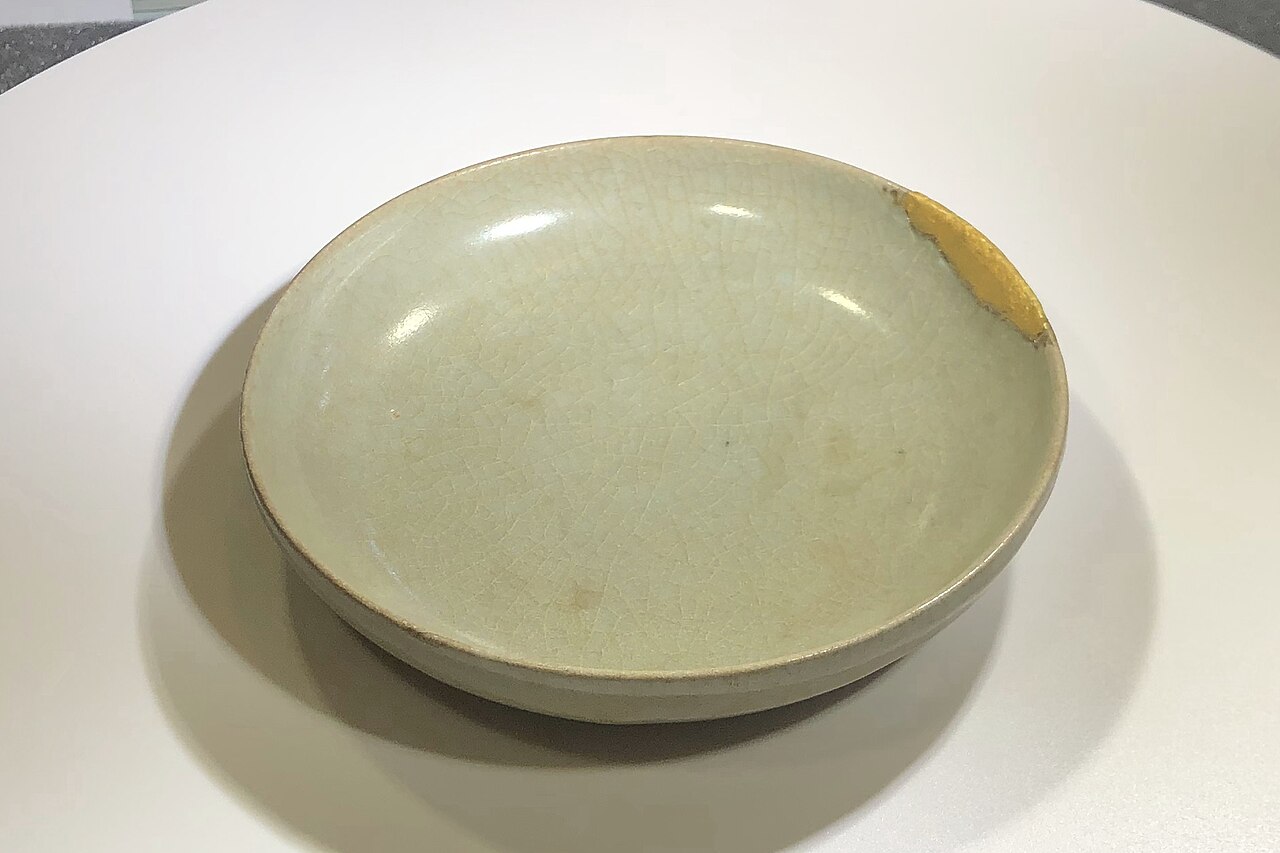
The Song dynasty (960–1279) is widely regarded as the supreme age of Chinese ceramics, a period when the art of the potter reached heights of subtlety and refinement that have never been surpassed. Chinese ceramic tradition identifies five great kiln types of the Song: Ru, Guan, Ge, Ding, and Jun. Each produced wares of distinctive character, and each has been the subject of intense scholarly study, collector passion, and, in some cases, enduring mystery. The rarest and most prized of all are the Ru wares, produced at a kiln site in Baofeng, Henan province, for a period of perhaps only twenty years during the late Northern Song. Fewer than one hundred authentic Ru ware pieces are believed to survive worldwide, each one a national treasure. Their glaze — a luminous, pale blue-green of extraordinary depth and warmth — was described by Song connoisseurs as resembling "the blue of the sky after rain seen through a rift in the clouds" (Tregear, 1982, p. 104).
Guan (official) ware was produced under direct imperial supervision, first at the Northern Song capital of Kaifeng and later at the Southern Song capital of Hangzhou. Like Ru ware, Guan ware is characterized by a thick, unctuous glaze that often develops a network of fine cracks (craquelure) during cooling — a feature that Song taste elevated from defect to aesthetic virtue, celebrating the delicate web of fissures as an emblem of naturalistic beauty and the passage of time. Ge ware, closely related to Guan, is defined by an even more pronounced crackle pattern, sometimes featuring a dramatic contrast between large dark cracks and fine golden ones, known as "iron wire and golden thread." Ding ware, produced in Hebei province, represented a different aesthetic direction: its thin, ivory-white body and elegant carved or molded decorations made it the preferred tableware of the Northern Song court, prized for its lightness and refinement. Jun ware, with its distinctive opalescent blue glaze streaked with purple splashes, represented yet another approach, creating effects of color and luminosity that seemed almost accidental — as though nature, not the potter, had determined the final appearance of each piece (Li, 2016, pp. 78–95).
The Song ceramic aesthetic stands in sharp contrast to the elaborate decoration and brilliant polychrome effects that would characterize later periods. Song potters achieved their effects through the manipulation of form, glaze, and firing rather than painted decoration, creating objects whose beauty resides in the subtle interplay of shape, surface, and light. This reductive aesthetic — in which perfection is approached through elimination rather than addition — reflects broader Song cultural values, including the Neo-Confucian emphasis on moral cultivation through simplicity, the Chan Buddhist appreciation of emptiness as fullness, and the literati preference for understatement over display. A Song celadon bowl, with its single unbroken glaze, its gentle curve, and its quiet luminosity, embodies these values with an eloquence that requires no supplementary ornament. Modern studio potters worldwide, from Bernard Leach to contemporary ceramicists, have repeatedly turned to Song dynasty ceramics as the ultimate standard of pottery as art — a tradition in which the humblest domestic vessel achieves the status of profound aesthetic experience (Rawson, 2007, pp. 210–225).
"After the rain, where the clouds part to reveal the blue sky — make this color for me."
Attributed to Emperor Huizong (Song dynasty), on Ru ware glazeJingdezhen: The Porcelain Capital of the World
No city in history has been more completely defined by a single industry than Jingdezhen, the small city in northeastern Jiangxi province that served as China's — and the world's — porcelain capital for nearly a thousand years. Situated near rich deposits of both kaolin clay and petuntse, and connected by river to major trade routes, Jingdezhen emerged during the Song dynasty as a major ceramic production center and by the Ming dynasty had become the largest industrial complex in the premodern world. At its peak during the eighteenth century, the city employed hundreds of thousands of workers in a vast network of specialized workshops, each responsible for a single stage of the production process — forming, glazing, painting, firing — in a division of labor so refined that a single piece of porcelain might pass through seventy pairs of hands before completion. The Jesuit missionary Père d'Entrecolles, who visited Jingdezhen in 1712 and sent detailed descriptions back to Europe, was astonished by the scale and organization of the industry, comparing the glow of the kiln fires at night to "a great city all on fire" (Kerr & Wood, 2004, p. 255).
The establishment of imperial kilns (guanyao) at Jingdezhen during the early Ming dynasty marked a new chapter in the history of Chinese ceramics. Under the supervision of imperially appointed directors, these kilns produced porcelain exclusively for the court, working to exacting standards that pushed the boundaries of what was technically possible. The early fifteenth century, during the reigns of the Yongle and Xuande emperors, witnessed the perfection of blue-and-white porcelain — that iconic combination of cobalt blue decoration on a pure white body that would become China's most recognizable artistic export. The cobalt pigment was imported from Persia, a fact that testifies to the global connections that sustained Jingdezhen's production even in an era often imagined as one of Chinese isolation. The imperial kiln director was a position of enormous responsibility: pieces that failed to meet imperial standards were deliberately smashed and buried, a practice that has provided modern archaeologists with an invaluable — if heartbreaking — record of production techniques and quality control (Pierson, 2009, pp. 34–56).
Jingdezhen's influence extended far beyond China's borders. Export porcelain, produced in enormous quantities from the sixteenth century onward, reached markets across Asia, the Middle East, Africa, and Europe, fundamentally shaping ceramic traditions in every region it touched. The Portuguese, who established direct maritime trade with China in the early sixteenth century, were the first Europeans to import Chinese porcelain in commercial quantities, and the blue-and-white wares they brought back ignited a collecting craze that swept across the continent. The Dutch East India Company subsequently transported millions of pieces to Europe, where Chinese porcelain influenced everything from Delft pottery to Meissen figurines to the decorative vocabulary of the Rococo style. The very word "china" became a generic term for fine ceramics in English, a linguistic testament to the country's total dominance of the field. Jingdezhen's extraordinary legacy demonstrates how a single material innovation, sustained by centuries of accumulated craft knowledge, could reshape global material culture on a scale matched by few other human inventions (Finlay, 2010, pp. 198–234).
Blue-and-White: The Global Masterpiece

Blue-and-white porcelain — qinghua ci in Chinese — is perhaps the most universally recognized art form in the world, a decorative tradition so successful that it was adopted, adapted, and imitated across virtually every ceramic-producing culture on earth. The technique involves painting designs in cobalt oxide onto the unfired porcelain body, then applying a transparent glaze and firing at high temperature, which fuses the decoration permanently into the surface. The resulting combination of pure white ground and luminous blue painting proved so aesthetically satisfying and technically durable that it quickly eclipsed all competing decorative approaches. The earliest known blue-and-white porcelains date from the Tang dynasty, but the technique reached maturity at Jingdezhen during the Yuan dynasty (1271–1368), when large dishes and jars decorated with bold, energetic designs were produced for export to the Islamic world. The famous David Vases, dated 1351 and now in the British Museum, are the earliest securely dated blue-and-white porcelains and demonstrate a fully developed decorative vocabulary of dragons, phoenixes, and floral scrolls (Carswell, 2000, p. 67).
The Ming dynasty (1368–1644) elevated blue-and-white porcelain to its highest artistic achievement. The Yongle (1403–1424) and Xuande (1426–1435) periods are particularly prized by collectors for the quality of their cobalt — known as "Mohammedan blue" (Sumaliqing) because of its Central Asian origin — which produces a deep, slightly mottled blue of extraordinary richness. The best Xuande blue-and-white is characterized by what connoisseurs call "heaping and piling" (duidie), an effect in which the imported cobalt, rich in iron, creates darker spots within the blue decoration, producing a subtle three-dimensional quality that later potters using purer domestic cobalt could never quite replicate. Later Ming periods developed their own distinctive styles: the refined elegance of the Chenghua reign (1465–1487), famous for its delicate doucai (contrasting color) wares, and the exuberant energy of the Jiajing (1522–1566) and Wanli (1573–1620) periods, with their dense, all-over decorative schemes. Each reign period developed signature motifs, colors, and qualities that collectors learned to identify, making Ming blue-and-white one of the most intensively studied and catalogued categories in all of art history (Medley, 1989, pp. 165–198).
The global influence of blue-and-white porcelain is virtually without parallel in the decorative arts. In the Islamic world, Chinese blue-and-white inspired the great Iznik pottery tradition of Ottoman Turkey, which adapted Chinese motifs to Islamic decorative sensibilities. In Japan, the blue-and-white tradition was absorbed and transformed at Arita and Imari, producing distinctive Japanese interpretations that were themselves exported to Europe. Korean potters developed their own sublime blue-and-white tradition under the Joseon dynasty. In Europe, the attempt to reproduce Chinese blue-and-white drove the development of tin-glazed earthenware traditions from Delft to Faenza to Talavera, and ultimately motivated the race to discover the secret of true porcelain itself. Vietnamese, Thai, and Persian potters all created their own versions of the blue-and-white aesthetic. No other decorative tradition in human history has achieved such universal adoption, crossing every boundary of culture, religion, and geography to become what Finlay (2010, p. 4) has called "the first truly global art form."
"The vessel carries the Way."
Traditional Chinese aesthetic maximImperial Marks and the Art of Connoisseurship
The practice of marking porcelain with the reign name of the ruling emperor — typically written in cobalt blue on the base of the vessel in a six-character format reading "Great [Dynasty] [Reign name] Year Made" — is one of the most distinctive features of Chinese imperial ceramics and has become a critical tool in the complex art of porcelain connoisseurship. The practice became standard during the Ming dynasty, beginning with the Yongle reign, and continued through the Qing dynasty, providing what appears to be a straightforward dating system. In reality, the interpretation of reign marks is far more complicated, because later periods frequently applied earlier reign marks to their own products — a Kangxi-era vase might bear a Xuande mark, not as a forgery but as an homage to an admired predecessor. This practice, known as "apocryphal marking," means that a reign mark alone is never sufficient evidence for dating a piece of porcelain; it must be evaluated in conjunction with the form, glaze, decoration, and potting quality of the vessel as a whole (Ayers, 2002, p. 156).
The development of porcelain connoisseurship in China has a history nearly as long as porcelain itself. Song dynasty writers produced the earliest surviving ceramic criticism, evaluating wares according to criteria including glaze quality, resonance when struck, and what we might today call "presence" — the ineffable quality that distinguishes an exceptional piece from a merely competent one. By the late Ming dynasty, a sophisticated collector culture had emerged, with specialized dealers, illustrated catalogues, and heated debates about authenticity and quality. The Qing dynasty emperor Qianlong, perhaps the most avid art collector in Chinese history, assembled a porcelain collection of staggering scope and quality, personally inscribing poems on favored pieces — a practice that modern curators regard with mixed feelings, as the imperial calligraphy simultaneously enhanced the piece's historical interest and compromised its aesthetic integrity. Qianlong's catalogue of the imperial collection, compiled over decades, remains a foundational document of Chinese ceramic studies (Krahl & Ayers, 1986, pp. 12–28).
Modern porcelain scholarship draws on an increasingly scientific toolkit, including thermoluminescence dating, X-ray fluorescence analysis of glaze and body composition, and microscopic examination of kiln-firing indicators. These techniques have resolved many long-standing attribution disputes and exposed numerous fakes, but they have also confirmed that the trained human eye remains an irreplaceable instrument of connoisseurship. The subtle differences in cobalt color between Xuande and Chenghua wares, the barely perceptible orange-peel texture of an authentic Yongzheng glaze, the precise weight and balance of a genuine Song dynasty bowl — these qualities can be measured and analyzed, but they are first perceived by the experienced connoisseur through years of handling and close observation. Chinese porcelain connoisseurship thus represents a rare domain in which traditional knowledge and modern science complement rather than compete with each other, each illuminating aspects of these remarkable objects that the other alone could not reveal (Vainker, 1991, pp. 215–230).
"Skill that rivals the work of Heaven."
Classical Chinese idiomLegacy and the Living Tradition
The story of Chinese porcelain in the modern era is one of disruption, revival, and reinvention. The Taiping Rebellion of the mid-nineteenth century devastated Jingdezhen, destroying kilns, scattering craftspeople, and effectively ending the imperial porcelain tradition that had sustained the city for five centuries. The collapse of the Qing dynasty in 1912 eliminated the court patronage that had driven the highest achievements of Chinese ceramics, and the turbulent decades that followed left little room for the kind of sustained, refined production that the tradition required. Yet the knowledge survived, carried in the hands and memories of hereditary potting families who preserved techniques passed down through generations. When the People's Republic of China established state-run porcelain factories at Jingdezhen in the 1950s, these family traditions provided the foundation for a revival that, while initially directed toward mass production and political propaganda, gradually recovered much of the technical mastery of earlier centuries (Pierson, 2009, pp. 178–195).
The reform era beginning in the 1980s unleashed a renaissance in Chinese porcelain that continues to gain momentum. Individual studio potters, freed from the constraints of state production, began exploring both traditional and experimental approaches to the medium. Some dedicated themselves to reproducing the great wares of the past — Song celadons, Ming blue-and-white, Qing famille rose — with a fidelity that can challenge even expert connoisseurs. Others pushed the medium in radically new directions, creating sculptural installations, conceptual pieces, and collaborative works that expanded the definition of what porcelain could be. The contemporary artist Ai Weiwei's porcelain works, including his installations of millions of hand-painted sunflower seeds and his recreation of the twelve bronze zodiac heads in blue-and-white porcelain, demonstrate how traditional craft knowledge can serve contemporary artistic vision. These works draw their power precisely from the tension between porcelain's deep historical associations and the provocatively modern contexts in which Ai places it (Clunas, 1997, pp. 198–212).
Jingdezhen today is experiencing a remarkable transformation, as a new generation of Chinese and international artists, designers, and entrepreneurs converge on the ancient porcelain capital. The city's centuries of accumulated craft infrastructure — its clay deposits, its kiln technology, its communities of skilled artisans — provide resources that no other location can match, attracting creators from around the world who come to study, collaborate, and produce. This contemporary chapter in Jingdezhen's history suggests that Chinese porcelain's greatest contribution may not be any individual object, however sublime, but rather the demonstration that a creative tradition sustained over centuries can continuously regenerate itself, adapting to new conditions while maintaining continuity with its deepest sources of knowledge and inspiration. The white gold of the East, first kindled in the kilns of ancient Zhejiang, continues to glow with an undiminished fire (Finlay, 2010, pp. 342–358).
Quiz
What was a key breakthrough in porcelain development during the Tang dynasty?
Which dynasty is known for the 'Five Great Song Kilns'?
How did the establishment of imperial kilns at Jingdezhen impact porcelain production?
What is a defining feature of blue-and-white porcelain?
What role did the Jesuit missionary Père d'Entrecolles play in the history of Jingdezhen?
Why did Chinese porcelain earn the nickname 'white gold'?
What distinguishes Ru ware from other Song dynasty ceramics?
What is a significant legacy of Jingdezhen in modern times?
Write your thoughts, then get feedback from Jason — you can turn any answer into a full discussion.
9. How do the ceramics of the Song dynasty reflect broader cultural values of the time?
10. In what ways has contemporary Chinese porcelain art maintained continuity with its historical roots while adapting to modern contexts?
Frequently Asked Questions
Common questions about Chinese Porcelain: White Gold of the East
Why was Chinese porcelain called white gold in Europe?
European collectors called Chinese porcelain "white gold" because for centuries they could not replicate its translucent, glass-like quality and were willing to pay extraordinary prices for it. Kings and aristocrats amassed vast collections, and Augustus the Strong of Saxony famously traded an entire regiment of soldiers for a set of Chinese porcelain vases.
How did China keep the secret of porcelain making for so long?
China's porcelain monopoly lasted over a thousand years because the process required a specific combination of kaolin clay, petuntse stone, and kiln temperatures above 1,300 degrees Celsius that other cultures could not replicate. European potters attempted for centuries to unlock the formula, finally succeeding in 1708 at Meissen in Saxony through systematic scientific experimentation.
What is the difference between Chinese blue and white porcelain and celadon?
Blue and white porcelain features cobalt oxide designs painted under a transparent glaze, creating the iconic white-and-blue contrast that peaked during the Ming dynasty. Celadon, by contrast, is prized for its jade-like green glaze achieved through iron oxide fired in a reduction kiln, and was the dominant luxury ceramic of the Song dynasty centuries earlier.
Where was Chinese porcelain originally made?
The city of Jingdezhen in Jiangxi province has been China's porcelain capital since the Song dynasty and remains the center of production today. Its unique combination of local kaolin deposits, abundant timber for kiln fuel, and river transport made it the ideal location, and at its peak the city operated thousands of kilns employing hundreds of thousands of workers.
How did Chinese porcelain influence world trade and culture?
Chinese porcelain was one of the most traded luxury goods in history, traveling the Silk Road and maritime routes to reach every corner of the globe. It directly inspired the development of European ceramic industries, influenced Islamic art and Ottoman Iznik pottery, and its blue-and-white aesthetic became a universal design language found in cultures from Delft to Japan.