
Podcast


Podcast: Chinese Calligraphy: The Supreme Art of the Brush
Listen to Jason & Amy discuss Chinese Calligraphy: The Supreme Art of the Brush
New here?
Origins in Bone and Bronze
The story of Chinese calligraphy begins not with ink and paper but with sharp implements scratched across tortoise shells and animal bones. During the Shang dynasty (c. 1200–1046 BCE), diviners carved questions to ancestors and spirits onto prepared oracle bones, then subjected them to intense heat until cracks appeared. The resulting patterns were interpreted as answers from the spirit world, and the questions themselves were inscribed in what we now call jiaguwen, or oracle bone script. These earliest known examples of Chinese writing already display a remarkable sense of spatial composition, with characters arranged in orderly columns and individual strokes executed with deliberate care. As Keightley (1978) demonstrated through decades of painstaking research, these inscriptions reveal not merely a primitive writing system but a sophisticated graphic tradition already attentive to balance, proportion, and visual rhythm.
The transition from bone to bronze during the Western Zhou dynasty (1046–771 BCE) brought a transformation in the character of Chinese writing. Cast into the surfaces of ritual vessels, jinwen (bronze script) developed rounder, more fluid forms, freed from the constraints of carving into resistant shell and bone. The inscriptions on vessels such as the Mao Gong Ding, with its nearly five hundred characters, represent some of the longest surviving Bronze Age texts in the world. These bronze inscriptions served both commemorative and legal functions, recording royal decrees, land grants, and military victories. According to Rawson (1999), the aesthetic qualities of bronze inscriptions were inseparable from their ritual significance — the beauty of the script was understood as a reflection of the moral authority of the commissioner.
The unification of China under the Qin dynasty in 221 BCE brought the first great standardization of the written script. Chancellor Li Si oversaw the creation of Small Seal script (xiaozhuan), which regularized the wildly divergent regional writing systems into a single, elegant standard. The smooth, symmetrical curves of seal script gave each character an almost architectural quality, as though every stroke had been measured with a compass and straightedge. This moment of standardization was more than an administrative convenience — it established the principle that calligraphy was an instrument of political and cultural unity, an idea that would resonate throughout Chinese history. The seal script remains in use today for name chops and formal inscriptions, a living link to the empire that first imagined a single written language for all of China (Qiu, 2000, p. 87).
"Writing is a painting of the heart."
Yang Xiong (53 BCE – 18 CE)The Five Scripts and Their Characters
Chinese calligraphy is traditionally understood through five major script types, each with its own aesthetic logic and expressive possibilities. Seal script (zhuanshu), the oldest surviving standardized form, is characterized by its even line weight and symmetrical, almost pictographic structure. Clerical script (lishu) emerged during the Han dynasty as a practical simplification, introducing the distinctive horizontal "silkworm head and wild goose tail" strokes that gave characters a broad, stable appearance. Regular script (kaishu), perfected during the Tang dynasty, became the standard for formal writing and remains the basis for printed Chinese characters today. Running script (xingshu) relaxes the strict structure of regular script, allowing strokes to connect and flow into one another with a natural, conversational grace. Finally, cursive or grass script (caoshu) pushes abbreviation and fluidity to their extremes, reducing characters to swift, almost abstract gestures that can be read only by those deeply versed in the tradition (Harrist & Fong, 1999).
Each script type carries distinct cultural associations and expressive registers. Regular script, with its precise, upright strokes, has long been associated with moral rectitude and scholarly discipline — a calligrapher who masters kaishu demonstrates patience, control, and respect for tradition. Running script, by contrast, is the script of personal correspondence, poetic inscriptions, and informal expression; it reveals the individual temperament of the writer more openly than any formal hand. The great calligrapher Zhao Mengfu of the Yuan dynasty was celebrated for a running script that combined structural clarity with an effortless, almost musical rhythm, earning comparison to the flow of a mountain stream. The relationship between these scripts is not merely historical succession but a living repertoire: a skilled calligrapher moves between them as a musician shifts between registers, choosing the script that best suits the occasion, the content, and the intended emotional tone (Billeter, 1990, p. 112).
Cursive script occupies a special place in the calligraphic imagination as the form closest to pure expressive freedom. The Tang dynasty monk Huaisu was legendary for producing his wildest cursive works in a state of drunken inspiration, his brush racing across the paper in a torrent of energy that seemed to transcend conscious control. Yet this apparent abandon concealed rigorous training — Huaisu reportedly practiced so intensely that he wore through several stone inkstones and filled an entire burial mound with discarded brushes. The paradox at the heart of cursive script is that supreme spontaneity requires supreme discipline. Every seemingly effortless curve and daring abbreviation is grounded in thousands of hours of practice, so that the hand moves not from carelessness but from a freedom that lies on the other side of mastery. This dialectic between control and release, structure and improvisation, remains one of the central philosophical tensions animating Chinese calligraphy to this day (Tseng, 2012).
"The eight principles of the character "yong" are the essentials of learning calligraphy."
Traditional calligraphic maximWang Xizhi and the Orchid Pavilion
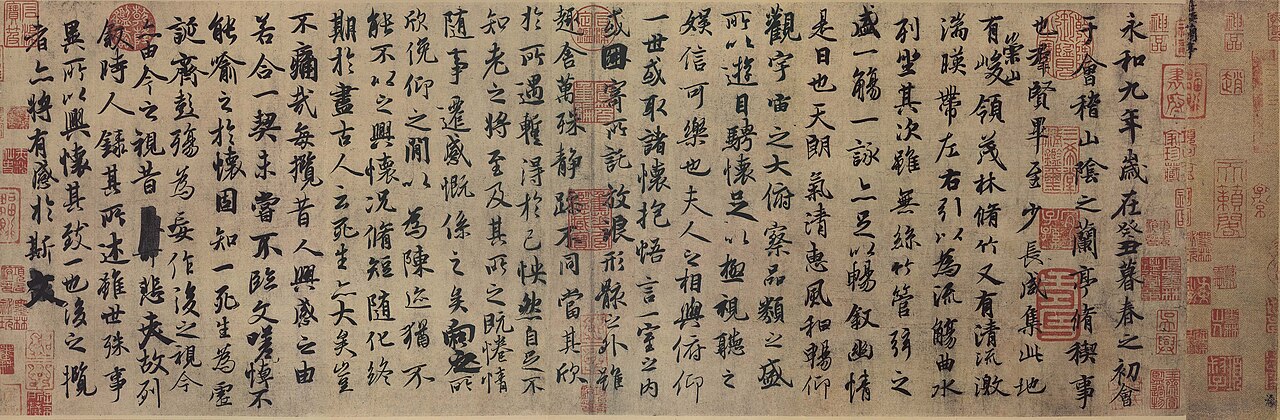
No single work occupies a more exalted position in the history of Chinese calligraphy than Wang Xizhi's Preface to the Orchid Pavilion (Lanting Ji Xu), composed in the spring of 353 CE during a gathering of forty-two scholars and poets at a scenic spot near modern Shaoxing in Zhejiang province. The event itself was a refined literary game: cups of wine were floated down a winding stream, and whenever a cup stopped before a guest, that person was obliged to compose a poem or drink a forfeit. Wang Xizhi, serving as host, wrote the preface to the resulting collection of poems in a single sitting, producing a masterpiece of running script that has been revered for over sixteen centuries. According to tradition, Wang later attempted to rewrite the preface but could never recapture the particular magic of that first spontaneous draft — a story that encapsulates the Chinese aesthetic ideal of unrepeatable, once-in-a-lifetime inspiration (Ledderose, 1979, p. 23).
The Lanting Xu is celebrated not only for its technical brilliance but for the philosophical depth of its content. Wang Xizhi meditates on the fleeting nature of human joy, the inevitability of aging and death, and the consolation offered by art and friendship. The calligraphy itself seems to embody these themes: the characters flow with an organic irregularity, each one subtly different from the next, as though alive with the breath of the moment. Of the twenty instances of the character zhi (之) in the text, no two are written identically — a detail that has fascinated calligraphers and critics for centuries. This principle of variation within unity became a cornerstone of Chinese calligraphic aesthetics, demonstrating that true mastery lies not in mechanical consistency but in responsive, living adaptation to the demands of each moment (McNair, 2007).
The original manuscript of the Lanting Xu was lost, probably interred in the tomb of the Tang emperor Taizong, who was so obsessed with Wang Xizhi's calligraphy that he reportedly had the work buried with him. What survives today are a series of extraordinary copies, most famously the "Shennong" tracing copy attributed to the Tang court calligrapher Feng Chengsu. These copies have themselves become treasured masterpieces, and the tradition of copying the Lanting Xu has served as a primary method of calligraphic education for over a millennium. Emperor Taizong's passion for Wang Xizhi was not merely personal taste but a deliberate political act: by elevating Wang's calligraphy to the status of supreme model, the emperor established an aesthetic orthodoxy that reinforced his own cultural authority. The Lanting Xu thus stands at the intersection of art, philosophy, and imperial power — a single sheet of writing that shaped the course of an entire civilization's visual culture (Wen, 2019, pp. 56–61).
The Four Treasures of the Study
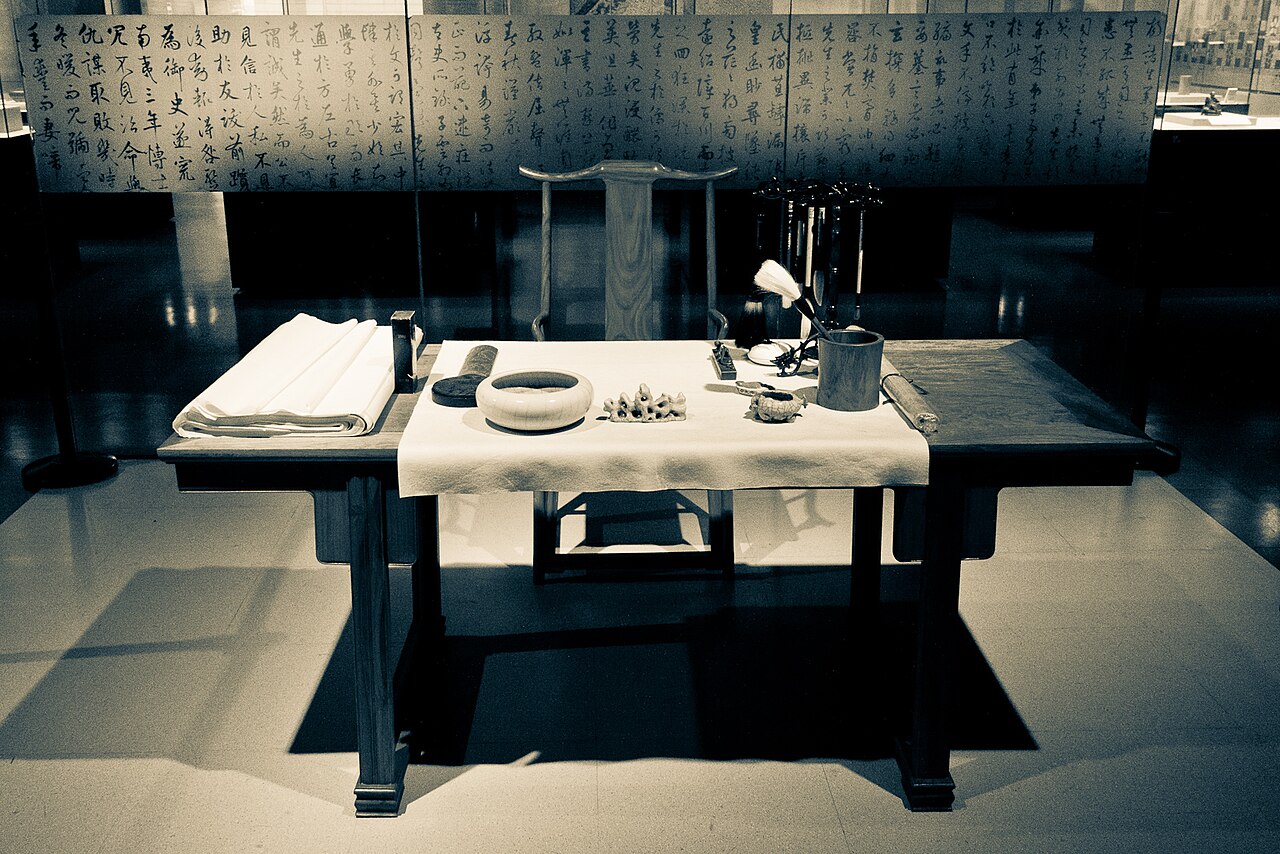
The practice of Chinese calligraphy is inseparable from its material culture, traditionally summarized as the Four Treasures of the Study (wenfang sibao): the brush (bi), the ink (mo), the paper (zhi), and the inkstone (yan). Each of these implements has its own rich history, regional traditions, and connoisseurial lore, and the selection and care of one's writing tools has always been regarded as an expression of personal cultivation. The brush, typically made from animal hair bound to a bamboo shaft, comes in an extraordinary variety of types — soft goat hair for flowing, wet strokes; stiff weasel hair for sharp, precise lines; and mixed-hair brushes that offer a balance between the two. The great Song dynasty calligrapher Mi Fu was famously particular about his brushes, claiming that the slightest variation in hair quality could ruin a work, and his detailed notes on brush-making remain a valuable historical source (Sturman, 1997, p. 134).
Ink, in its traditional form, is a solid stick made from pine soot or oil soot bound with animal glue and shaped into decorated bars or cakes. The calligrapher grinds the ink stick against a wetted stone, a meditative ritual that serves as both practical preparation and psychological centering before the act of writing. The finest ink sticks, such as those produced by the Ming dynasty master Cheng Junfang, were celebrated as art objects in their own right, elaborately molded and inscribed with poems, landscapes, or auspicious motifs. The quality of the ink — its blackness, its sheen, its viscosity — directly affects the character of the calligraphy, and experienced practitioners speak of ink having its own "temperament" that must be understood and accommodated. Paper, too, is far from a neutral ground: the legendary Xuan paper of Anhui province, made from the bark of the blue sandalwood tree, is prized for its extraordinary absorbency, which captures every nuance of brush pressure and ink density (Tsien, 1985).
The inkstone completes the quartet as the most durable and collectible of the Four Treasures. Carved from fine-grained stone, the inkstone provides the slightly abrasive surface needed to grind the ink stick into liquid. The two most prized varieties — Duan stone from Guangdong and She stone from Anhui — have been quarried for over a thousand years, and antique inkstones command extraordinary prices among collectors. Beyond their functional purpose, inkstones became canvases for sculptural art, carved with landscapes, dragons, clouds, and literary inscriptions. The Song emperor Huizong, himself one of the finest calligraphers in Chinese history, amassed a legendary collection of inkstones and wrote connoisseurial treatises on their qualities. The Four Treasures together constitute a complete aesthetic world in miniature, transforming the simple act of writing into a multisensory ritual that engages sight, touch, smell, and even hearing — the soft grinding of ink on stone, the whisper of the brush across paper (Clunas, 1997, pp. 102–108).
"The wonder of brush and ink lies entirely in temperament."
Liu Xizai, "Outline of Art" (Yigai)Calligraphy as Meditation and Self-Cultivation
In the Chinese intellectual tradition, calligraphy has always been understood as far more than a practical skill or a decorative art — it is a discipline of the whole person, a mirror of moral character, and a path of spiritual cultivation. The ancient dictum "writing is a picture of the heart" (shu wei xin hua) encapsulates this belief: every stroke reveals the calligrapher's inner state, their emotional equilibrium, their depth of learning, and their moral fiber. A trembling hand betrays anxiety; a rigid line reveals an inflexible mind; a stroke that is both strong and supple suggests a personality that combines firmness with grace. This intimate connection between calligraphy and character made the art a central element of Confucian self-cultivation, and proficiency in the brush was required of every aspiring scholar-official throughout imperial Chinese history (Yen, 2005, p. 78).
The meditative dimension of calligraphy practice has been recognized across Chinese philosophical traditions. Daoist practitioners saw in the flowing rhythms of cursive script an echo of the spontaneous, effortless action (wuwei) that characterizes the sage's engagement with the world. Buddhist monks, particularly those of the Chan (Zen) tradition, cultivated calligraphy as a form of moving meditation, a practice in which the distinction between practitioner and practice dissolves into a state of pure, unselfconscious presence. The Tang dynasty calligrapher-monk Huaisu exemplified this synthesis of Buddhist practice and calligraphic art, producing works of cursive script that seemed to emerge from a state beyond rational deliberation. In the Confucian tradition, the daily practice of calligraphy served as a form of self-regulation, a structured ritual through which the scholar could order their thoughts, calm their emotions, and cultivate the inner stillness necessary for effective governance and ethical action (Billeter, 1990, p. 245).
In contemporary China and throughout the Chinese diaspora, calligraphy continues to function as a practice of mindfulness and personal development. Scientific studies have documented measurable reductions in heart rate, blood pressure, and cortisol levels during calligraphy practice, lending empirical support to centuries of anecdotal testimony about the art's calming effects. Modern calligraphy education in China often frames the art in these therapeutic terms, presenting it as an antidote to the stresses of digital life and a means of reconnecting with cultural roots. Yet the deepest practitioners resist any reduction of calligraphy to mere stress relief, insisting that the art's true value lies in its capacity to transform the practitioner over years and decades of sustained engagement. As the contemporary calligrapher and scholar Xiong Bingming has argued, calligraphy is not a technique to be mastered but a lifelong dialogue between the self and the tradition, in which both are continuously renewed (Barrass, 2002, p. 189).
Modern Calligraphy and a Living Tradition
The twentieth century brought unprecedented challenges to the tradition of Chinese calligraphy, as successive waves of modernization questioned the relevance of an art so deeply rooted in imperial culture and classical learning. The simplification of Chinese characters in the 1950s, the promotion of ballpoint pens over brushes, and the Cultural Revolution's assault on traditional culture all seemed to threaten the survival of calligraphy as a living art. Yet the tradition proved remarkably resilient. Even during the Cultural Revolution, Mao Zedong's own distinctive calligraphic style — bold, sweeping, and deliberately unorthodox — served as an inadvertent reminder that the brush remained a potent instrument of personal and political expression. In Taiwan, Hong Kong, and overseas Chinese communities, traditional calligraphic practice continued without interruption, preserving both classical techniques and the philosophical frameworks that sustained them (Sullivan, 1999, p. 265).
The contemporary calligraphy scene is characterized by a productive tension between tradition and innovation. On one hand, a vigorous classical revival movement emphasizes faithful study of historical masterpieces, rigorous technical training, and deep engagement with the literary and philosophical traditions that give calligraphy its meaning. Organizations such as the Chinese Calligraphers Association, with millions of members, promote this classical approach through exhibitions, competitions, and educational programs. On the other hand, avant-garde artists like Xu Bing, Gu Wenda, and Qiu Zhijie have exploded the boundaries of calligraphic practice, creating installations, performances, and conceptual works that use the visual language of Chinese writing as raw material for radical artistic experimentation. Xu Bing's Book from the Sky, an installation composed entirely of invented, meaningless characters printed from hand-carved woodblocks, challenges viewers to confront their assumptions about the relationship between form and meaning in written language (Harrist & Fong, 1999, pp. 312–318).
The digital age has paradoxically strengthened rather than weakened interest in calligraphy. As handwriting disappears from daily life, replaced by keyboards and touchscreens, calligraphy has been revalued as a practice that engages the body, grounds attention in the present moment, and offers a tangible connection to deep cultural memory. Online platforms and social media have created new communities of calligraphy enthusiasts, sharing techniques, critiques, and inspirations across national boundaries. In 2009, Chinese calligraphy was inscribed on UNESCO's Representative List of the Intangible Cultural Heritage of Humanity, an international recognition that both honored the tradition's past and affirmed its continuing vitality. The supreme art of the brush, born in the divination pits of ancient Shang, continues to evolve, absorb, and inspire — proof that the oldest of arts can remain the most alive (Tseng, 2012, p. 301).
Quiz
What was the primary purpose of oracle bone inscriptions during the Shang dynasty?
Which script type is known for its abbreviation and fluidity, making it difficult to read without deep understanding?
What event is associated with Wang Xizhi's Preface to the Orchid Pavilion?
What is the significance of the 'Four Treasures of the Study' in Chinese calligraphy?
How did the transition from bone to bronze affect Chinese writing?
Which script type is most associated with personal expression and informal writing?
What philosophical belief is encapsulated in the dictum 'writing is a picture of the heart'?
What role did calligraphy play during the Cultural Revolution in China?
Write your thoughts, then get feedback from Jason — you can turn any answer into a full discussion.
9. How might the practice of calligraphy serve as a form of meditation or self-cultivation?
10. In what ways has modern technology impacted the practice and appreciation of Chinese calligraphy?
Frequently Asked Questions
Common questions about Chinese Calligraphy: The Supreme Art of the Brush
Why is calligraphy considered the highest art form in China?
Chinese calligraphy is considered the supreme art because it unites poetry, visual beauty, and philosophical expression in a single brushstroke. Unlike painting, which depicts the external world, calligraphy directly reveals the artist's inner character, education, and spiritual cultivation through the rhythm and energy of their writing.
What are the Four Treasures of the Study in Chinese calligraphy?
The Four Treasures of the Study (文房四宝) are the brush, ink stick, paper, and inkstone — the essential tools for Chinese calligraphy and painting. Each treasure was elevated to an art form in its own right, with famous varieties like Xuan paper from Anhui and Duan inkstones from Guangdong prized by connoisseurs for centuries.
What are the five main scripts in Chinese calligraphy?
The five major script styles are seal script (篆书), clerical script (隶书), regular script (楷书), running script (行书), and cursive script (草书). Each developed in succession over thousands of years, from the formal ancient seal script used on bronze vessels to the fluid, expressive cursive that resembles abstract art.
How long does it take to learn Chinese calligraphy?
Traditional training requires years of disciplined practice, often beginning with copying masterworks stroke by stroke. Most practitioners spend at least three to five years mastering regular script before moving to more expressive styles, and Chinese tradition holds that true mastery is a lifelong pursuit requiring both technical skill and moral cultivation.
Who are the most famous Chinese calligraphers in history?
Wang Xizhi (303–361 CE) is universally revered as the "Sage of Calligraphy" for his masterpiece the Preface to the Orchid Pavilion. Other towering figures include Yan Zhenqing, known for his powerful regular script, the Song dynasty master Mi Fu, and the Tang emperor Huizong, who invented the distinctive "slender gold" style.