

August 7, 2026 · 星期五
Start of Autumn
立秋· four seasons, namely: spring 春, summer 夏, autumn 秋 and winter 冬

 Today’s episode with Jason & Amy
The Start of Autumn (立秋) is a time for reflecting on the balance and cycle of nature in Chinese culture.
Start of Autumn
立秋lì qiū
Today is the solar term known as 立秋 (lìqiū), or Start of Autumn, in the traditional Chinese calendar. This period signifies the end of summer and the beginning of autumn. It is one of the 24 solar terms that have been used in China for thousands of years to guide agricultural activities. The concept of 立秋 is deeply rooted in Chinese culture, marking a time to prepare for the harvest and celebrate the changing seasons, which are integral to life and agriculture in China[1].
During 立秋, farmers start to assess the growth of their crops and plan for upcoming harvests. In many parts of China, this is a time of anticipation as families prepare for the busy harvest season. The term also symbolizes the gradual transition to cooler weather, as the intense heat of summer begins to wane and the air becomes crisp. This change is often celebrated with seasonal foods such as pumpkins and sweet potatoes, which are believed to align with the cooling climate[2].
In Chinese culture, the four seasons (四季, sìjì) play a significant role, representing a cycle of life and renewal. Each season brings its own beauty and challenges, influencing not just agriculture but also festivals, clothing, and daily life. The Start of Autumn is a reminder of the harmonious balance between people and nature, highlighting the importance of living in tune with the natural rhythms of the world. This day serves as a poignant symbol of change and adaptation, themes that resonate deeply within the Chinese cultural context[3].
The Start of Autumn (立秋) is a time for reflecting on the balance and cycle of nature in Chinese culture.
今天是立秋。
Jīntiān shì lìqiū.
Today is the Start of Autumn.
- [1] 《礼记》 (The Book of Rites), an ancient Chinese text detailing traditional practices and the significance of solar terms.
- [2] 《月令》 (Yueling), a traditional agricultural calendar that describes activities for each solar term.
- [3] 《四季》 (The Four Seasons), a classic work discussing the cultural importance of the seasons in Chinese life.
Jason & Amy on 四季
Podcast: Daily Chinese: 四季 — Start of Autumn
Jason & Amy on 四季 and Start of Autumn
New here?
春夏秋冬是四季。
Chūn xià qiū dōng shì sìjì.
Spring, summer, autumn, and winter are the four seasons.
This sentence lists the four seasons in Chinese.
四季的变化很美。
Sìjì de biànhuà hěn měi.
The changes of the four seasons are beautiful.
This sentence describes the beauty of seasonal changes.
四季都有不同的节日。
Sìjì dōu yǒu bùtóng de jiérì.
Each of the four seasons has different festivals.
This sentence explains that there are festivals specific to each season.
四季的轮回象征着生命的循环。
Sìjì de lúnhuí xiàngzhēng zhe shēngmìng de xúnhuán.
The cycle of the four seasons symbolizes the cycle of life.
This abstract sentence uses the seasons as a metaphor for life's cycles.
The use of 四季 in expressions
四季 + noun/verb
The word 四季 can be used to describe or refer to phenomena related to all four seasons.
Use 四季 to discuss topics that encompass all seasons.
四季都有变化。
Sìjì dōu yǒu biànhuà.
All four seasons have changes.
四季如春的城市。
Sìjì rú chūn de chéngshì.
A city where it's spring all year round.
四季的节日。
Sìjì de jiérì.
Festivals of the four seasons.
What does 四季 mean?
How is 四季 pronounced?
How do you write "four seasons" in Chinese?
Listen. What does the sentence mean?
一年有___。(There are ___ in a year.)
四季的变化很美 — What does this sentence mean?
What does the solar term 立秋 signify in Chinese culture?
Arrange into a correct sentence
Frequently asked questions about the word 四季
You can say '中国有四季' (China has four seasons) to describe the seasonal climate.
The individual seasons are: 春 (spring), 夏 (summer), 秋 (autumn), and 冬 (winter).
Yes, '四季如春' is a common idiom that means 'the four seasons are like spring', indicating a pleasant and mild climate.
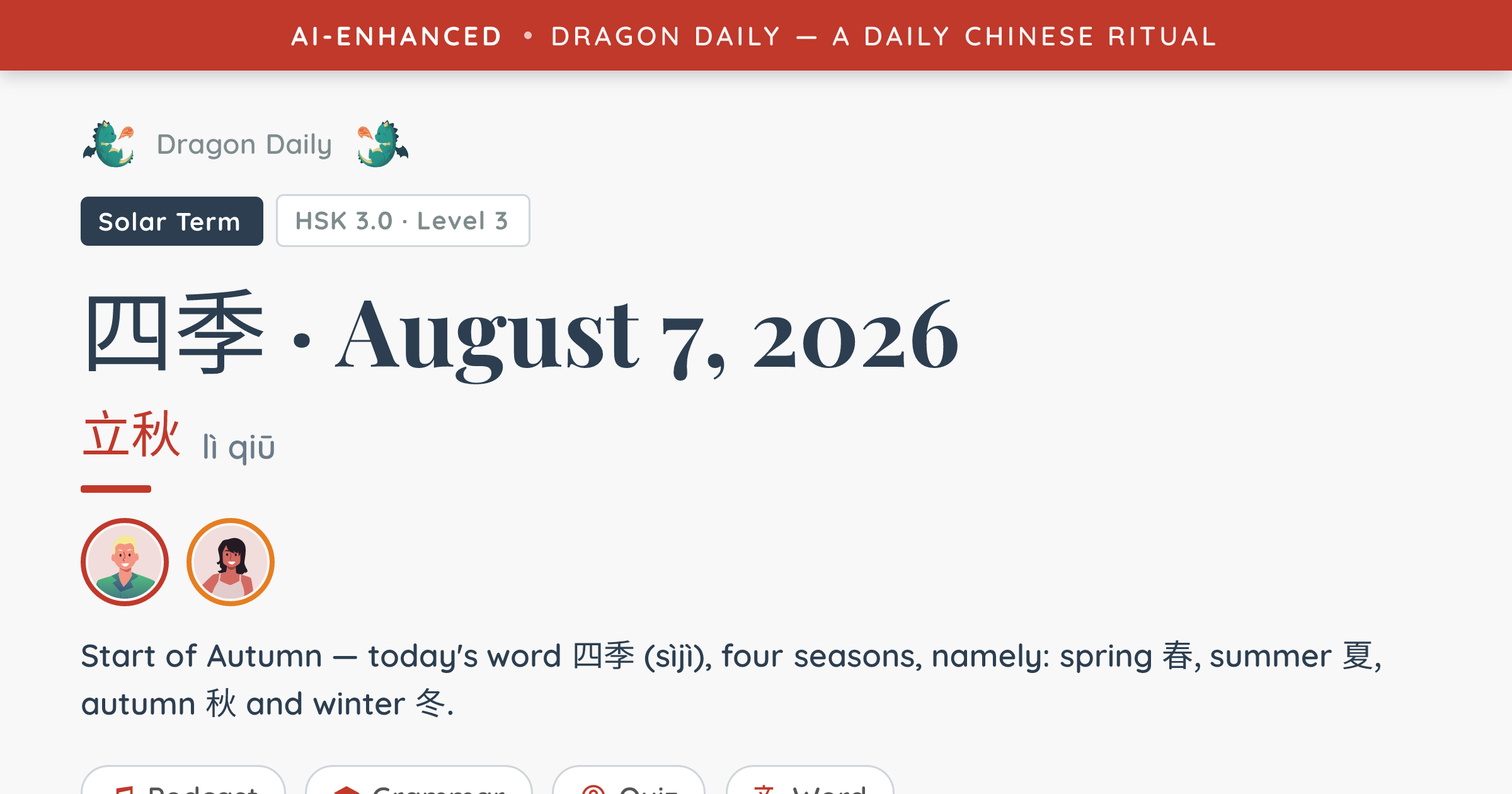
Today's Mandarin word: 四季 (sìjì) — four seasons, namely: spring 春, summer 夏, autumn 秋 and winter 冬.
Learn it on Mandarin Temple's Dragon Daily 🐉