
Podcast


Podcast: Zhuangzi: Dreams, Butterflies, and Radical Freedom
Listen to Jason & Amy discuss Zhuangzi: Dreams, Butterflies, and Radical Freedom
New here?
The Inner Chapters
The text known as the Zhuangzi is attributed to a man named Zhuang Zhou (c. 369–286 BCE), about whom very little is known with certainty. The Records of the Grand Historian tells us he was from the state of Meng, held a minor government post as a superintendent of a lacquer garden, and declined offers of high office, preferring philosophical independence to political entanglement (Graham, 1981). Beyond these sparse biographical details, what we know of Zhuangzi comes from the text itself — a work of extraordinary literary power that stands as one of the supreme achievements of classical Chinese prose. The text as we have it was edited by the scholar Guo Xiang in the third century CE, who reduced an earlier, longer version to the current thirty-three chapters.
Scholars generally agree that the text is composite, drawing on multiple authors and traditions. The most important division is between the "Inner Chapters" (chapters 1–7), which are widely attributed to Zhuangzi himself, and the "Outer" and "Miscellaneous" chapters (8–33), which represent the work of later followers and related thinkers (Ziporyn, 2009). The Inner Chapters display a distinctive voice — witty, paradoxical, philosophically daring — that is recognized as one of the great literary achievements of world philosophy. They include some of the most famous passages in Chinese literature: the butterfly dream, the debate at the river, the story of Cook Ding, and the cosmic journey of the great Peng bird.
The philosophical ambition of the Inner Chapters is nothing less than a total liberation of consciousness from the fixed categories, conventional judgments, and habitual perspectives that ordinarily constrain human thought. Zhuangzi does not propose a system to replace existing systems; he undermines the very impulse to systematize (Mair, 1994). His method is not argument in the conventional sense but a kind of philosophical performance — stories, jokes, impossible dialogues, and bewildering reversals that work on the reader's imagination rather than their logic. The goal is not to prove a thesis but to induce a shift in perspective, a loosening of the grip of ordinary consciousness that opens the way to what Zhuangzi calls "free and easy wandering" (xiaoyao you).
"Once Zhuang Zhou dreamed he was a butterfly, flitting and fluttering about, happy with himself and doing as he pleased."
Zhuangzi, Chapter 2 (Qi Wu Lun)The Butterfly Dream
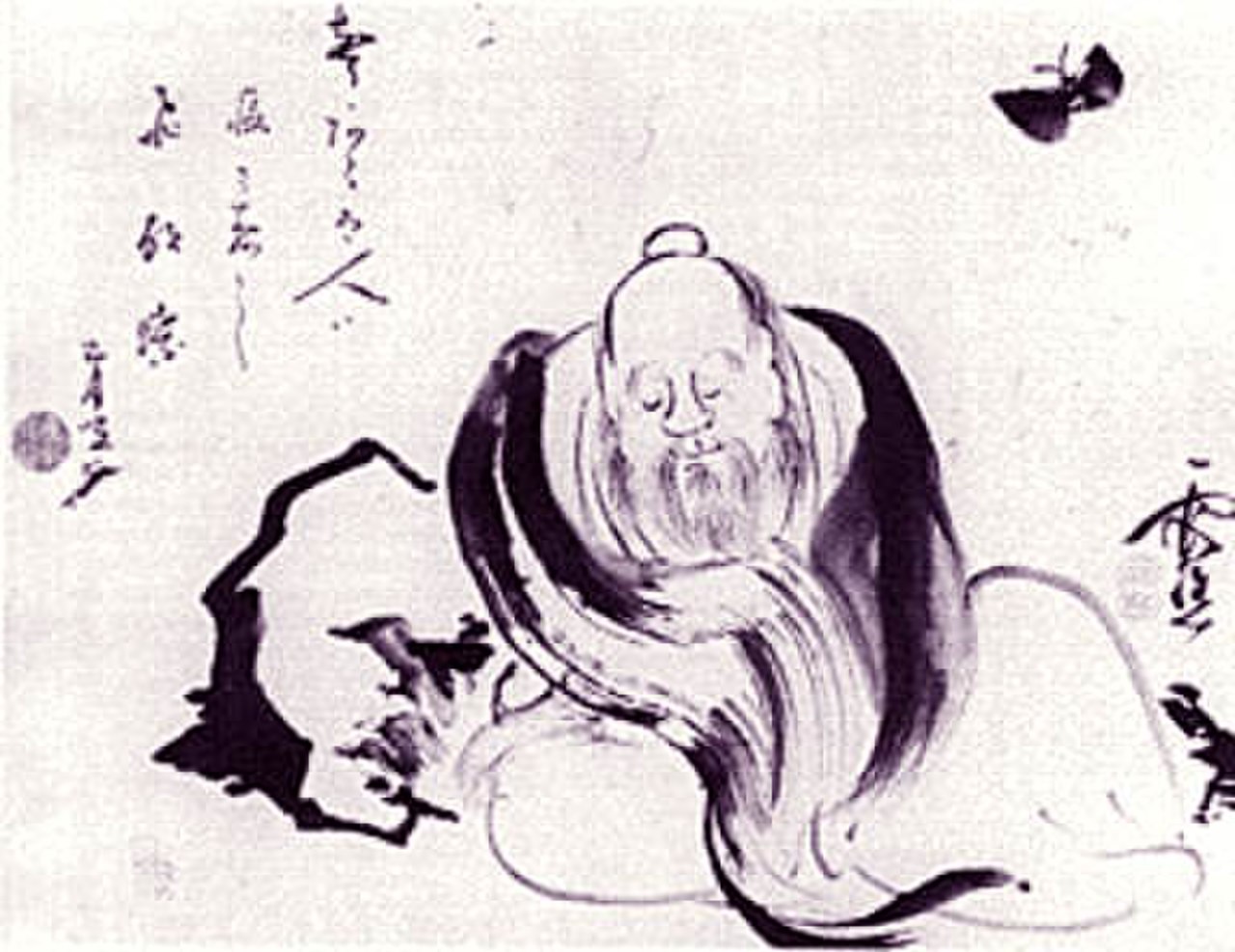
The most famous passage in the Zhuangzi — and perhaps the most famous passage in all of Chinese philosophy — is the butterfly dream, which concludes the second Inner Chapter: "Once Zhuang Zhou dreamed he was a butterfly, fluttering happily here and there, unaware that he was Zhuang Zhou. Suddenly he woke up, and there he was, solid and unmistakable Zhuang Zhou. But he didn't know whether he was Zhuang Zhou who had dreamed he was a butterfly, or a butterfly dreaming he was Zhuang Zhou" (Graham, 1981). This brief parable, barely fifty characters in Chinese, has generated centuries of commentary and remains one of the most discussed thought experiments in world philosophy.
The butterfly dream operates on multiple levels. At the most basic level, it raises the epistemological question of how we can distinguish waking from dreaming — a question that would later preoccupy Descartes and that continues to fuel philosophical and scientific inquiry today. But Zhuangzi's intent is not merely skeptical. He is not arguing that we might be dreaming; he is pointing to the fluidity of identity and the arbitrariness of the distinction between self and other, subject and object (Ziporyn, 2009). The passage concludes with the enigmatic statement: "Between Zhuang Zhou and the butterfly there must be some distinction. This is called the transformation of things." The "transformation of things" (wu hua) suggests that what we call identity is not a fixed essence but a process of ceaseless change and metamorphosis.
The philosophical implications are radical. If the boundary between Zhuangzi and the butterfly is permeable — if identity is fluid rather than fixed — then all the categories by which we organize experience (self/other, human/animal, life/death, waking/dreaming) are provisional rather than absolute (Mair, 1994). This does not mean they are meaningless; Zhuangzi is not a nihilist. Rather, he invites us to hold our categories lightly, to recognize that every perspective is partial, and to embrace the ceaseless transformations of existence with wonder rather than anxiety. The butterfly dream is not a puzzle to be solved but an experience to be undergone — a moment of vertigo that cracks open the shell of ordinary consciousness and lets in the light of a larger reality.
Equality of Things
The second Inner Chapter, "Qi Wu Lun" (齐物论), is one of the most philosophically dense and challenging texts in the Chinese tradition. The title is ambiguous: it can be read as "On the Equality of Things," "On Making Things Equal," or even "On the Sorting of Things That Evens Them Out" (Graham, 1981). This ambiguity is deliberate, as the chapter systematically undermines the assumption that the world comes pre-divided into fixed, objective categories. Zhuangzi argues that all distinctions — right and wrong, beautiful and ugly, useful and useless, large and small — are relative to a particular perspective and have no absolute validity. What counts as right from one standpoint appears wrong from another; what seems large to a mouse seems small to the Peng bird.
This relativism is not, however, a counsel of despair or indifference. Zhuangzi does not conclude that because all perspectives are partial, none matters. Rather, he suggests that the recognition of relativity is itself liberating. When we stop insisting that our perspective is the only correct one, we become open to the perspectives of others — not just other humans but other creatures, other modes of being (Ziporyn, 2009). The famous passage in which Zhuangzi and the logician Huizi argue about whether fish are happy illustrates this point. Huizi insists that since Zhuangzi is not a fish, he cannot know what fish enjoy. Zhuangzi replies: "You are not me, so how do you know I don't know what fish enjoy?" The exchange dissolves into an infinite regress that parodies the very enterprise of philosophical argument and points toward a more intuitive, empathetic mode of understanding.
The "Qi Wu Lun" also contains Zhuangzi's most sustained critique of language and logic. He argues that words inevitably distort reality by imposing fixed categories on a fluid, ever-changing world. "The Dao is obscured by small accomplishments; speech is obscured by flowery rhetoric" (Mair, 1994). This is not anti-intellectualism but a recognition of the limits of discursive thought. Zhuangzi is especially critical of the Confucian and Mohist philosophers who spend their time debating right and wrong, each convinced of their own correctness. He compares such disputes to the noise of wind blowing through hollow trees — each opening produces a different sound, but none of these sounds is the voice of the wind itself. The Dao, like the wind, cannot be captured in any particular formulation.
"Our life has a limit, but knowledge has none. To pursue what is limitless with what is limited — this is perilous!"
Zhuangzi, Chapter 3 (Yang Sheng Zhu)Uselessness and Freedom
One of Zhuangzi's most distinctive and counterintuitive themes is the paradoxical value of uselessness. In a world that judges everything by its utility — trees by their timber, animals by their meat, people by their productivity — Zhuangzi champions the useless, the crooked, the misshapen, and the apparently worthless (Graham, 1981). A massive, ancient tree survives when all the straight, useful trees around it have been cut down: "Everyone knows the usefulness of the useful, but no one knows the usefulness of the useless." A sacred ox, fattened and garlanded for sacrifice, would gladly trade places with an ordinary calf. A man whose deformity exempts him from military service outlives all his able-bodied neighbors. In each case, what the world considers a disadvantage turns out to be a source of preservation and freedom.
These stories are not simply clever inversions of conventional values; they express a deep philosophical point about the dangers of instrumental thinking. When everything is evaluated solely in terms of its usefulness to human purposes, the world becomes a warehouse of resources to be exploited, and human beings themselves become instruments to be used (Ziporyn, 2009). Zhuangzi's celebration of uselessness is a protest against this reduction of existence to function. The great tree is valuable not because it produces timber but because it simply is — because it provides shade, shelters birds, and inspires wonder. Its value is intrinsic, not instrumental. In this respect, Zhuangzi anticipates modern environmental ethics and the recognition that nature has value beyond its utility to human beings.
The theme of uselessness connects to Zhuangzi's broader vision of freedom. The useful person — the skilled artisan, the brilliant strategist, the talented administrator — is always in demand and therefore always in danger of being co-opted, exploited, and worn out in service to others (Mair, 1994). The useless person, by contrast, is left alone and can devote themselves to what truly matters: cultivating the spirit, enjoying the natural world, and following the Dao. This is not laziness or irresponsibility but a deliberate rejection of the social pressure to be productive and a defense of the contemplative life. Zhuangzi's ideal is not the hermit who withdraws from the world but the sage who moves through the world without being caught by it — who participates in social life without being defined or limited by social roles.
Cook Ding's Ox
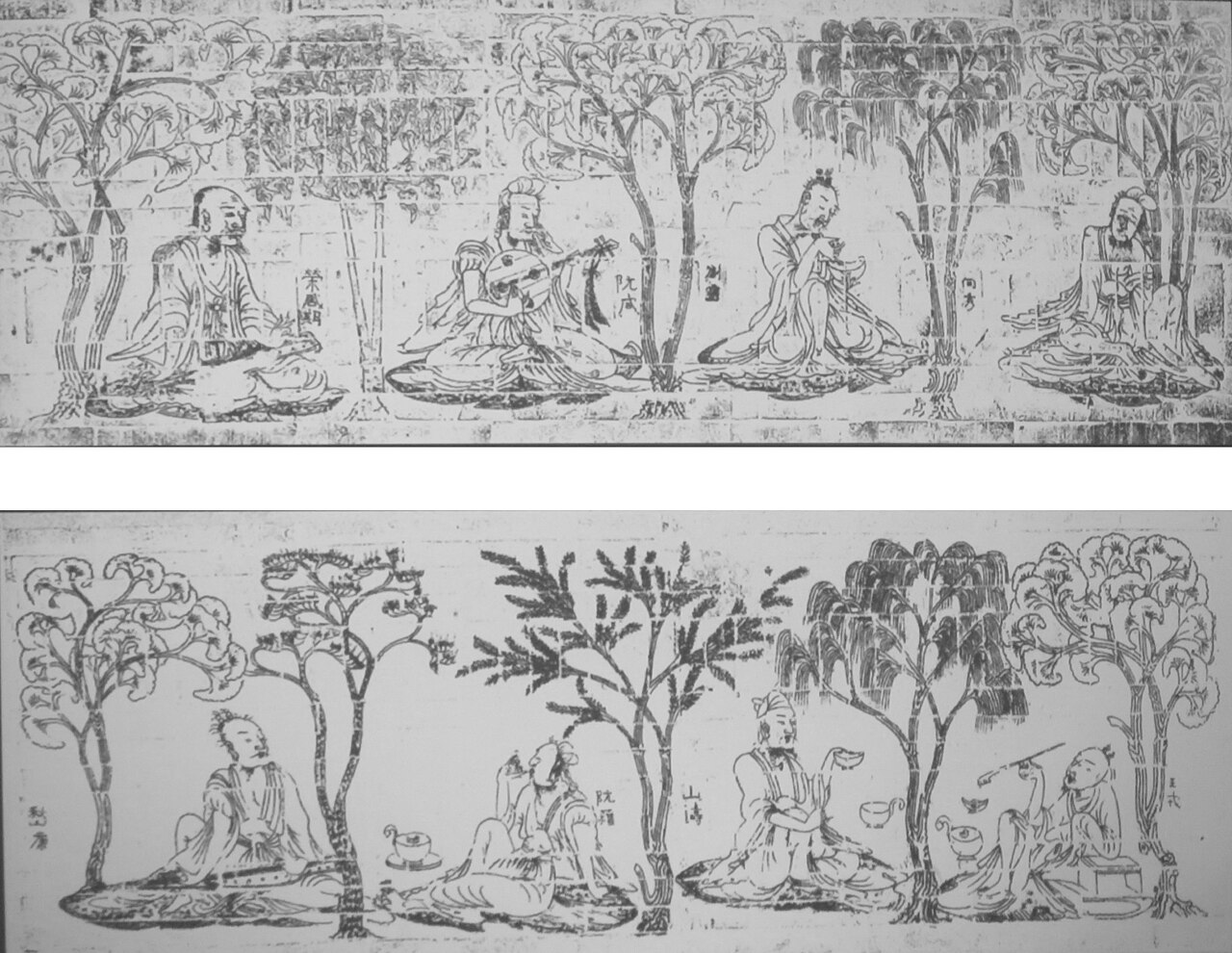
The story of Cook Ding (Pao Ding) is one of the most celebrated passages in the Zhuangzi and one of the most vivid illustrations of wu wei — effortless action in perfect attunement with the nature of things. Cook Ding has been asked to carve an ox for Lord Wen Hui. His knife moves through the carcass with extraordinary grace: "At every touch of his hand, every heave of his shoulder, every move of his feet, every thrust of his knee — zip! zoop! He slithered the knife along with a zing, and all was in perfect rhythm" (Graham, 1981). Lord Wen Hui marvels and asks how a cook has achieved such mastery. Cook Ding replies that what he cares about is the Dao, which goes beyond mere skill.
Cook Ding explains that when he first began cutting up oxen, all he could see was the ox. After three years, he no longer saw the whole ox but perceived its inner structure — the spaces between joints and sinews where a blade can pass without resistance. Now, after nineteen years, he works by spirit rather than sight, following the natural grain of the animal's body with a knife so sharp that there is no thickness to it (Ziporyn, 2009). When he encounters a particularly difficult place, he slows down, moves the blade with subtlety, and the flesh falls apart like a clod of earth crumbling to the ground. This description captures perfectly the Daoist ideal of action that is so perfectly adapted to its material that effort and resistance disappear.
The story has multiple layers of meaning. On one level, it is a celebration of craft and the knowledge that comes through bodily practice rather than theoretical study. On another level, it is a metaphor for navigating the complexities of life: the joints and tendons of the ox represent the obstacles, difficulties, and entanglements of human existence, and Cook Ding's skill represents the ability to move through them without forcing or being damaged (Mair, 1994). Lord Wen Hui draws the moral explicitly: "Excellent! I have heard the words of Cook Ding and learned the way of nourishing life." The story suggests that the art of living, like the art of butchery, requires not brute force but sensitivity, patience, and an intimate knowledge of the grain of things. It is no accident that this story appears in the chapter titled "The Secret of Caring for Life" (yangsheng zhu) — for Zhuangzi, skill, freedom, and the preservation of life are ultimately one and the same.
"Everyone knows the usefulness of the useful, but no one knows the usefulness of the useless."
Zhuangzi, Chapter 4 (Ren Jian Shi)Zhuangzi's Legacy
The Zhuangzi's influence on Chinese culture is immense and multifaceted. In philosophy, it provided a counterweight to the Confucian emphasis on social obligation, ritual propriety, and political engagement. While Confucianism addressed the human being as a social creature embedded in networks of relationship and duty, the Zhuangzi spoke to the individual in search of inner freedom, spiritual transformation, and communion with the natural world (Graham, 1981). These two traditions — one emphasizing responsibility, the other spontaneity — have functioned as complementary poles of Chinese intellectual life for over two millennia. Many Chinese thinkers have been "Confucian in office, Daoist in retirement," drawing on different philosophical resources for different aspects of their lives.
In literature and the arts, the Zhuangzi's influence is perhaps even greater than in philosophy proper. Its stories, images, and turns of phrase have entered the Chinese language as common expressions and allusions. The butterfly dream, Cook Ding's knife, the Peng bird, the debate about the fish — these are cultural touchstones that every educated Chinese person recognizes (Mair, 1994). Chinese landscape painting, with its emphasis on mist, emptiness, and the insignificance of the human figure amid vast natural scenery, owes much to the Zhuangzi's vision. Chinese poetry, from the Six Dynasties nature poets to the Tang dynasty masters Li Bai and Wang Wei, draws extensively on Zhuangzian themes of transformation, impermanence, and the dissolution of the boundary between self and world.
In the modern world, the Zhuangzi has found new audiences and new applications. Western philosophers from Martin Buber to Jacques Derrida have engaged with the text, finding in it resources for phenomenology, deconstruction, and comparative philosophy (Ziporyn, 2009). Psychologists and therapists have connected Zhuangzi's insights to acceptance and commitment therapy, mindfulness practices, and the psychology of creativity. Environmental philosophers have drawn on his vision of the interconnectedness and intrinsic value of all living things. The Zhuangzi speaks with particular power to an age marked by information overload, identity anxiety, and ecological crisis, offering a vision of freedom that lies not in mastering the world but in learning to move with its ceaseless transformations.
Quiz
What is the main philosophical ambition of the Inner Chapters of the Zhuangzi?
Who is primarily attributed with the authorship of the Inner Chapters of the Zhuangzi?
What does the butterfly dream in the Zhuangzi primarily illustrate?
What is the significance of 'uselessness' in Zhuangzi's philosophy?
Which chapter of the Zhuangzi contains the story of Cook Ding?
What does Zhuangzi's critique of language and logic suggest?
How does the Zhuangzi contrast with Confucianism?
What does the story of Cook Ding exemplify in Daoist philosophy?
Write your thoughts, then get feedback from Jason — you can turn any answer into a full discussion.
9. Why do you think Zhuangzi's vision of 'free and easy wandering' might appeal to people today?
10. How might Zhuangzi's ideas about the 'usefulness of the useless' relate to modern environmental ethics?
Frequently Asked Questions
Common questions about Zhuangzi: Dreams, Butterflies, and Radical Freedom
What is the butterfly dream in Zhuangzi?
In Zhuangzi's most famous parable, he dreams he is a butterfly fluttering happily, unaware of being Zhuangzi — then wakes and wonders whether he is a man who dreamed of being a butterfly, or a butterfly now dreaming of being a man. This story illustrates the fluidity of identity and the impossibility of finding an absolute standpoint from which to distinguish reality from illusion.
What is the main philosophy of Zhuangzi?
Zhuangzi advocates radical freedom through releasing attachment to fixed perspectives, social conventions, and even the fear of death. His philosophy centers on embracing the constant transformation of all things, cultivating spontaneous responsiveness (wu wei), and finding joy in the natural flow of life rather than in human-made distinctions of success and failure.
How is Zhuangzi different from Laozi?
While both are considered Daoist philosophers, Laozi's Dao De Jing is concise and focuses on political leadership and cosmic principles, whereas the Zhuangzi is a sprawling literary masterpiece filled with humor, paradox, and wild imagination. Zhuangzi is more skeptical of all systems — including Daoism itself — and emphasizes personal spiritual freedom over governance.
What does the Zhuangzi say about death?
Zhuangzi presents death as a natural transformation rather than something to fear, famously drumming on a pot and singing after his wife's death because he saw her passing as part of the endless cycle of change in the cosmos. He argued that clinging to life and dreading death reflects a limited perspective that fails to appreciate the unity of all transformations.
Why is the Zhuangzi considered a literary masterpiece?
The Zhuangzi is celebrated for its inventive use of parables, dialogues, absurdist humor, and poetic imagery that make it unique among ancient philosophical texts worldwide. Its literary brilliance has inspired Chinese poets, painters, and writers for over two thousand years, and its playful style makes profound metaphysical ideas accessible and entertaining.