
Podcast


Podcast: The Wok: Engineering Fire and Flavor
Listen to Jason & Amy discuss The Wok: Engineering Fire and Flavor
New here?
Han Dynasty Origins of the Wok
The wok — that concave, thin-walled cooking vessel that has become the single most important piece of equipment in Chinese kitchens — emerged during a period of extraordinary technological innovation. The Han dynasty (206 BCE–220 CE) saw the development of blast furnace technology capable of producing cast iron at temperatures exceeding 1,100 degrees Celsius, several centuries before comparable techniques appeared in Europe. This mastery of iron metallurgy made it possible to produce thin, lightweight cooking vessels at scale — a development that would transform not merely how the Chinese cooked but what they cooked and, ultimately, how they thought about flavor itself. The earliest wok-like vessels, known as 镬 (huò), appear in Han dynasty archaeological contexts, typically as wide, shallow iron pans with gently sloping sides.
The emergence of the wok must be understood against the background of a fuel crisis that shaped Chinese culinary evolution for centuries. By the Han period, the forests of northern China had been extensively cleared for agriculture and construction, making firewood an increasingly expensive commodity. The wok's genius lay in its efficiency: its thin walls and concave shape concentrated heat at the bottom while distributing it rapidly up the sides, allowing food to be cooked in minutes over small, hot fires. As historian E. N. Anderson (1988) has argued, the Chinese emphasis on cutting food into small pieces before cooking — a practice that strikes Western observers as merely aesthetic — was in fact a rational adaptation to fuel scarcity, and the wok was the perfect instrument for this approach. Small pieces of food, tossed rapidly in a thin-walled pan over high heat, cooked through in moments with minimal fuel expenditure.
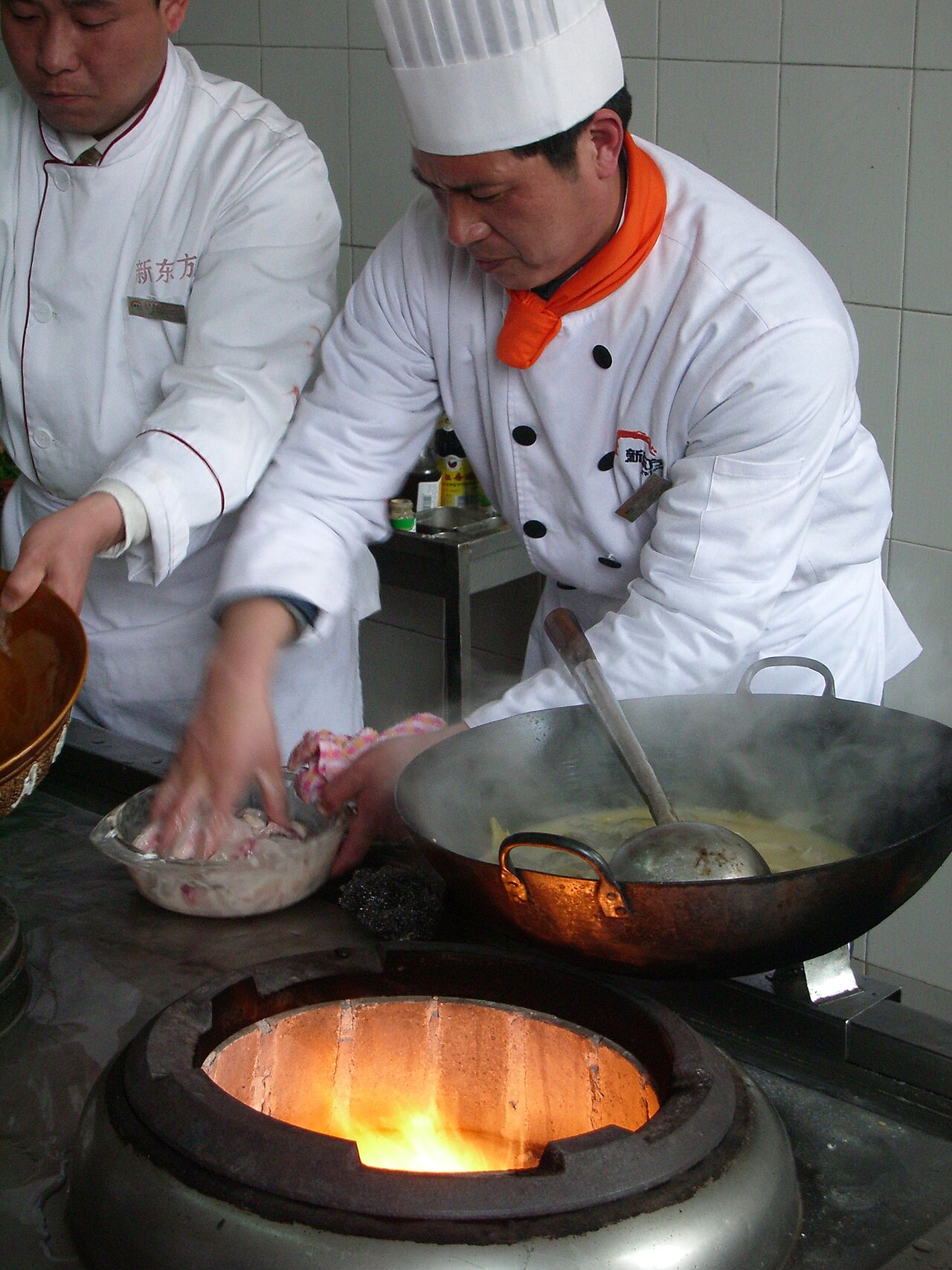
The wok's design also reflected the practical realities of Chinese kitchen architecture. Unlike the raised hearths and enclosed ovens of European kitchens, the traditional Chinese stove (灶, zào) was a low, brick structure with one or more circular openings designed to cradle the rounded base of a wok directly over the fire. This integration of vessel and stove created an extraordinarily efficient cooking system: the flames licked up around the wok's curved surface, transferring heat through maximum contact area, while the stove's enclosed chamber directed the draft upward for optimal combustion. The symbiosis between wok and stove was so complete that to understand either in isolation is to miss the point — they were components of a single, elegantly engineered thermal system.
Metallurgy and Design
The material science of the wok is a story of deliberate trade-offs between thermal conductivity, durability, weight, and cost. Traditional Chinese woks were made from cast iron — an alloy of iron and carbon (typically 2–4 percent) that could be poured into molds and produced cheaply in large quantities thanks to China's advanced blast furnace technology. Cast iron woks were heavy, somewhat brittle, and slow to heat, but they retained heat superbly and developed, over years of use, a natural non-stick patina of polymerized oil known as the seasoning. For households that cooked multiple meals daily over wood or coal fires, a well-seasoned cast iron wok was a prized possession, often passed from mother to daughter across generations.
The twentieth century brought a shift to carbon steel — a thinner, lighter alloy with lower carbon content (typically 1–2 percent) — which responded more rapidly to changes in heat, a quality essential for the explosive, high-temperature cooking techniques that define Cantonese and Sichuan wok cookery. As food scientist Harold McGee (2004) has explained, the ideal wok material must balance two competing requirements: it must heat up quickly to sear food on contact, but it must also distribute heat evenly enough to prevent scorching. Carbon steel strikes this balance better than almost any alternative, which is why it remains the material of choice in professional Chinese kitchens worldwide. Stainless steel, aluminum, and non-stick woks have been marketed to Western consumers, but serious wok cooks dismiss them — stainless steel heats too unevenly, aluminum is too soft and reactive, and non-stick coatings cannot withstand the extreme temperatures that stir-frying demands.
The geometry of the wok is as important as its material. The classic Cantonese wok has a round bottom and two small loop handles, designed to sit in the circular opening of a traditional stove. The northern Chinese wok often features a single long handle, better suited to the tossing motion used in stir-frying. The wok's concave shape creates a natural temperature gradient — fiercely hot at the center where it contacts the flame, progressively cooler toward the rim — that an experienced cook exploits constantly, pushing cooked items up the sides to rest while adding new ingredients to the hot center. This built-in temperature zonation means that a single wok can simultaneously sear, steam, and warm, functioning as a complete kitchen in a single vessel.
"A craftsman who wishes to do good work must first sharpen his tools."
Confucius, Analects (论语)Wok Hei: The Breath of the Wok
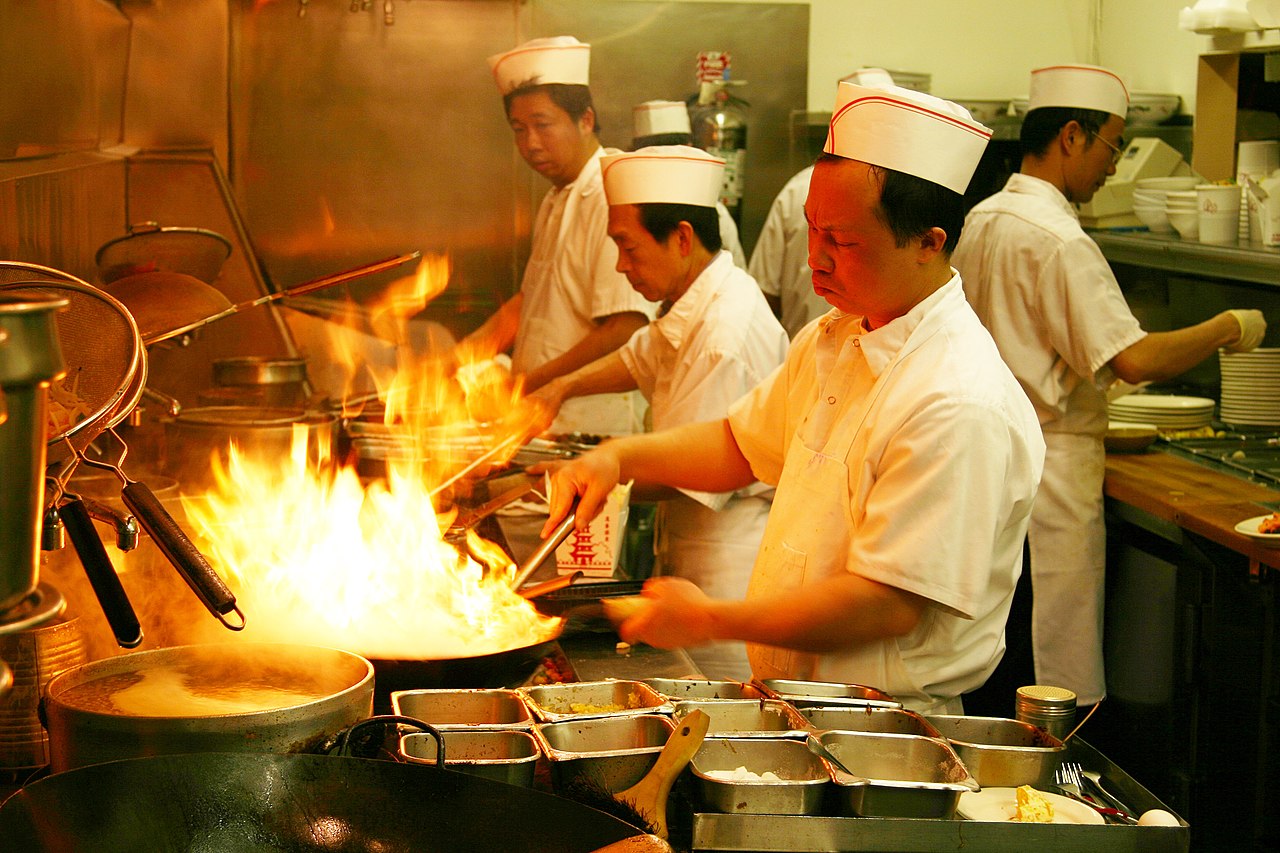
Ask any Cantonese cook what separates a great stir-fry from a merely competent one, and the answer will be immediate: wok hei (镬气, wok hay in Cantonese, huò qì in Mandarin) — literally "the breath of the wok." Wok hei is the elusive, smoky, slightly charred flavor that develops when food is tossed in a properly heated wok over an extremely high flame. It is not a single taste but a complex of flavors produced by the Maillard reaction (the browning of proteins and sugars at high temperatures), the caramelization of natural sugars, and the combustion of vaporized oil that ignites briefly as the food is tossed through the flame. The result is a flavor that is simultaneously smoky, sweet, and savory — a taste that cannot be replicated by any other cooking method and that fades within minutes of the food leaving the wok.
The pursuit of wok hei has driven the design of Chinese restaurant stoves to extraordinary extremes. A professional Cantonese wok burner produces heat outputs of 100,000 to 150,000 BTUs — roughly ten to fifteen times the output of a typical Western home burner — and the best restaurants custom-build their stoves to maximize flame contact with the wok's surface. Grace Young, whose landmark book The Breath of a Wok (2004) brought the concept of wok hei to English-language readers, has described watching Cantonese chefs work over these infernal burners: the wok glows dull red, oil vaporizes on contact, and the cook must work with explosive speed, tossing the food in continuous motion to prevent burning while allowing just enough contact with the superheated metal to trigger the chemical reactions that produce wok hei.
The physics of wok hei reveal why it is so difficult to achieve at home. The Maillard reaction accelerates dramatically above 150 degrees Celsius, and the complex flavor compounds associated with wok hei develop primarily at temperatures between 200 and 300 degrees Celsius — temperatures that require not only a powerful burner but also a wok thin enough to transmit heat almost instantaneously and a cook fast enough to keep the food moving. Home stoves, even gas models, rarely produce enough heat to bring a wok to wok hei temperatures when loaded with food, which is why serious home cooks have been known to cook stir-fries in tiny batches, use outdoor propane burners, or even modify their kitchen ventilation to accommodate the smoke that wok hei inevitably produces.
Stir-Frying: Technique and Science
Stir-frying (炒, chǎo) is the cooking technique most intimately associated with the wok, and it is far more demanding than its apparent simplicity suggests. The method requires that all ingredients be prepared — cut, measured, marinated, and arranged within arm's reach — before the wok is heated, because once cooking begins, the process unfolds at a pace that leaves no time for preparation. This principle of mise en place, though it shares a name with the French culinary concept, predates it by centuries in Chinese kitchen practice. The Song dynasty food writer Wu Zimu noted in his Mengliang Lu (梦粱录, 1274 CE) that the accomplished cook must have "everything prepared before the fire is lit," a dictum that remains the first commandment of wok cooking.
The fundamental motion of stir-frying — the rapid tossing and turning of food in a small amount of very hot oil — accomplishes several things simultaneously. It exposes every surface of every piece of food to the searing heat of the wok's bottom, producing the Maillard browning that is essential to flavor. It prevents any single piece from remaining in contact with the hot metal long enough to burn. And it aerates the food, allowing steam to escape rather than accumulate and braise the ingredients into sogginess. According to food scientist Kenji López-Alt (2015), the goal of stir-frying is to apply maximum heat for minimum time — to cook the food through while retaining the crisp texture, vibrant color, and fresh flavor that are the hallmarks of the technique. Overcrowding the wok is the most common error, because adding too much food drops the temperature below the threshold needed for searing, producing steamed rather than stir-fried results.
The vocabulary of Chinese wok techniques extends far beyond simple stir-frying. Bao (爆, "explode-frying") uses even higher heat and faster motion for the most intense searing. Liu (溜, "slippery-frying") involves velveting ingredients in an oil or water bath before a brief final stir-fry. Chao (炒) itself subdivides into sheng chao (生炒, raw stir-fry), shu chao (熟炒, cooked stir-fry), and qing chao (清炒, clear stir-fry, without heavy saucing). The wok is also used for deep-frying (zha, 炸), braising (shao, 烧), smoking (xun, 熏), steaming (zheng, 蒸, using a bamboo steamer set inside the wok), and even dry-roasting spices and tea leaves. This versatility — the ability to perform virtually every cooking technique with a single piece of equipment — is what has made the wok indispensable across Chinese cuisines for two millennia.
"Even a clever wife cannot cook without rice — one cannot make something from nothing."
Chinese proverb (民间谚语)Regional Wok Traditions
The wok's universality across China masks significant regional variations in how it is used, what it is used for, and what qualities are prized in the finished dish. Cantonese cuisine, widely regarded as the most technically sophisticated of China's regional traditions, places supreme value on wok hei and on the preservation of ingredients' natural flavors and textures. A Cantonese stir-fry of Chinese broccoli (gai lan) with oyster sauce should showcase the vegetable's vivid green color, its crisp-tender bite, and its fresh, faintly bitter flavor, with the wok contributing a whisper of smoke rather than dominating the dish. This minimalist aesthetic demands flawless technique — the wok must be scorching hot, the oil must be of the highest quality, and the cooking time must be measured in seconds rather than minutes.
Sichuan wok cookery operates on different principles, prizing bold, layered flavors over delicacy. The Sichuan cook begins by "frying the spice" (炒料, chǎo liào) — heating dried chilies, Sichuan peppercorns, and doubanjiang (fermented chili-bean paste) in oil until the oil is fragrant and deeply colored. This spice-infused oil becomes the foundation of the dish, and every ingredient added subsequently absorbs its complex flavors. The technique is slower and more deliberate than Cantonese stir-frying, reflecting a cuisine that values depth and persistence of flavor over the evanescent brightness of wok hei. Fuchsia Dunlop (2001) has described the Sichuan wok as "a crucible for the marriage of flavors," a characterization that captures the difference between the Cantonese and Sichuan approaches: where the Cantonese wok highlights, the Sichuan wok transforms.
In the wok traditions of Fujian and Taiwan, the emphasis shifts again — here, the wok is frequently used for braising and slow-cooking rather than high-heat stir-frying. The signature dish of Fujian cuisine, Buddha Jumps Over the Wall (佛跳墙, fó tiào qiáng), is a complex braise of dozens of luxury ingredients — abalone, shark fin, sea cucumber, dried scallops, ginseng — simmered for hours in a clay pot, but the initial preparation of many components involves wok-frying to develop flavor before the long braise. Hakka cuisine, the cooking of China's migratory Hakka people, uses the wok for salt-baking (盐焗, yán jú), a technique in which a whole chicken is wrapped in parchment and buried in superheated rock salt inside a covered wok, roasting slowly in its own juices. Each regional tradition reveals a different facet of the wok's extraordinary versatility.
The Wok in Modern Kitchens
The wok's migration from Chinese kitchens to the wider world has been one of the most significant developments in global culinary culture over the past half-century. In the West, the wok arrived initially as a novelty item — a piece of exotic cookware sold alongside fondue sets and electric crêpe makers — but has gradually been recognized for what it is: perhaps the most efficient and versatile piece of cooking equipment ever devised. The food writer Grace Young has been the most eloquent advocate for the wok in the English-speaking world, arguing in The Breath of a Wok (2004) that the wok is not merely a pan but a complete cooking system, and that mastering it requires understanding not just technique but the cultural and material context from which it emerged.
The challenge of adapting the wok to Western kitchens is fundamentally a challenge of heat. Western gas stoves, with their enclosed burners and low BTU output, cannot replicate the conditions of a Chinese restaurant wok station, and the flat-bottomed woks designed for Western electric stoves sacrifice the concave geometry that is essential to proper stir-frying. Some manufacturers have responded with dedicated wok burners that channel high-output gas flames upward around the wok's surface, and the popularity of outdoor wok cooking on propane burners has grown among serious enthusiasts. But the fundamental constraint remains: wok hei, the defining flavor of great Chinese stir-frying, requires a level of thermal intensity that most Western home kitchens simply cannot provide, a limitation that has led some food scientists to explore alternative approaches, including the use of blowtorches and specially designed induction wok systems.
Despite these challenges, the wok's influence on global cooking continues to expand. The stir-fry has become one of the most widely practiced cooking techniques in the world, adopted and adapted by cuisines from Thai to Mexican to fusion. The wok's principles — high heat, small pieces, fast cooking, minimal oil — align remarkably well with contemporary nutritional advice, making it an appealing tool for health-conscious cooks. And the growing international interest in authentic regional Chinese cuisine has brought renewed attention to the wok traditions that industrialization and convenience culture had begun to erode within China itself. In a sense, the wok is experiencing a global revival driven by the same forces that created it in the first place: the search for a cooking method that is fast, efficient, flavorful, and endlessly adaptable.
"Governing a great nation is like cooking a small fish — handle it gently."
Laozi, Dao De Jing (道德经), Chapter 60Quiz
What technological advancement during the Han dynasty facilitated the production of woks?
Why was the wok particularly efficient in ancient Chinese kitchens?
What is the primary challenge of achieving wok hei in Western kitchens?
Which material became popular for wok construction in the twentieth century?
What cooking technique is most closely associated with the wok?
How does the wok's shape contribute to its cooking efficiency?
Which regional Chinese cuisine values wok hei the most?
What is a common error when stir-frying in a wok?
Write your thoughts, then get feedback from Jason — you can turn any answer into a full discussion.
9. How might the efficiency of the wok in ancient China relate to modern environmental concerns?
10. Why do you think the wok has become popular globally despite the challenges of replicating traditional Chinese cooking conditions?
Frequently Asked Questions
Common questions about The Wok: Engineering Fire and Flavor
Why is the wok the most important tool in Chinese cooking?
The wok's concave shape creates a wide range of temperature zones in a single vessel, from searing heat at the bottom to gentle warmth at the sides, allowing cooks to stir-fry, deep-fry, steam, braise, and smoke all in one pan. Its thin carbon steel construction responds instantly to heat changes, and the round bottom concentrates flames efficiently — making it the most versatile cooking tool ever designed.
What is wok hei and why does it matter?
Wok hei (镬气, "breath of the wok") is the elusive smoky, charred flavor that can only be achieved when food is tossed in an extremely hot wok over an intense flame. It results from a combination of Maillard reactions, caramelization, and the brief ignition of vaporized oil, and it is considered the defining characteristic that separates professional Chinese stir-fry from home cooking.
How do you season a new carbon steel wok?
Seasoning a new carbon steel wok involves scrubbing off the factory coating, heating it over high flame until it discolors, then rubbing thin layers of high-smoke-point oil while continuing to heat until a dark patina forms. This process creates a natural non-stick surface that improves with each use, and a well-seasoned wok passed down through generations develops a depth of flavor that new cookware cannot match.
What type of wok is best for home cooking?
A 14-inch round-bottomed carbon steel wok is the traditional choice and the best option for gas stoves, as it heats quickly and develops seasoning over time. For electric or induction stoves, a flat-bottomed carbon steel wok is necessary for proper heat contact, and cast iron woks are an alternative that retain heat well but are heavier and slower to respond to temperature changes.
Why does restaurant stir-fry taste better than homemade?
Restaurant wok stations generate heat output of up to 100,000 BTUs or more, roughly ten times the power of a home gas burner, which is essential for achieving wok hei and properly searing ingredients without steaming them. This extreme heat, combined with a professional cook's rapid tossing technique and a deeply seasoned wok, creates flavors and textures that are nearly impossible to replicate on a standard home stove.