
Podcast


Podcast: Chinese Noodles: The Thread of Life
Listen to Jason & Amy discuss Chinese Noodles: The Thread of Life
New here?
The Lajia Discovery: Four Thousand Years of Noodles
In 2002, a team of archaeologists led by Houyuan Lu of the Chinese Academy of Sciences made a discovery that would rewrite the history of one of the world's most ubiquitous foods. At the Lajia site in Qinghai province, on the upper reaches of the Yellow River, they excavated an overturned earthenware bowl buried under three meters of sediment deposited by a catastrophic earthquake and flood approximately four thousand years ago. Beneath the bowl, preserved in the airless, waterlogged conditions of the sealed vessel, lay a mass of thin, yellow noodles — the oldest ever found. The discovery, published in the journal Nature in 2005, ignited a fierce debate: China, Italy, and the Arab world had each claimed credit for inventing the noodle, and here was physical evidence placing the innovation squarely in prehistoric China, more than two millennia before Marco Polo's famous journey.
Analysis of the Lajia noodles revealed that they were made not from wheat — the grain most associated with noodles today — but from foxtail millet and broomcorn millet, the principal cereals of ancient northern China. These grains lack the gluten that gives wheat noodles their elasticity, raising the question of how the ancient cooks achieved a dough supple enough to form into long strands. According to Houyuan Lu's team, the technique likely involved repeatedly stretching and folding the dough by hand, a method that exploits the starch granules' ability to bond under mechanical stress even without gluten — a process remarkably similar to the hand-pulling technique still used by lamian makers in northwestern China today. The continuity was striking: a four-thousand-year-old technology, adapted but never abandoned.
The Lajia site itself was a Bronze Age settlement of the Qijia culture, a people who inhabited the arid margins of the Tibetan Plateau. The noodle bowl was found alongside the remains of houses, pottery, and human skeletons — victims of the same disaster that preserved the noodles. The catastrophe appears to have been an earthquake that triggered a massive mudslide, burying the village so rapidly that daily life was frozen in place: a meal interrupted, a bowl overturned, its contents sealed for four millennia. For food historians, the Lajia noodles were more than a curiosity; they were proof that the transformation of grain into elongated, boiled dough — the fundamental definition of a noodle — was a Chinese innovation of staggering antiquity.
The Han Dynasty Wheat Revolution
While the Lajia discovery pushed the origins of noodles back to the Neolithic period, the noodle as we know it today — made from wheat flour, elastic with gluten, shaped into a diversity of forms — is largely a product of the Han dynasty (206 BCE–220 CE). Wheat had entered China from western Asia via Central Asian trade routes by the late Shang dynasty, but for centuries it remained a minor crop, overshadowed by the millets that had sustained Chinese agriculture since the Neolithic. The turning point came during the Han, when advances in milling technology — particularly the widespread adoption of the rotary stone mill — made it possible to grind wheat into fine flour efficiently and in large quantities. As historian Francesca Bray (1984) has documented, this technological shift transformed wheat from a coarsely processed porridge grain into the basis of a vast family of refined flour foods, including noodles, steamed breads, and dumplings.
The earliest written references to noodle-like foods in Chinese literature date to the Han period. The character 饼 (bǐng), which in later centuries would come to mean flatbread or cake, was used in Han texts as a generic term for any food made from wheat flour dough, including boiled strips that would today be recognized as noodles. The more specific term 汤饼 (tāngbǐng, "soup cake") — denoting strips of dough boiled in broth — appears in texts from the Eastern Han and Three Kingdoms periods. By the time of the Qimin Yaoshu (齐民要术), Jia Sixie's monumental agricultural encyclopedia compiled around 544 CE, noodle-making techniques were described in considerable detail, including methods for cutting, pulling, and even grating dough into various shapes.
The Han dynasty's expansion along the Silk Road further enriched noodle culture by facilitating the exchange of ingredients, techniques, and culinary ideas between China and Central Asia. Wheat cultivation intensified in the northwestern provinces — Gansu, Shaanxi, Shanxi — that lay along the trade routes, and these regions became, and remain, the heartland of Chinese noodle culture. The dry climate and alkaline soils of the northwest produced hard, high-protein wheat ideally suited to noodle-making, and the local cuisines developed a repertoire of noodle dishes — pulled, sliced, shaved, rolled — that exploited the grain's glutenous potential to its fullest.
"Dumplings when departing, noodles when arriving — food marks every journey."
Chinese proverb (民间谚语)Pulled Noodles: The Art of Lamian
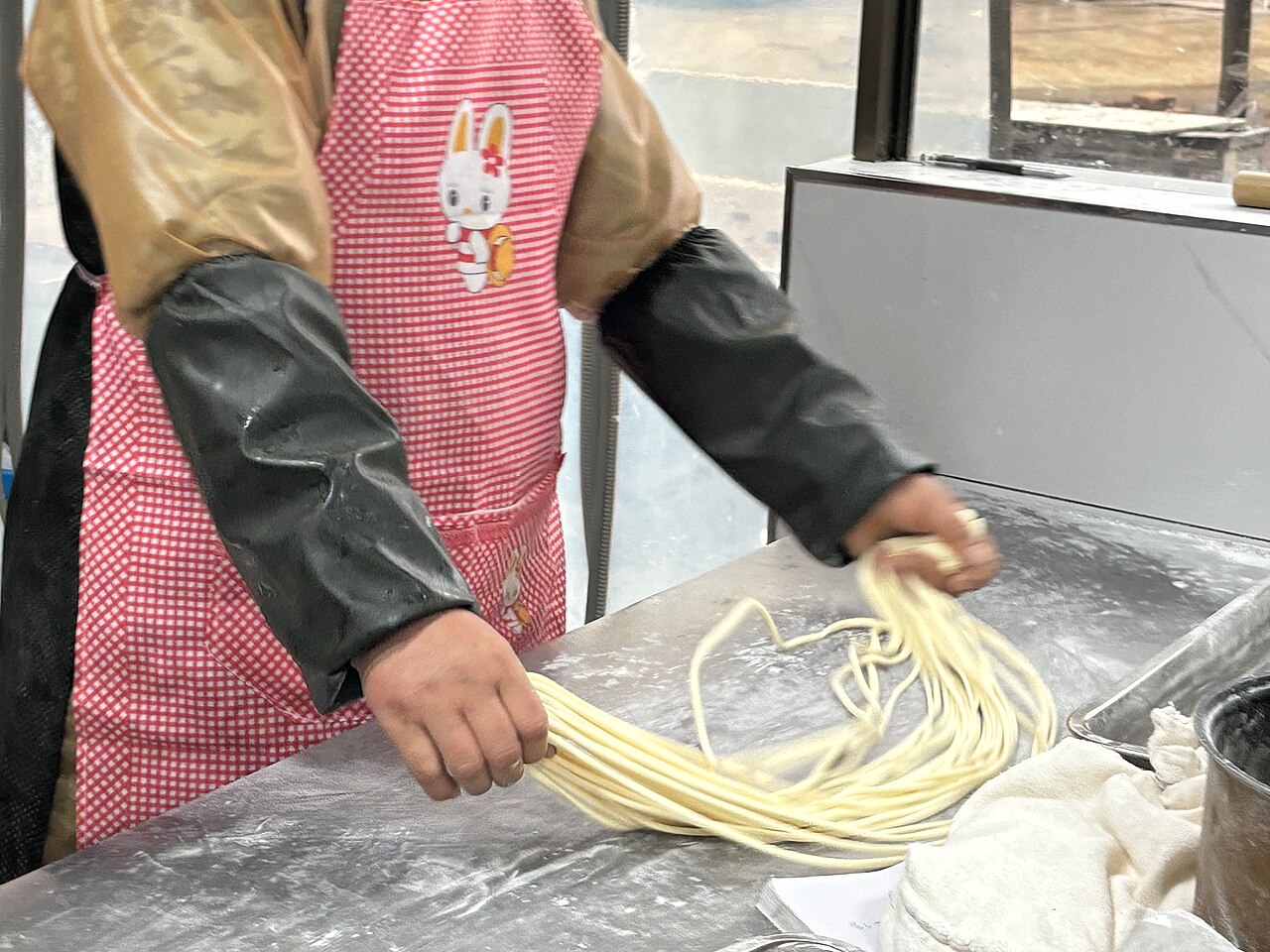
Of all the methods for shaping noodles, none is more spectacular or more technically demanding than hand-pulling — the technique that produces lamian (拉面, lāmiàn, literally "pulled noodles"). A lamian master begins with a log of carefully prepared dough — wheat flour, water, a pinch of alkaline salt to strengthen the gluten — and, through a mesmerizing sequence of stretching, twisting, and folding, transforms it into hundreds of uniform strands in a matter of seconds. The process doubles the number of noodles with each fold: one pull yields two strands, two pulls yield four, three yield eight, and so on, until eight or nine folds produce 256 or 512 strands of noodle, each as thin as a chopstick or, in the hands of an expert, as fine as a hair.
The physics of lamian are deceptively complex. As food scientist Harold McGee (2004) has explained, the pulling process works because wheat gluten — a network of the proteins glutenin and gliadin — is both elastic and plastic: it stretches when pulled and retains its new shape when released. The alkaline salt (蓬灰, pénghūi, traditionally derived from burnt desert grasses, now typically replaced by potassium carbonate) relaxes the gluten network, making the dough more extensible without sacrificing its ability to hold together. The lamian master must judge the dough's readiness by feel — too stiff and it will snap, too soft and the strands will stick together — and the pulling motion must be swift and confident, with the arms swinging the dough in a wide arc to let gravity assist the stretching.
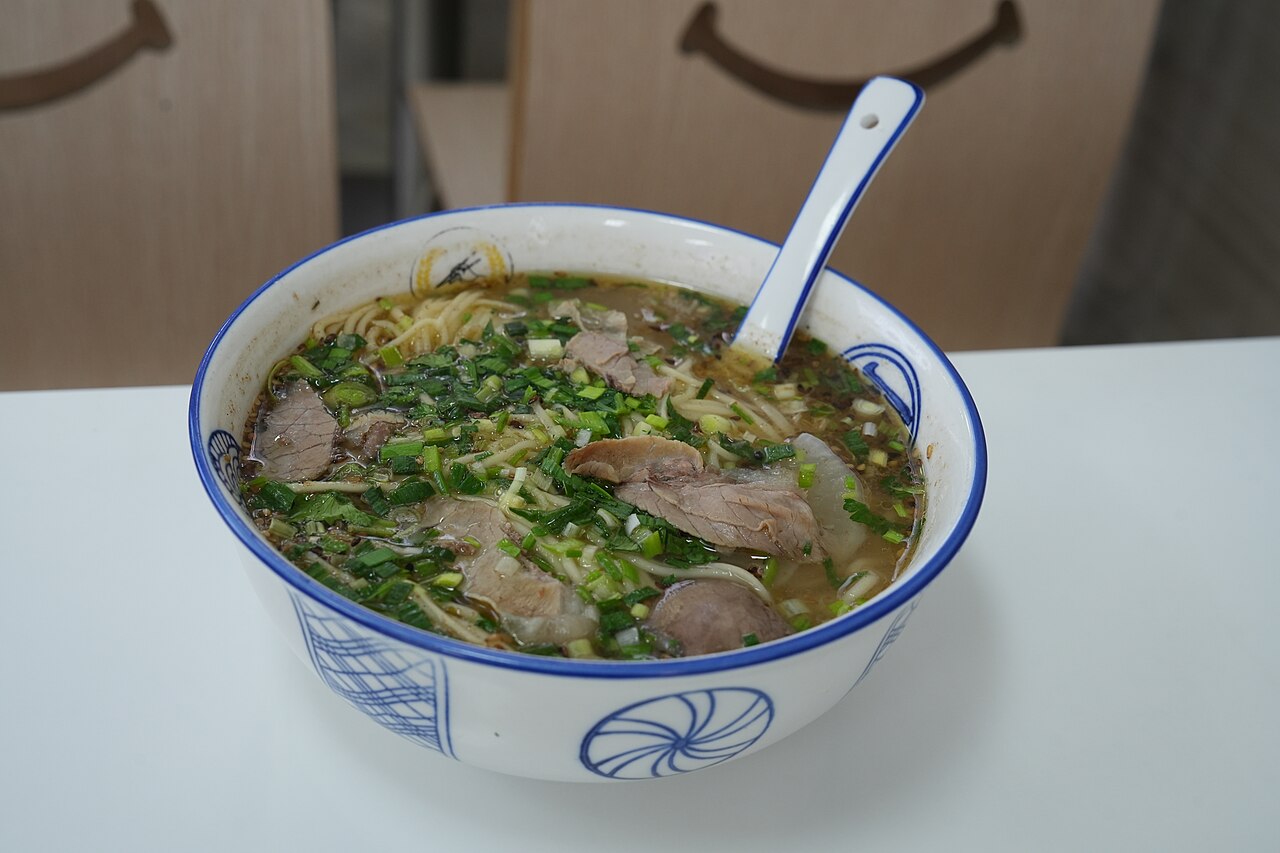
Lamian masters have traditionally trained through years of apprenticeship, and the skill remains a source of regional pride, particularly in Gansu province. The city of Lanzhou, Gansu's capital, has elevated lamian to a civic identity: the Lanzhou beef noodle soup (兰州牛肉面, Lánzhōu niúròu miàn) — clear broth, hand-pulled noodles, sliced beef, chili oil, cilantro, and radish — is arguably China's most beloved street food, with an estimated forty thousand Lanzhou noodle restaurants operating across the country. The Chinese government has even established vocational schools dedicated to lamian technique, recognizing the dish as both a cultural heritage and an engine of economic development for one of China's poorer provinces.
Regional Noodle Traditions
China's regional noodle traditions constitute a culinary atlas of staggering diversity, each bowl reflecting the climate, agriculture, and cultural temperament of its place of origin. In Sichuan, dan dan mian (担担面) — thin wheat noodles tossed in a sauce of sesame paste, chili oil, Sichuan peppercorn, preserved vegetables, and minced pork — embodies the province's philosophy of layered flavor and controlled heat. The name derives from the carrying pole (扁担, biǎndan) that itinerant vendors once used to transport their noodle stalls through the streets of Chengdu, and the dish retains a street-food directness despite its complex sauce. As Dunlop (2001) has observed, the genius of dan dan mian lies in the balance between the ma (numbing) of the peppercorn and the la (hot) of the chili, with the sesame paste providing a rich, grounding bass note beneath the high registers of spice.
In Beijing, zhajiangmian (炸酱面) — thick wheat noodles topped with a sauce of fermented soybean paste stir-fried with diced pork, served with an array of fresh vegetable garnishes including shredded cucumber, radish, and edamame — represents the robust, no-nonsense aesthetic of northern Chinese cooking. The dish is simplicity elevated through the quality of its sauce, which requires patient frying to develop a deep, savory, almost caramelized flavor. Yunnan province offers a radically different noodle experience with crossing-the-bridge noodles (过桥米线, guòqiáo mǐxiàn), a dish built around a bowl of intensely hot chicken broth with a layer of insulating oil on its surface, into which the diner adds raw ingredients — paper-thin slices of pork, chicken, fish, quail eggs, chrysanthemum petals — that cook in seconds upon contact with the superheated liquid.
Shanxi province, with its harsh continental climate and long tradition of wheat cultivation, has developed the most diverse repertoire of noodle-cutting techniques in China. Dao xiao mian (刀削面, knife-shaved noodles) are carved directly from a block of dough held against the forearm, the cook wielding a curved blade with such speed that the noodle shavings fly through the air into the boiling pot in a continuous arc. Cat's ear noodles (猫耳朵, māo ěrduo), pinched into shell-like shapes between thumb and finger, trap sauce in their concavities. Hand-rolled noodles (手擀面, shǒu gǎn miàn), rolled to translucent thinness and cut into wide ribbons, are the foundation of hearty stews. Each technique produces a different texture and a different relationship between noodle and sauce — a vocabulary of form that has been refined over centuries of daily practice.
"Life is like noodles — some strands are long, some short."
Chinese folk saying (民间俗语)Noodle Symbolism in Festivals and Ceremony
In Chinese culture, noodles are far more than sustenance; they are a language of aspiration, a medium through which hopes for longevity, prosperity, and continuity are expressed in edible form. The most deeply rooted of these symbolic traditions is the serving of longevity noodles (长寿面, chángshòu miàn) at birthday celebrations. The noodles are made as long as possible — ideally a single unbroken strand — and must not be cut or bitten short, for their unbroken length represents the unbroken thread of life. To sever a longevity noodle is to invite misfortune; to slurp it whole is to embrace a long and prosperous future. This tradition, documented in texts as early as the Han dynasty, remains virtually universal in Chinese communities worldwide.
The symbolic associations of noodles extend through the calendar of Chinese festivals and life events. During the Lunar New Year, families in northern China eat jiaozi (dumplings) on New Year's Eve but noodles on New Year's Day, the long strands representing continuity from the old year into the new. At weddings, noodles symbolize the couple's bond — long, intertwined, unbroken. When a baby reaches its first month of life, the family distributes red-dyed eggs and noodles to announce the milestone, the noodles representing the hope that the child's life will be long and smooth. Moving into a new home calls for a bowl of noodles to ensure that the household's fortune will extend far into the future. As Simoons (1991) documented in his study of Chinese food symbolism, the noodle's meaning derives from its physical form: length equals longevity, an equation so deeply embedded in the culture that it operates as an automatic association, requiring no explanation.
The ritual dimension of noodles illustrates a broader principle of Chinese food culture: that eating is never merely a biological act but always also a social and symbolic one. The bowl of noodles served at a birthday table is simultaneously a meal, a blessing, a wish, and a statement of cultural identity. It connects the diner to a tradition that stretches back millennia and forward into the indefinite future — which is, of course, precisely the point. In a civilization that has placed extraordinary emphasis on continuity, filial piety, and the maintenance of ancestral bonds across generations, the noodle's symbolism is not decorative but structural. It expresses, in the most intimate and everyday form possible, the values that hold the culture together.
Noodles on the World Stage
The global journey of Chinese noodles is a story of adaptation, reinvention, and occasional misattribution. The most famous vector of noodle diffusion is the Silk Road, along which wheat cultivation, milling technology, and noodle-making techniques traveled westward into Central Asia, Persia, and eventually the Mediterranean world. The exact mechanisms of this transfer remain debated among food historians: Serventi and Sabban (2002) have argued convincingly that pasta-making developed independently in both China and Italy, while others maintain that Arab traders served as intermediaries, carrying dried noodle technology from China to the Middle East and thence to Sicily. Whatever the route, by the medieval period, elongated boiled dough products had become staple foods across Eurasia, from Chinese lamian to Italian spaghetti to Central Asian lagman to Japanese udon.
The most consequential modern adaptation of Chinese noodles occurred in postwar Japan, where a Taiwanese-Japanese inventor named Momofuku Ando developed instant ramen in 1958. Ando's innovation — flash-frying cooked noodles to dehydrate them, then packaging them with a seasoning sachet — was born from the food shortages that plagued postwar Japan and was directly inspired by the Chinese noodle soups he had eaten as a child in Taiwan. Instant ramen became one of the most successful food products in history, with global consumption exceeding 100 billion servings per year by 2020. The Japanese public voted it the greatest Japanese invention of the twentieth century, an honor that reflects both the product's practical impact and the degree to which it has been culturally assimilated — its Chinese origins largely forgotten.
In the twenty-first century, Chinese noodle traditions are experiencing a global renaissance driven by diaspora communities, food media, and a growing Western appetite for regional Chinese cuisine. Lanzhou beef noodle shops have expanded internationally, with outposts in New York, London, Tokyo, and Sydney. Biang biang noodles — the wide, belt-like wheat noodles of Shaanxi province, named onomatopoetically for the sound of dough slapping against the counter — have become a social media sensation, their character (one of the most complex in Chinese writing, with over fifty strokes) serving as a viral symbol of the dish's cultural authenticity. For a food whose origins lie in a Neolithic bowl buried by a mudslide on the Tibetan Plateau, the noodle has traveled remarkably far — and shows no sign of stopping.
"Food is the heaven of the people."
Sima Qian, Records of the Grand Historian (史记)Quiz
What was significant about the noodle discovery at the Lajia site?
Which grain were the ancient Lajia noodles made from?
During which Chinese dynasty did wheat become a significant crop for noodle production?
What is unique about the lamian noodle-making technique?
What dish is Lanzhou most famous for?
What does the serving of longevity noodles symbolize in Chinese culture?
Which modern food product was inspired by Chinese noodle soups?
What region is known for its diverse noodle-cutting techniques?
Write your thoughts, then get feedback from Jason — you can turn any answer into a full discussion.
9. Why do you think the discovery of ancient noodles at the Lajia site was important for understanding Chinese cultural history?
10. How might the symbolism of noodles in Chinese festivals and ceremonies reflect broader cultural values?
Frequently Asked Questions
Common questions about Chinese Noodles: The Thread of Life
Did noodles originate in China or Italy?
Archaeological evidence strongly supports China as the birthplace of noodles, with a 4,000-year-old bowl of millet noodles discovered at the Lajia site in Qinghai province in 2005. Italian pasta likely developed independently from Arab influences, and while Marco Polo may have encountered Chinese noodles, he almost certainly did not "bring noodles back" to Italy as popular legend claims.
What are the most popular types of Chinese noodles?
China boasts hundreds of noodle varieties, but the most iconic include hand-pulled lamian (拉面) from Lanzhou, knife-cut daoxiao mian (刀削面) from Shanxi, dan dan noodles (担担面) from Sichuan, chow mein (炒面) stir-fried noodles from Guangdong, and rice noodles (米粉) from southern China. Each region has developed unique noodle shapes, textures, and serving styles.
Why are noodles served at Chinese birthday celebrations?
Long noodles symbolize longevity in Chinese culture, making them an essential food at birthday celebrations — particularly a dish called "longevity noodles" (长寿面, chángshòu miàn). The noodles are deliberately left uncut, and slurping them in a single long strand without breaking is considered auspicious, representing a wish for a long and prosperous life.
What is the difference between lamian and ramen?
Lamian (拉面, "pulled noodles") is the Chinese ancestor of Japanese ramen, which takes its name directly from the Chinese word. Chinese lamian, particularly the Lanzhou beef noodle tradition, emphasizes hand-pulled technique and a clear beef broth, while Japanese ramen evolved with distinctive regional broths like tonkotsu (pork bone) and miso, plus unique toppings like chashu pork and nori.
How are hand-pulled Chinese noodles made?
Hand-pulled noodles (拉面) are made by repeatedly stretching and folding a wheat dough with high gluten content, doubling the number of strands with each pull. A skilled noodle master can transform a single lump of dough into thousands of hair-thin strands in under a minute, a technique that requires years of practice and produces a uniquely springy, elastic texture impossible to replicate by machine.