
Podcast


Podcast: The Philosophy of the Chinese Banquet
Listen to Jason & Amy discuss The Philosophy of the Chinese Banquet
New here?
Confucian Roots of Banquet Culture
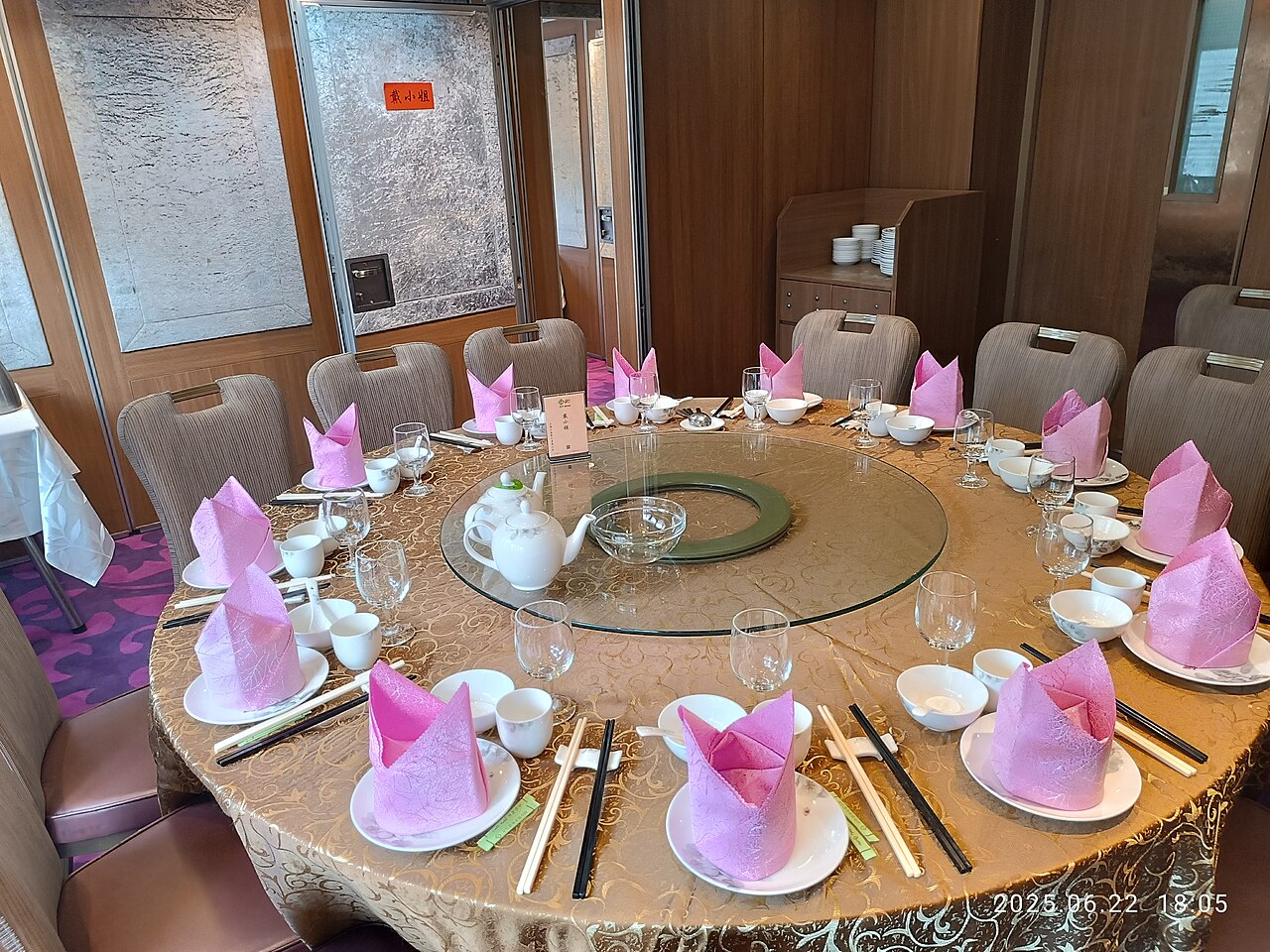
The Chinese banquet is not a meal; it is a performance of civilization. Its roots reach back to the ritual feasts described in the Zhou Li (周礼, Rites of Zhou), a text compiled during the Han dynasty but purporting to describe the ceremonial institutions of the Western Zhou period (c. 1046–771 BCE). In the Zhou court, feasting was governed by elaborate rules that specified the number of dishes to be served according to the host's rank, the precise arrangement of food on the table, the order of toasts, and the music and dance that accompanied each course. These were not arbitrary conventions but expressions of 礼 (lǐ), ritual propriety — the Confucian principle that social harmony depends on every person understanding and fulfilling the obligations of their role. The banquet table was, in this view, a microcosm of the well-ordered state: each dish in its proper place, each guest in their proper seat, each toast offered in the proper sequence.
Confucius himself was deeply attentive to food and dining, and the Analects contains numerous passages that reveal his views on proper eating. He would not eat food that was not cut properly, that lacked the correct sauce, or that was not in season. He insisted on sitting in the correct position at table and never ate to excess. These were not the eccentricities of a fussy eater but the practical expressions of a philosophical system that saw civilization as a web of meaningful forms. As the sinologist Michael Nylan (2001) has argued, Confucian ritual was not about rigid conformity but about cultivating an aesthetic sensitivity to the patterns of social life — a sensitivity that expressed itself as naturally in the arrangement of a banquet as in the governance of a state.
The Confucian emphasis on the social function of food established a framework that would shape Chinese banquet culture for over two millennia. Unlike the Western tradition, in which the meal is primarily an occasion for eating and conversation, the Chinese banquet is primarily an occasion for the negotiation and reinforcement of social relationships. The host demonstrates generosity and status through the lavishness of the food; the guest demonstrates respect and gratitude through appreciation and reciprocity. The exchange of toasts, the offering of the choicest morsels to honored guests, the ritual modesty of declining the seat of honor before accepting it — all of these conventions encode a complex grammar of social obligation that every educated Chinese person was expected to master.
The Structure of a Formal Banquet
A formal Chinese banquet follows a carefully orchestrated sequence that builds from light to heavy, from cold to hot, and from savory to sweet — a progression that reflects both aesthetic logic and the practical requirements of digestion. The meal typically opens with a selection of cold appetizers (冷盘, lěng pán or 凉菜, liáng cài), arranged on a large platter in geometrically precise patterns that showcase the kitchen's skill. These might include sliced drunken chicken, marinated jellyfish, smoked fish, spiced beef shank, pickled vegetables, and seasoned tofu — a survey of flavors and textures designed to stimulate the appetite without satiating it. In grand banquets, the cold platter is an art form in itself, with ingredients carved and arranged into the shapes of phoenixes, dragons, or flowers, a tradition that dates to the Tang dynasty court.
Following the cold dishes come the hot stir-fried dishes (热炒, rè chǎo), typically four to eight in number, served in rapid succession. These form the heart of the banquet and are expected to display the full range of the chef's technique: a wok-seared dish that showcases wok hei, a delicate steamed preparation, a rich braised meat, a whole fish presented intact (its completeness symbolizing abundance and wholeness). The sequence is punctuated by a soup (汤, tāng), which serves as a palate cleanser and a digestive aid, often positioned midway through the hot courses. The climax of the meal is the arrival of a prestige dish — typically a whole roasted suckling pig, a steamed whole fish, Peking duck, or a luxury ingredient such as abalone, sea cucumber, or shark fin — which announces the host's wealth and the importance of the occasion.
The banquet concludes with a staple food (主食, zhǔshí) — typically fried rice, noodles, or dumplings — followed by a dessert course (甜品, tiánpǐn) that might include sweet red bean soup, sesame balls, or fresh fruit. There is a deliberate irony in this structure: the staple food, which in everyday Chinese meals constitutes the bulk of the diet, appears at the banquet only as a token afterthought, a signal that the host has provided such an abundance of delicacies that the guests need not fill up on mere grain. Indeed, guests who eat too much of the staple food risk implying that the preceding courses were insufficient — a social gaffe that experienced diners carefully avoid. As the food historian Joanna Waley-Cohen (2007) has observed, the banquet's structure is a text to be read: every element, from first cold dish to final fruit, carries social meaning.
"In food, one does not object to the finest grain; in meat, one does not object to the finest cut."
Confucius, Analects (论语)Symbolism of Banquet Foods
No cuisine in the world invests food with more symbolic meaning than the Chinese, and nowhere is this symbolism more densely concentrated than at the banquet table. The whole fish that appears at virtually every Chinese banquet — always presented intact, head and tail — embodies the proverb 年年有余 (nián nián yǒu yú, "surplus year after year"), because the word for fish (鱼, yú) is a homophone of the word for abundance (余, yú). The fish is typically placed with its head pointing toward the guest of honor, and etiquette dictates that no one should turn the fish over after eating the top side — to flip a fish is to invoke the image of a capsized boat, an omen of disaster that is especially potent in fishing communities along the coast.
Chicken, served whole, represents the phoenix and symbolizes prosperity and good fortune; the head is traditionally offered to the most senior guest as a mark of respect. Noodles, as discussed elsewhere, represent longevity and must never be cut. Dumplings, whose shape resembles gold ingots used as currency in imperial China, symbolize wealth. Lobster (龙虾, lóngxiā, literally "dragon shrimp") invokes the dragon, the supreme symbol of imperial power and good fortune. Sweet lotus seed soup (莲子汤, liánzǐ tāng) is served at wedding banquets because 莲子 (liánzǐ) is a near-homophone of 连子 (liánzǐ, "continuous sons"), expressing the wish for the couple's fertility. Even the number of dishes carries meaning: banquets typically feature eight courses because the number eight (八, bā) sounds like the word for prosperity (发, fā).
This symbolic system operates through a combination of visual resemblance, phonetic puns, and cultural associations that are deeply embedded in the Chinese language and worldview. The reliance on homophones is particularly notable: because Mandarin and its dialects are tonal languages with a relatively small inventory of possible syllables, homophonic connections abound, and the Chinese imagination has exploited these connections to create a rich symbolic vocabulary that pervades daily life but reaches its fullest expression at the banquet table. As anthropologist Eugene Anderson (1988) has documented, this food symbolism is not static folklore but a living, evolving system that adapts to new ingredients and new social contexts while maintaining its underlying logic — the conviction that what we eat shapes what we become, and that a well-chosen meal can bend the arc of fortune.
The Art of Toasting: Ganbei
If the food at a Chinese banquet encodes social meaning, the drinking rituals amplify it to maximum volume. The Chinese toast — 干杯 (gānbēi, literally "dry the cup") — is not merely an invitation to drink but a declaration of relationship, a challenge to reciprocity, and, in the context of business entertaining, a high-stakes negotiation conducted under the guise of conviviality. At a formal banquet, the host opens the drinking with a toast to the assembled guests, typically expressing gratitude for their presence and hopes for the evening's enjoyment. The guest of honor responds with a counter-toast. Then begins the elaborate dance of individual toasts, as guests circulate the table offering ganbei to one another — each toast requiring both parties to drain their glasses in a single gesture, hold the empty glass up for inspection, and refill immediately.
The social dynamics of ganbei are complex and consequential. A toast from a superior to a subordinate is a gesture of inclusiveness and favor; a toast from a subordinate to a superior is a gesture of respect and ambition. Refusing a toast is a serious breach of etiquette that implies distrust or contempt, and the ability to drink heavily without visible impairment is widely regarded as a sign of masculine strength and social reliability — a perception that has made the Chinese banquet a challenging environment for women and non-drinkers, and one that health advocates have increasingly criticized. The preferred spirit for formal toasting is baijiu (白酒), a clear, grain-based liquor with an alcohol content typically between 40 and 60 percent, whose most prestigious brands — Moutai (茅台), Wuliangye (五粮液), Luzhou Laojiao (泸州老窖) — command prices comparable to fine Burgundy and are gifted between business partners as tokens of esteem.
The culture of banquet drinking has come under increasing scrutiny in recent decades. In 2012, the Chinese government issued regulations restricting the use of public funds for lavish banquets, specifically targeting the excessive consumption of Moutai and other premium spirits at official events. This anti-corruption campaign, intensified under President Xi Jinping, dramatically reduced the scale and frequency of government-funded banquets and temporarily depressed the baijiu market. Yet the underlying culture of relational drinking persists in the private sector and in personal entertaining, where the banquet remains the primary venue for building the networks of trust and obligation known as guanxi (关系). As sociologist Mayfair Yang (1994) has argued, the Chinese banquet is fundamentally an institution for the production and exchange of social capital, and drinking is its most concentrated ritual mechanism.
"Is it not a joy to have friends come from afar?"
Confucius, Analects (论语)The Manchu-Han Imperial Feast
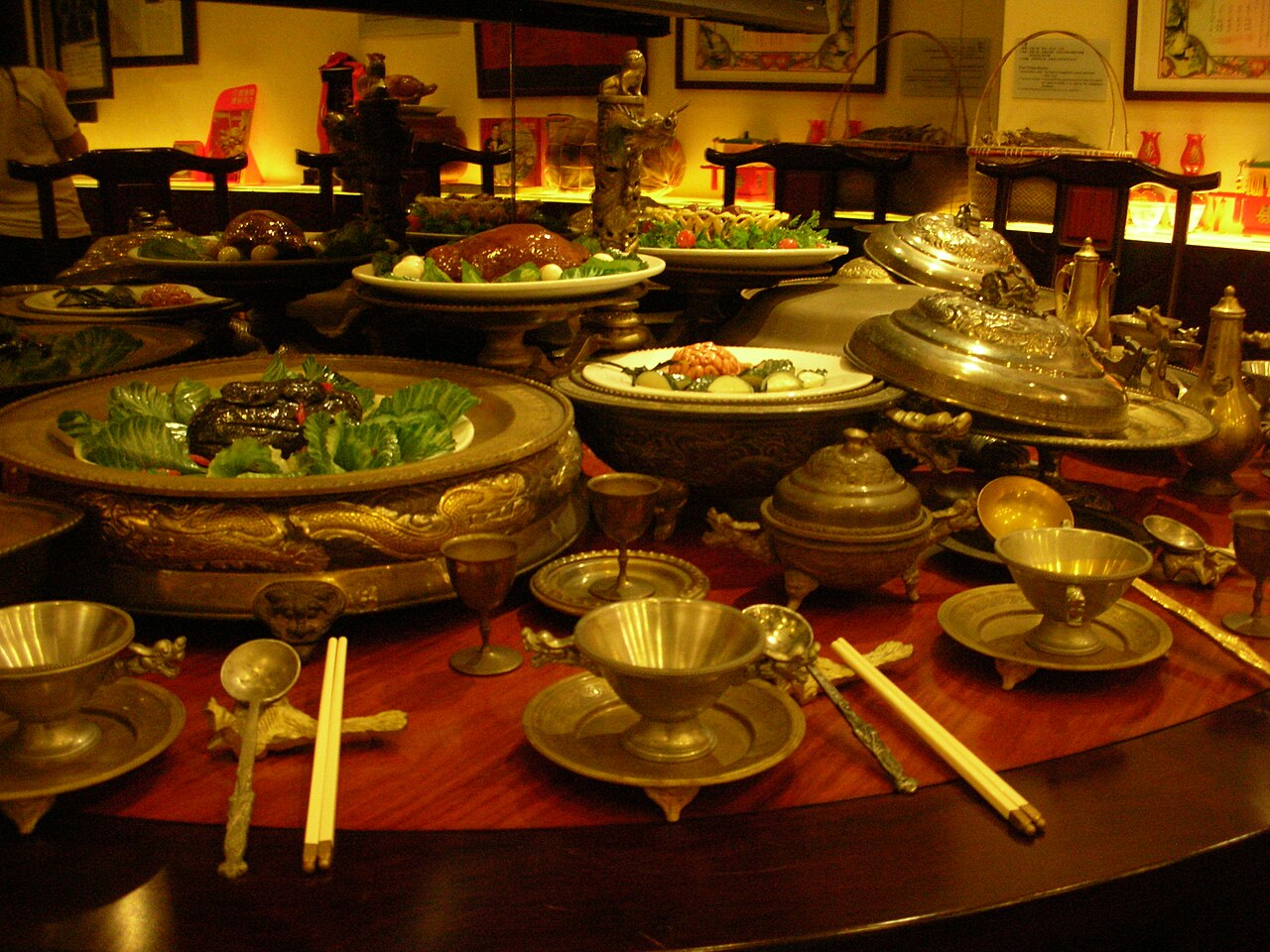
No discussion of the Chinese banquet is complete without an account of its most extravagant historical expression: the Manchu-Han Imperial Feast (满汉全席, Mǎn-Hàn quánxí), a legendary banquet said to combine the culinary traditions of the Manchu conquerors and the Han Chinese majority into a single gargantuan meal of 108 dishes served over three days. The feast is traditionally associated with the Kangxi Emperor's reign (1661–1722), when the Qing court sought to unify the empire's diverse ethnic groups through cultural synthesis — a project that extended from governance and philosophy to the banquet table itself. Whether the Manchu-Han Imperial Feast existed in precisely the form later described remains a matter of scholarly debate, but the concept became iconic, representing the absolute pinnacle of Chinese culinary ambition.
The feast, as reconstructed by food historians and modern restaurateurs, encompassed an encyclopedic survey of Chinese and Manchu cuisine. It included roasted meats from the Manchu nomadic tradition — whole roasted lamb, venison, and game birds — alongside the refined dishes of Han haute cuisine: shark fin soup, bird's nest dessert, braised bear paw, steamed whole abalone, dried sea cucumber in brown sauce. The 108 dishes were divided into categories: cold appetizers, hot dishes, stir-fries, braised dishes, roasted dishes, soups, snacks, pastries, and fruits, each category representing a different cooking method and a different region's specialty. The number 108 itself carried Buddhist symbolism, corresponding to the 108 beads on a Buddhist prayer mala, representing the 108 worldly afflictions that must be overcome to achieve enlightenment — a spiritual overlay on a supremely material indulgence.
The modern Manchu-Han Feast exists primarily as a tourist attraction and a competitive showcase for ambitious restaurants, particularly in Beijing, Shenyang, and Taipei. Authentic recreations are rare and prohibitively expensive, with some restaurants charging upwards of 100,000 RMB per table. But the feast's cultural significance extends beyond any single meal: it represents the Chinese conviction that cuisine is not merely a craft but a civilization — a system of knowledge, technique, and meaning as complex and worthy of study as philosophy, painting, or architecture. The Manchu-Han Feast is, in this sense, the Chinese banquet pushed to its logical extreme: a meal that aspires to contain the totality of a culinary tradition within a single gathering, a feast that is simultaneously a museum, a performance, and a statement of cultural identity.
Modern Banquet Evolution
The Chinese banquet in the twenty-first century is a tradition in creative tension between continuity and change. The fundamental structure — cold dishes, hot dishes, soup, staple, dessert — remains intact, as do the core rituals of toasting, guest seating by status, and the offering of prestige dishes. But the content of the banquet has evolved significantly under the pressures of globalization, health consciousness, environmental awareness, and generational change. Shark fin soup, once the sine qua non of a prestigious banquet, has been increasingly abandoned in response to campaigns highlighting the ecological devastation of shark finning, with Chinese celebrities, chefs, and even government officials publicly pledging to remove it from their menus. The Chinese government banned shark fin from official state banquets in 2013, a decision that reflected both environmental concerns and the broader anti-extravagance campaign.
Contemporary banquet cuisine has responded to these changes by developing new expressions of luxury that do not depend on endangered species or excessive consumption. The emphasis has shifted from rare ingredients to rare technique — from the conspicuous consumption of expensive materials to the conspicuous mastery of culinary skill. A modern prestige dish might be a deceptively simple preparation of seasonal vegetables, elevated by flawless wok technique, exquisite presentation, and the use of premium condiments. The influence of Japanese kaiseki and French tasting-menu formats has encouraged some Chinese chefs to experiment with smaller portions, more courses, and more narrative coherence in the progression from dish to dish — a development that some traditionalists lament as a Western corruption and others celebrate as a natural evolution.
The banquet has also migrated from the restaurant to new venues and formats. Wedding banquets, once rigidly standardized, now frequently incorporate personalized elements — bespoke menus reflecting the couple's heritage, fusion dishes that blend Chinese and Western traditions, interactive food stations that replace the formal seated service. Corporate banquets, the primary engine of China's business entertaining culture, have been scaled back in the wake of anti-corruption regulations but have not disappeared; they have simply become more discreet, with smaller guest lists, less ostentatious venues, and a greater emphasis on the quality of conversation rather than the quantity of baijiu consumed. Through all of these changes, the banquet's essential function endures: it remains the stage on which Chinese social relationships are built, maintained, tested, and renewed — a tradition that has survived dynastic collapse, revolution, and modernization because it serves a need that no amount of social change has rendered obsolete.
"When drinking with a kindred spirit, a thousand cups are too few."
Chinese proverb (民间谚语)Quiz
What is the primary function of the Chinese banquet according to the article?
Which text is cited as describing the early ceremonial institutions influencing Chinese banquets?
What is the significance of serving a whole fish at a Chinese banquet?
What is the cultural significance of the number eight in Chinese banquets?
What is the role of soup in a formal Chinese banquet?
How did the modern Chinese banquet evolve in response to environmental awareness?
What is the symbolism of chicken served whole at a Chinese banquet?
What is ganbei in the context of a Chinese banquet?
Write your thoughts, then get feedback from Jason — you can turn any answer into a full discussion.
9. How might the Confucian principles reflected in the Chinese banquet influence social interactions in other areas of life?
10. In what ways do you think modern changes in Chinese banquet culture reflect broader societal shifts?
Frequently Asked Questions
Common questions about The Philosophy of the Chinese Banquet
What is a traditional Chinese banquet and how does it work?
A traditional Chinese banquet (宴席, yànxí) is a formal multi-course meal typically consisting of 8 to 12 dishes served sequentially, beginning with cold appetizers, progressing through increasingly impressive main courses, and concluding with a whole fish, rice or noodles, and sweet dessert. The number and grandeur of courses reflect the occasion's importance and the host's generosity toward their guests.
Why are certain foods served at Chinese wedding banquets?
Every dish at a Chinese wedding banquet carries symbolic meaning tied to wishes for the newlyweds. Lobster and chicken represent the dragon and phoenix (a symbol of marital harmony), whole fish symbolizes abundance (余, yú, a homophone for surplus), lotus seeds represent fertility, and sweet red bean soup at the end wishes the couple a sweet life together.
What is the correct seating order at a Chinese banquet?
Chinese banquet seating follows strict hierarchical rules rooted in Confucian social order. The guest of honor sits facing the entrance at the "head" of the round table, with the host directly opposite, and other guests are arranged by status in descending order from the guest of honor's left and right. Getting the seating wrong is considered a serious social misstep.
How many courses are in a Chinese banquet?
A standard Chinese banquet typically features 8 to 12 courses, with the number eight being especially favored because it is a homophone for prosperity (发, fā) in Chinese. Grand occasions like weddings may feature up to 16 courses, while imperial banquets historically included dozens of dishes, with the legendary Manchu-Han Imperial Feast comprising over 100 courses spread across three days.
What is the etiquette for toasting at a Chinese banquet?
Chinese banquet toasting follows specific protocols: the host offers the first toast to all guests, then individual toasts proceed by seniority. When toasting someone senior, you should hold your glass lower than theirs as a sign of respect. The phrase "ganbei" (干杯, "dry cup") means to drain your glass entirely, and refusing a toast from an elder or superior is considered very impolite.