
Podcast


Podcast: Sichuan Cuisine: The Art of Mala
Listen to Jason & Amy discuss Sichuan Cuisine: The Art of Mala
New here?
Origins of Sichuan Flavor

The Sichuan Basin, cradled by mountains on three sides and watered by the tributaries of the mighty Yangtze, has been one of China's most productive agricultural regions for over two millennia. The area's exceptional fertility earned it the title "Heaven's Storehouse" (天府之国, Tiānfǔ Zhī Guó) during the Han dynasty, and its isolation behind mountain barriers allowed a distinctive culinary tradition to develop with relatively little outside interference. Long before the arrival of the chili pepper from the Americas, Sichuan cooks had already established a reputation for bold, pungent flavors. The ancient Huayang Guozhi (华阳国志), a fourth-century chronicle of the region, noted that the people of Shu (the ancient name for Sichuan) "favored pungent and fragrant flavors" — a preference that would prove fateful when New World ingredients arrived.
The cornerstone of pre-Columbian Sichuan flavor was the Sichuan peppercorn — 花椒 (huājiāo), literally "flower pepper" — a small, reddish-brown husk from the prickly ash tree (Zanthoxylum bungeanum) that produces a unique tingling, numbing sensation on the tongue. This sensation, called má (麻) in Chinese, has no equivalent in European cuisine. Sichuan peppercorn had been prized in China since antiquity: it appears in the Shijing (Book of Songs), the oldest collection of Chinese poetry, dating to the eleventh century BCE, where it is mentioned as an offering to the gods and a symbol of fertility. In ancient Sichuan, peppercorn was combined with ginger, garlic, fermented bean paste, and vinegars to create flavor profiles of remarkable complexity. As Fuchsia Dunlop observes in The Food of Sichuan (2019), the province's culinary DNA was already encoded before the chili ever arrived.
The region's cuisine was also shaped by its climate. The Sichuan Basin is one of the most humid places in China, shrouded in fog and drizzle for much of the year — the Chinese saying "Sichuan dogs bark at the sun" (蜀犬吠日) refers to the rarity of clear skies. In traditional Chinese medicine, dampness is considered pathogenic, and pungent, warming foods are prescribed as a corrective. The Sichuanese preference for fiery flavors was thus not merely a matter of taste but a form of dietary medicine, a daily practice of rebalancing the body's internal climate through the strategic application of heat and numbing spice. This medical logic persists today: a Chengdu resident eating hot pot on a sweltering summer evening will explain, without irony, that sweating drives out internal dampness.
"China is the place for food, but Sichuan is the place for flavor."
Traditional Chinese proverbThe Chili Pepper Revolution
The chili pepper — Capsicum annuum and its relatives — is native to the Americas and was unknown in Asia before the sixteenth century. Portuguese traders brought it to the coasts of India and Southeast Asia in the early 1500s, and from there it spread rapidly through established trade networks into China. The earliest Chinese references to the chili pepper date to the late sixteenth century, when it appeared in herbals as an ornamental plant. The Zunsheng Bajian (遵生八笺), published in 1591, describes the chili as a decorative curiosity with small white flowers and bright red fruits. It took another century for the plant to make the leap from garden ornament to kitchen staple, and that transformation occurred not in the cosmopolitan coastal cities but in the mountainous interior provinces — Guizhou, Yunnan, Hunan, and Sichuan — where salt was expensive and chili served as an affordable flavor substitute.
The adoption of the chili pepper in Sichuan was neither instantaneous nor inevitable. As historian Brian Dott demonstrates in The Chile Pepper in China (2020), the chili's penetration into Sichuan cooking was a gradual process that unfolded over roughly two centuries, from the mid-seventeenth to the mid-nineteenth century. Early Sichuan cookbooks from the Qing dynasty mention chili peppers sparingly, treating them as one ingredient among many. It was not until the late Qing period, in the eighteenth and nineteenth centuries, that the combination of chili heat (辣, là) and peppercorn numbness (麻, má) — the signature málà (麻辣) flavor — emerged as the dominant taste profile of Sichuan cuisine. The marriage of these two ingredients, one indigenous and one foreign, created something entirely new: a compound sensation that was more than the sum of its parts.
The speed with which the chili conquered Sichuan after its initial slow adoption suggests that the province was, in a sense, waiting for it. The pre-existing love of pungent flavors, the humid climate that made hot food a medicinal necessity, and the mountainous terrain that limited access to expensive coastal salt all created an ecological niche that the chili filled perfectly. By the late nineteenth century, the transformation was complete. The chili pepper — an immigrant from the other side of the world, with no history in Asia before 1500 — had become so thoroughly assimilated into Sichuan identity that most Sichuanese assumed it had always been there. It is one of the most remarkable examples of culinary adoption in world history, and it reminds us that the most "traditional" cuisines are often surprisingly recent inventions.
The Twenty-Four Flavor Profiles
The sophistication of Sichuan cuisine lies not in the mere application of heat but in the systematic organization of flavor into a formal taxonomy that has no parallel in any other culinary tradition. Sichuan cooking theory recognizes twenty-four distinct compound flavor profiles — 复合味型 (fùhé wèixíng) — each defined by a specific combination of base ingredients applied in precise proportions. These flavor profiles are taught in Sichuan culinary schools as rigorously as scales are taught in conservatories, and a graduate of the Sichuan Higher Institute of Cuisine is expected to reproduce each one from memory. As Fuchsia Dunlop catalogues them in The Food of Sichuan (2019), they range from the familiar málà (numbing-hot) and yúxiāng (fish-fragrant) to the esoteric guàiwèi ("strange flavor," a combination of sweet, sour, salty, hot, numbing, and umami) and jiàngxiāng (sauce-fragrant, dominated by fermented bean paste).
The málà profile, while the most internationally famous, is only one note in this vast flavor orchestra. Consider yúxiāng (鱼香), "fish-fragrant" flavor: despite its name, it contains no fish. The profile originated in the seasonings used to cook fish — pickled chili, ginger, garlic, scallion, sugar, vinegar, and soy sauce — and was later applied to other ingredients. Yúxiāng eggplant (鱼香茄子), one of Sichuan's most beloved home-style dishes, bathes deep-fried eggplant in a sauce that balances sweet, sour, salty, and spicy in perfect equilibrium. Another profile, suānlà (酸辣, sour-hot), combines the tang of Baoning vinegar or pickled vegetables with chili heat to create dishes like hot-and-sour noodles (酸辣粉) that stimulate the appetite without overwhelming it. Each profile is not a recipe but a principle — a template that can be applied to hundreds of different ingredients.
The twenty-four flavor system reveals something fundamental about the Chinese approach to cooking: it is compositional rather than improvisational. A Sichuan chef does not simply throw ingredients together and taste; he or she selects a specific flavor profile appropriate to the main ingredient and the occasion, then executes it with precision. This systematic approach accounts for the remarkable consistency of Sichuan cooking across thousands of restaurants: a bowl of dan dan noodles in Chengdu should taste recognizably similar to one in Chongqing or Zigong, because both are executing the same flavor template. The system also makes Sichuan cuisine uniquely teachable and transmissible, which helps explain how a regional cooking tradition from an inland Chinese province managed to conquer the world's dining tables in a matter of decades.
"Each dish has its own character; a hundred dishes yield a hundred flavors."
Classical Sichuan culinary maximMapo Tofu and the Iconic Dishes
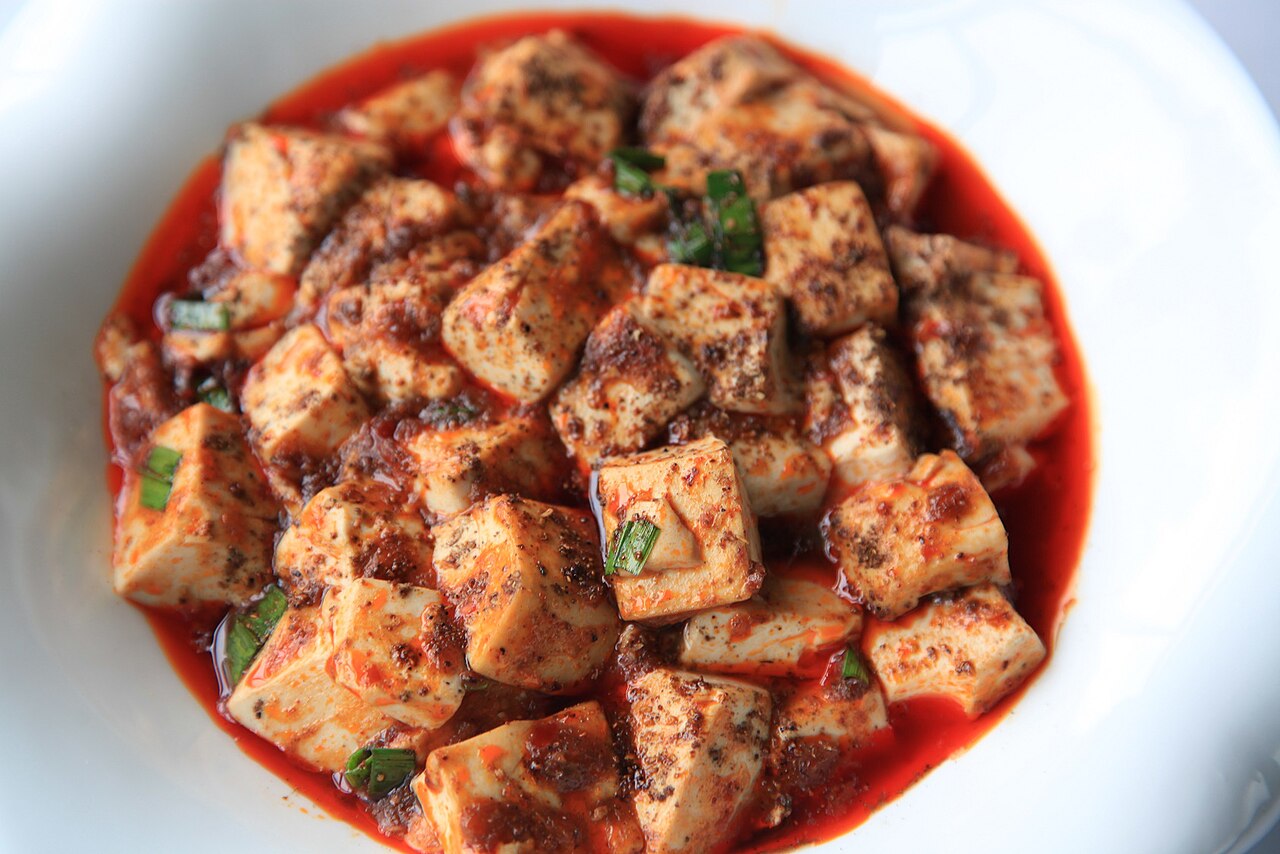
No dish better embodies the genius of Sichuan cuisine than mapo tofu (麻婆豆腐), a preparation so perfectly conceived that it has achieved a kind of culinary immortality. The dish was invented around 1862 at a small restaurant near the Wanfu Bridge in Chengdu, operated by a woman surnamed Chen whose pockmarked face (麻脸, máliǎn) earned her the nickname "Pockmarked Granny Chen" (陈麻婆). Her innovation was to combine the softest possible tofu with a fiery sauce of doubanjiang (fermented chili bean paste), ground beef or pork, Sichuan peppercorn, and chili oil, creating a dish that delivered the full málà experience while remaining comforting and accessible. The restaurant she founded, Chen Mapo Tofu (陈麻婆豆腐), still operates in Chengdu today and draws long queues of pilgrims seeking the authentic version of what has become one of the world's most widely consumed dishes.
The greatness of mapo tofu lies in its embodiment of what Sichuan food theorists call the "seven characteristics" (七个字) of ideal Sichuan cooking: má (numbing), là (spicy), tàng (scalding hot), xiān (fresh), nèn (tender), xiāng (aromatic), and sū (crispy, referring to the minced meat). A properly made mapo tofu should arrive at the table bubbling violently in its clay pot, the surface shimmering with a layer of crimson chili oil through which the snow-white cubes of tofu are barely visible. The first bite delivers a cascade of sensations: the silky collapse of the tofu, the coarse crunch of the meat, the deep umami of the doubanjiang, the slow burn of the chili, and finally the spreading numbness of the peppercorn that lingers for minutes after the last bite. According to food writer Dunlop (2001), no other single dish in the Chinese repertoire achieves such a complete synthesis of contrasting textures and flavors.
The pantheon of iconic Sichuan dishes extends far beyond mapo tofu. Kung pao chicken (宫保鸡丁), named after the Qing dynasty governor Ding Baozhen who held the title "Palace Guardian" (宫保), juxtaposes tender diced chicken with roasted peanuts and dried chili peppers in a complex sauce balancing sweet, sour, and savory. Twice-cooked pork (回锅肉, huíguōròu), perhaps the most commonly eaten dish in Sichuan homes, first simmers pork belly whole, then slices and stir-fries it with doubanjiang and fermented black beans until the fat becomes translucent and slightly caramelized. Dan dan noodles (担担面), named after the shoulder poles (担担, dàndān) on which street vendors carried their portable kitchens, layer a sauce of sesame paste, chili oil, preserved mustard greens, and minced pork over thin wheat noodles. Each of these dishes has traveled the world, but each is best understood as a specific expression of Sichuan's systematic flavor philosophy.
The Science of Sichuan Peppercorn
The unique numbing sensation produced by Sichuan peppercorn — a tingling, buzzing feeling that the Chinese describe as má (麻) — long mystified Western scientists accustomed to categorizing taste into the familiar quartet of sweet, sour, salty, and bitter. The mystery was solved in 2013 when a team of researchers led by Nobuhiro Hagura at University College London published a landmark study in the Proceedings of the Royal Society B demonstrating that the active compound in Sichuan peppercorn, hydroxy-alpha-sanshool, does not activate taste receptors at all. Instead, it stimulates light-touch mechanoreceptors in the lips and tongue — the same nerve fibers that detect vibration — causing them to fire at a frequency of approximately 50 hertz. The sensation of "numbness" is, in neurological terms, a tactile hallucination: the brain interprets the chemical stimulation of touch receptors as a physical vibration.
This discovery placed Sichuan peppercorn at the frontier of a scientific revolution in our understanding of flavor. The traditional Western model of four basic tastes (expanded to five with the addition of umami in 1985) was revealed to be radically incomplete. Flavor, it turns out, is not merely a matter of taste buds on the tongue but a multisensory experience involving touch, temperature, pain (in the case of chili capsaicin), and even sound. Sichuan peppercorn's activation of the somatosensory system — the body's network for processing touch and vibration — represents a flavor modality that has no name in English. The Chinese language, by contrast, has had a precise word for it for millennia: má. As the neuroscientist Charles Spence argues in Gastrophysics (2017), Chinese culinary vocabulary was centuries ahead of Western food science in recognizing the multisensory nature of eating.
The interaction between Sichuan peppercorn and chili pepper is equally fascinating from a neurological perspective. Capsaicin, the active compound in chili peppers, activates the TRPV1 pain receptor, which is also triggered by heat — hence the sensation of "burning." Sanshool's activation of touch receptors creates a competing signal that partially masks the pain of capsaicin while simultaneously lowering the threshold for its activation. The result is the famous málà synergy: the numbness makes the heat more tolerable while paradoxically making it more intense, creating a feedback loop that encourages the eater to consume more. This neurochemical dance, discovered empirically by Sichuan cooks centuries before any scientist could explain it, is perhaps the most sophisticated manipulation of human sensory perception achieved by any culinary tradition in history.
"Only by enduring the bitterest of the bitter can one rise above others."
Traditional Chinese proverbModern Sichuan Worldwide
The global spread of Sichuan cuisine is one of the most remarkable culinary phenomena of the twenty-first century. As recently as the 1990s, Sichuan food was virtually unknown outside China and overseas Chinese communities. The Chinese restaurants that lined the high streets of Western cities served almost exclusively Cantonese food — sweet-and-sour pork, chow mein, fried rice — adapted to local palates and bearing little resemblance to the fiery flavors of the Sichuan Basin. The transformation began in the early 2000s, driven by a combination of factors: the publication of Fuchsia Dunlop's Land of Plenty (2001), which introduced English-speaking audiences to authentic Sichuan cooking for the first time; the massive internal migration of Sichuanese workers to China's eastern cities, who brought their food culture with them; and the rising global interest in spicy food that accompanied the broader trend toward more adventurous eating.
By the 2010s, Sichuan cuisine had become the fastest-growing segment of the Chinese restaurant industry worldwide. Hot pot restaurants — 火锅 (huǒguō), the communal dining experience in which diners cook raw ingredients in a bubbling cauldron of chili-laced broth — multiplied across major cities from New York to London to Tokyo. The chain Haidilao (海底捞), founded in Sichuan in 1994, grew into a global empire with over 1,500 locations by 2023, its success built on a combination of authentic málà flavor and famously attentive service. In the United States, the explosive growth of Sichuan restaurants in cities like Los Angeles, where the San Gabriel Valley became a destination for serious Chinese food pilgrims, signaled a fundamental shift in American attitudes toward Chinese cuisine — a move away from adaptation and toward authenticity.
The global success of Sichuan cuisine has also sparked a culinary renaissance within Sichuan itself. Chengdu was designated a UNESCO City of Gastronomy in 2010, the first city in Asia to receive the honor, and the designation has fueled investment in culinary tourism, cooking schools, and food media. A new generation of Sichuan chefs, trained in classical technique but open to international influences, is pushing the boundaries of the tradition while remaining rooted in its flavor philosophy. Restaurants like Yu's Family Kitchen (喻家厨房) in Chengdu reinterpret historical Sichuan banquet dishes for contemporary diners, while street food vendors continue to serve the same dan dan noodles and cold rabbit (冷吃兔) that their grandparents sold. The result is a cuisine that is simultaneously ancient and modern, local and global — a living demonstration that culinary traditions thrive not by remaining static but by evolving in dialogue with the world.
Quiz
What geographical feature contributes to the distinctive culinary tradition of Sichuan?
Which ingredient was central to Sichuan cuisine before the arrival of the chili pepper?
What is the primary reason Sichuan cuisine uses hot and numbing spices according to traditional Chinese medicine?
When did chili peppers become a staple in Sichuan cuisine?
What distinguishes Sichuan's approach to flavor profiles?
What is a defining characteristic of mapo tofu?
What role does hydroxy-alpha-sanshool play in the flavor of Sichuan peppercorn?
What event marked a significant international recognition for Sichuan cuisine?
Write your thoughts, then get feedback from Jason — you can turn any answer into a full discussion.
9. How does the development of the málà flavor profile reflect the adaptability of Sichuan cuisine?
10. Why do you think Sichuan cuisine has gained such popularity worldwide in recent decades?
Frequently Asked Questions
Common questions about Sichuan Cuisine: The Art of Mala
What does mala mean in Chinese food?
Mala (麻辣) is a compound of two Chinese characters: má (麻), meaning "numbing," from the Sichuan peppercorn, and là (辣), meaning "spicy hot," from the chili pepper. Together they describe the signature tingling-and-burning sensation that defines Sichuan cuisine and has no direct equivalent in Western cooking.
Why is Sichuan food so spicy?
Sichuan's intense spiciness developed from a combination of cultural preference and practical medicine. The region's damp, humid climate led locals to embrace pungent foods as a way to counteract internal dampness according to traditional Chinese medicine, and the arrival of New World chili peppers in the 17th century supercharged an already bold flavor tradition.
What is the difference between Sichuan peppercorn and black pepper?
Sichuan peppercorn (花椒, huājiāo) is not related to black pepper at all — it comes from the prickly ash tree and produces a unique numbing, tingling sensation rather than simple heat. Black pepper delivers a sharp, pungent bite, while Sichuan peppercorn creates an almost electric buzzing on the tongue that temporarily alters how you perceive other flavors.
What are the most famous Sichuan dishes?
Some of the most celebrated Sichuan dishes include mapo tofu (麻婆豆腐), kung pao chicken (宫保鸡丁), twice-cooked pork (回锅肉), dan dan noodles (担担面), and Sichuan hot pot (火锅). Each dish showcases different aspects of the cuisine's complex layering of numbing, spicy, sweet, sour, and savory flavors.
How many flavor profiles does Sichuan cuisine have?
Sichuan cuisine is traditionally said to encompass 24 distinct flavor profiles (味型, wèixíng), far more than any other Chinese regional cuisine. These range from the famous mala (numbing-spicy) to lesser-known combinations like guaiwei ("strange flavor"), which blends sweet, sour, salty, spicy, and numbing notes in a single dish.