
Podcast


Podcast: Cantonese Dim Sum: A Living Tradition
Listen to Jason & Amy discuss Cantonese Dim Sum: A Living Tradition
New here?
Teahouse Origins
The story of dim sum begins not with food but with tea. During the Song dynasty (960–1279), the teahouses of southern China evolved from simple roadside establishments into elaborate social institutions where merchants, scholars, and laborers gathered to conduct business, exchange gossip, and spend leisurely hours over pots of fragrant tea. In Guangzhou, the great commercial capital of the south, these teahouses — known as 茶楼 (chálóu), literally "tea houses" — began offering small snacks to accompany the tea, a practice rooted in the traditional Chinese medical belief that tea on an empty stomach could cause digestive distress. These modest accompaniments — a few dumplings, some pickled vegetables, a dish of roasted nuts — were the humble ancestors of what would become one of the world's most elaborate culinary traditions.
The term "dim sum" itself — 点心 (diǎnxīn) — is a poetic expression meaning "to touch the heart," suggesting something that lightly satisfies without filling. The phrase appears in Song dynasty texts as a general term for small snacks eaten between meals, and its application to the specific Cantonese tradition of teahouse cuisine developed gradually over the following centuries. As food historian Yan-kit So documents in Classic Food of China (1992), the evolution from simple tea snacks to the elaborate dim sum repertoire we know today was driven by commercial competition among Guangzhou's teahouses, each striving to attract customers with ever more inventive and technically accomplished small dishes. By the late Qing dynasty, the major teahouses of Guangzhou employed teams of specialist dim sum chefs whose skills were distinct from those of regular kitchen cooks.
The teahouse was far more than a place to eat: it was the living room of Cantonese society. In a subtropical city where homes were often cramped and poorly ventilated, the teahouse offered space, comfort, and a social stage. Merchants sealed deals over tea; families celebrated festivals; retired men spent entire mornings reading newspapers and debating politics while servers circulated with trolleys of steaming bamboo baskets. This culture, known as yum cha (饮茶, yǐnchá, literally "drink tea"), became so central to Cantonese life that the phrase itself became synonymous with the entire experience of eating dim sum. To "yum cha" was not simply to drink tea; it was to participate in a social ritual as structured and meaningful as any formal ceremony, differing only in its democratic accessibility — the teahouse welcomed everyone, from the wealthiest merchant to the poorest laborer.
"Drinking tea by the Cantonese sea — this I cannot forget."
Mao Zedong, poem to Liu Yazi (1949)Yum Cha Culture
The culture of yum cha is governed by an elaborate set of unwritten customs that transform the act of eating into a communal performance. The meal traditionally begins in the early morning and can extend well past noon, its leisurely pace dictated not by hunger but by sociability. Guests are seated at large round tables — typically with family, friends, or business associates — and tea is ordered first, the choice of tea serving as a statement of taste and sophistication. Pu'er (普洱), the dark, fermented tea from Yunnan, is the most traditional choice in Guangzhou, valued for its ability to cut through the richness of dim sum. Chrysanthemum tea (菊花茶) offers a lighter, floral alternative, while tieguanyin (铁观音), a fragrant oolong, is favored by connoisseurs. The teapot is placed at the center of the table, and the custom of refilling neighbors' cups before one's own is a fundamental expression of Cantonese courtesy.
The ordering of dim sum dishes follows its own protocol. In traditional teahouses, servers push trolleys laden with bamboo steamers and covered plates through the dining room, calling out the names of their offerings. Diners signal their selections by pointing or nodding, and a card on the table is stamped to record each order. The dishes arrive in a carefully calibrated sequence: lighter steamed items first, followed by fried and baked items, then congee or noodle dishes, and finally sweet desserts. This progression mirrors the structure of a formal Chinese meal, moving from delicate to robust and from savory to sweet, though in practice the pace is flexible and diners often order additional rounds as the morning progresses. In modern restaurants, the trolley system has often been replaced by paper order sheets, but the underlying rhythm of the meal remains unchanged.
The social dimension of yum cha cannot be overstated. In Cantonese culture, the teahouse is the arena where relationships are maintained and negotiated. The practice of "morning tea" (早茶, zǎochá) is particularly important for the elderly, who gather daily at their regular teahouse, sitting at their regular table, greeted by name by the servers. For this generation, yum cha is not an occasional treat but a daily ritual as essential as breathing — a structured social space that combats the isolation of old age and provides a reason to get dressed, leave the house, and engage with the world. As anthropologist Sidney Mintz observed in Tasting Food, Tasting Freedom (1996), the social functions of communal eating often outlast and outweigh the purely nutritional ones, and Cantonese yum cha is perhaps the most vivid illustration of this principle in the modern world.
The Art of Dumpling Making
The technical demands of dim sum preparation are extraordinary, rivaling those of any culinary tradition on earth. A dim sum chef — 点心师傅 (diǎnxīn shīfu) — typically undergoes three to five years of specialized apprenticeship, during which time he or she masters a repertoire of several hundred individual preparations. The skills required are diverse and demanding: the rolling of translucent wrappers from wheat starch dough, the pleating of dumplings into precisely symmetrical forms, the calibration of steaming times to the second, and the composition of fillings that achieve exact balances of flavor, texture, and moisture. A master dim sum chef is both artisan and engineer, working with the precision of a watchmaker and the aesthetic sensibility of a sculptor.
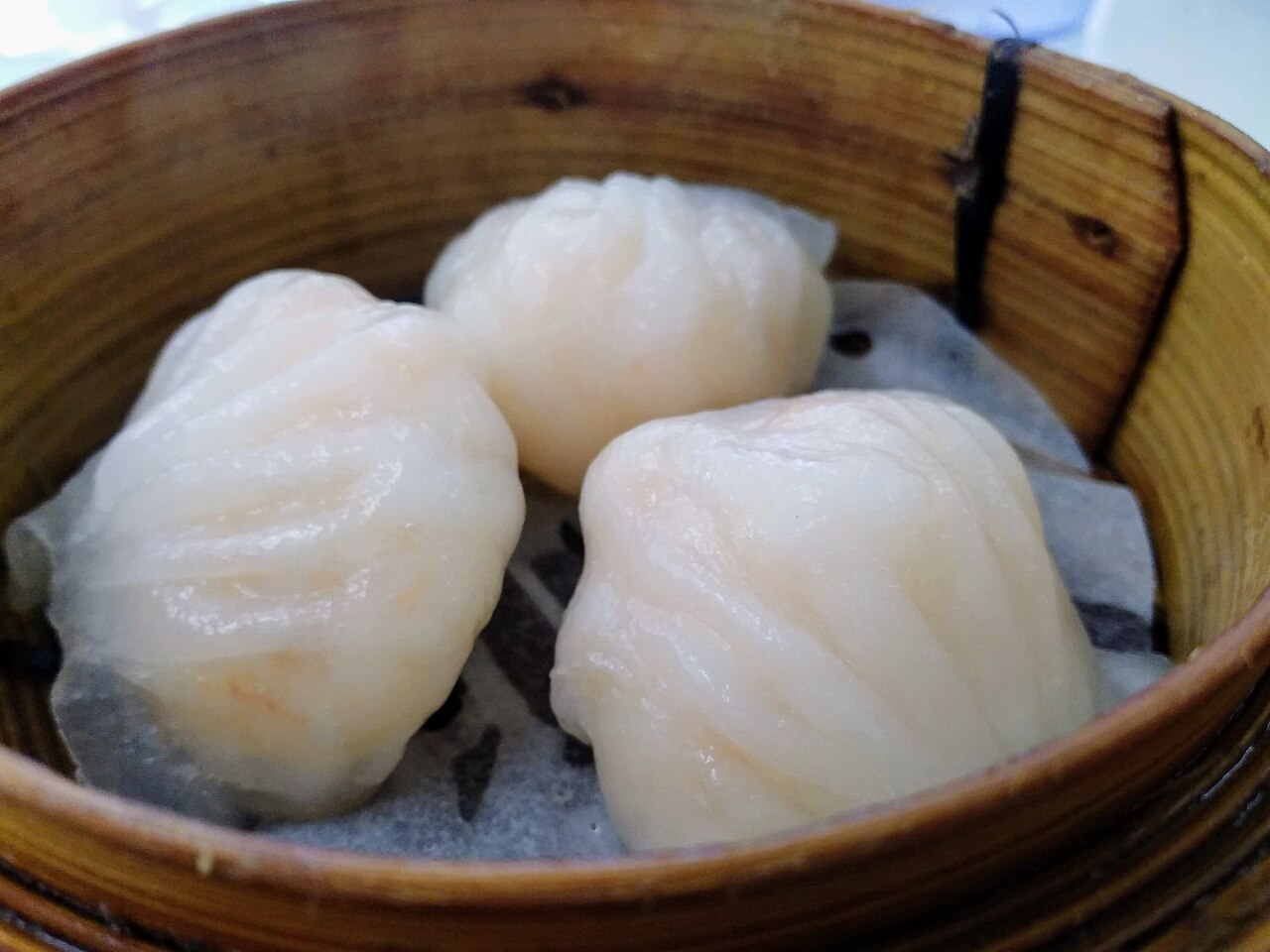
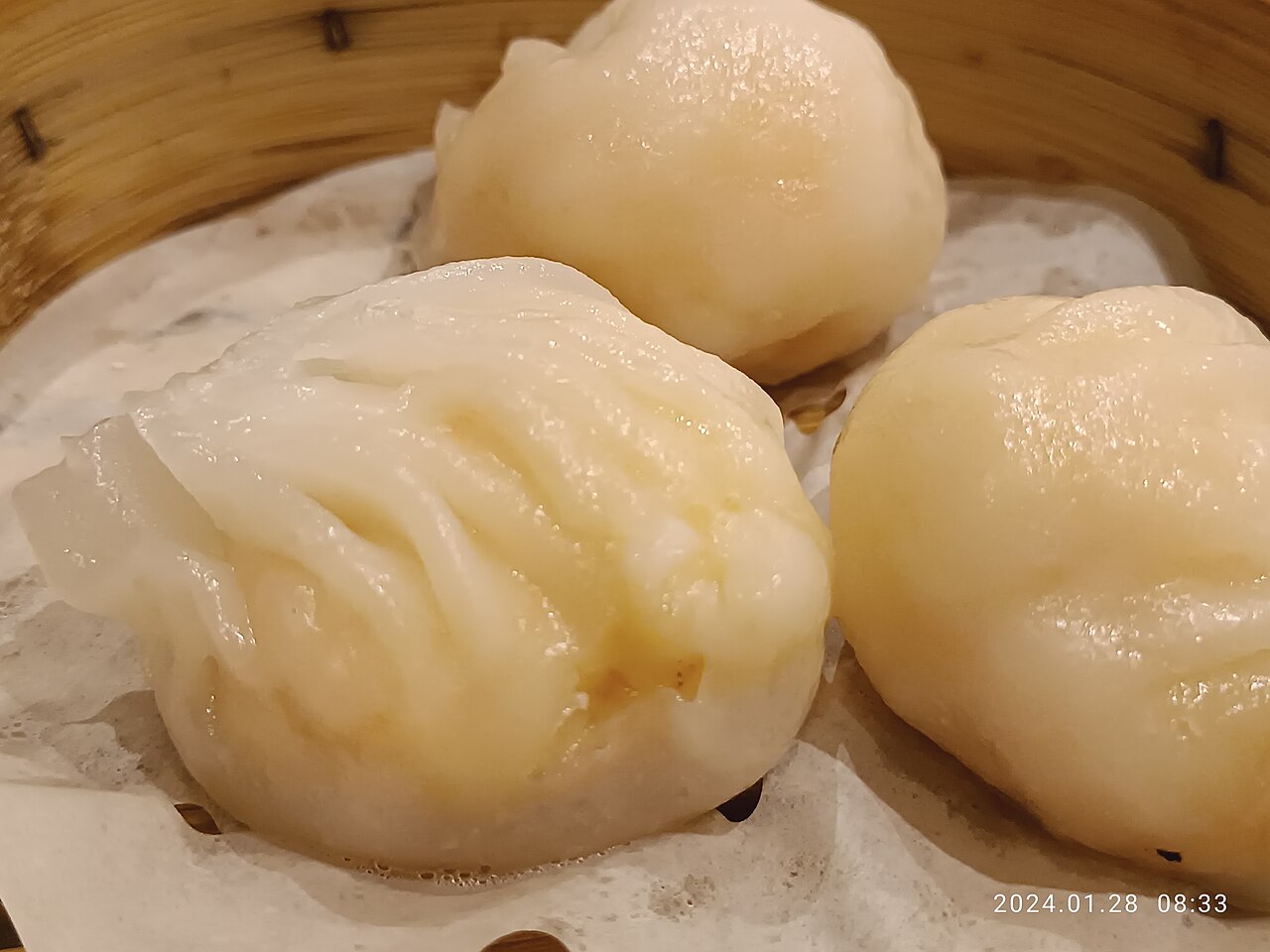
The har gow (虾饺, xiājiǎo) — the translucent shrimp dumpling that is widely considered the supreme test of a dim sum chef's skill — illustrates the art form's technical demands. The wrapper must be made from a dough of wheat starch and tapioca starch, kneaded and rolled to a thickness of approximately two millimeters — thin enough to be nearly transparent when steamed, yet strong enough to contain the filling without tearing. Each dumpling must contain a precisely portioned filling of fresh shrimp (chopped, not minced, to preserve texture), bamboo shoots, and a small amount of pork fat that melts during steaming to create a burst of juice when bitten. The wrapper is then pleated into a crescent shape with exactly seven to ten folds — the number is a matter of school and personal pride — creating a visual effect that resembles a tiny bonnet or comb. As Grace Young documents in The Wisdom of the Chinese Kitchen (1999), the har gow is the dish by which Cantonese diners judge a restaurant's quality: if the har gow is excellent, everything else can be trusted.
The diversity of dim sum preparations is staggering. The steamed category alone includes siu mai (烧卖), open-topped pork and shrimp dumplings crowned with a dot of crab roe; char siu bao (叉烧包), fluffy steamed buns filled with sweet barbecued pork; cheung fun (肠粉), silky rice noodle rolls wrapped around shrimp, beef, or char siu; and phoenix claws (凤爪), chicken feet braised in a fermented black bean sauce that transforms a humble ingredient into a delicacy of extraordinary richness. The fried repertoire includes spring rolls, taro croquettes, and wu gok (芋角), deep-fried taro dumplings with a lacy, honeycomb exterior. Baked items include egg tarts (蛋挞), whose flaky Portuguese-influenced pastry crust encases a wobbly custard filling, and pineapple buns (菠萝包), whose crackled sugar topping resembles the skin of a pineapple. The full dim sum repertoire at a major Cantonese restaurant may exceed two hundred items, each one a distinct creation with its own technique, history, and aesthetic.
"For food, go to Guangzhou."
Traditional Cantonese proverbSignature Dishes and Their Stories
Every great dim sum dish carries a story, and the stories reveal as much about Cantonese culture as the food itself. The char siu bao (叉烧包), perhaps the most universally recognized dim sum item, has its origins in the Cantonese barbecue tradition that dates back centuries. The filling of diced char siu pork, bound in a sweet oyster sauce glaze, is encased in a leavened dough that splits open during steaming to reveal the glistening meat within — a visual signature so iconic that the "smiling" split-top bun has become a symbol of dim sum itself. The dish represents a meeting of two Cantonese traditions: the ancient art of barbecued meat and the Song dynasty innovation of filled steamed buns, combined into a single creation that is greater than the sum of its parts.
The lo mai gai (糯米鸡), a parcel of glutinous rice stuffed with chicken, Chinese sausage, dried shrimp, and mushrooms and wrapped in a lotus leaf before steaming, tells a story of Cantonese ingenuity in preserving and flavoring food. The lotus leaf, which imparts a subtle, grassy fragrance to the rice during steaming, functions as both wrapping and seasoning — an elegant solution that eliminates the need for a bowl while adding a layer of flavor impossible to achieve by other means. The dish is believed to have originated in the rural Pearl River Delta, where lotus plants grew wild in the paddies and their leaves were a free and abundant resource. In the teahouse, this humble peasant preparation was refined and elevated, the filling enriched with luxury ingredients, but the fundamental principle of the lotus-leaf wrapper — nature as both vessel and flavor — remained intact.
The custard tart (蛋挞, dàntà) offers a fascinating case study in culinary hybridization. The dish is clearly related to the Portuguese pastel de nata, introduced to Macau by Portuguese colonizers in the sixteenth century, yet the Cantonese version is distinctly different: the custard is smoother and less caramelized, the pastry shell may be either flaky (in the Western style) or cookie-like (in a uniquely Cantonese variation), and the overall sweetness is restrained in deference to the Cantonese palate. The egg tart's journey from Lisbon to Macau to Guangzhou to Hong Kong and eventually to dim sum restaurants worldwide is a microcosm of the larger story of Cantonese cuisine: a tradition that absorbs foreign influences voraciously but always transforms them into something recognizably, irreducibly Cantonese. As culinary historian Kian Lam Kho writes in Phoenix Claws and Jade Trees (2015), Cantonese cooking is not merely conservative or merely innovative — it is both simultaneously, honoring tradition while relentlessly seeking improvement.
Hong Kong Dim Sum Evolution
The transfer of dim sum culture from Guangzhou to Hong Kong during the twentieth century was one of the most consequential developments in the history of Chinese cuisine. The great wave of migration from Guangdong province to Hong Kong, accelerated by the upheavals of the Chinese Civil War and the establishment of the People's Republic in 1949, brought with it a generation of master chefs who had trained in the legendary teahouses of Guangzhou. In Hong Kong's freewheeling capitalist economy, freed from the political constraints that would soon decimate traditional food culture on the mainland during the Cultural Revolution, these chefs had the freedom and the incentive to innovate. The result was an explosion of creativity that transformed dim sum from a regional Cantonese tradition into an international culinary art form.
Hong Kong's contribution to dim sum was not merely preservation but genuine invention. The city's chefs created dozens of new dishes that have since become dim sum standards: the crystal shrimp dumpling with its impossibly thin wrapper, the baked barbecued pork bun with its golden sugar crust, the mango pudding that concludes a dim sum meal with a burst of tropical sweetness. The competitive pressure of Hong Kong's restaurant industry — one of the densest in the world — drove constant innovation while maintaining exacting standards. A dim sum restaurant that served substandard har gow would lose its customers overnight; one that invented a brilliant new dish could become the talk of the city. This dynamic of fierce competition and demanding consumers created what food critic Janice Leung Hayes has called "the greatest dim sum culture the world has ever known."
The physical space of the Hong Kong dim sum restaurant also evolved dramatically. The traditional Guangzhou teahouse had been a cavernous, somewhat rustic establishment where diners sat at communal tables and servers shouted their wares over the din. Hong Kong transformed this template, creating dim sum palaces of increasing grandeur — the most famous being Maxim's Palace at City Hall, a vast, chandeliered dining room that could seat eight hundred. At the same time, smaller, more casual establishments proliferated in working-class neighborhoods, serving excellent dim sum at prices accessible to office workers and taxi drivers. The democratization of quality was Hong Kong's great achievement: in this city, a construction worker eating siu mai from a street stall could expect the same technical precision as a banker dining at the Peninsula Hotel. This insistence on universal quality, regardless of price point, remains the defining characteristic of Hong Kong's food culture.
"One pot of tea, two dishes — the perfect yum cha."
Traditional Cantonese saying describing the ideal dim sum orderDim Sum Worldwide
The Cantonese diaspora, one of the largest and most far-flung emigrant communities in world history, carried dim sum to every continent. Beginning in the mid-nineteenth century, waves of Cantonese emigrants — driven by war, famine, and the lure of gold rushes in California and Australia — established Chinatowns in cities around the world. In these communities, the teahouse served the same social function it had in Guangzhou: a gathering place, a home away from home, a venue for preserving cultural identity in an alien land. The dim sum served in these early overseas teahouses was often simplified, adapted to available ingredients and local tastes, but it maintained the essential structure of the yum cha experience — tea, small dishes, communal dining, and the unhurried rhythms of a weekend morning.
The global elevation of dim sum from ethnic curiosity to mainstream gastronomy accelerated dramatically in the early twenty-first century. In London, the establishment of high-end dim sum restaurants in the West End — led by Hakkasan, which received a Michelin star in 2003, making it the first Chinese restaurant in Europe to be so honored — signaled that dim sum could compete with French and Japanese cuisine at the highest levels of fine dining. In New York, the dim sum parlors of Flushing and Sunset Park attracted devoted followings that crossed every demographic boundary. In Sydney, Melbourne, and Vancouver — cities with large Cantonese communities — dim sum became a mainstream weekend ritual adopted by non-Chinese diners with an enthusiasm that would have astonished earlier generations. As food journalist Andrew Coe documents in Chop Suey: A Cultural History of Chinese Food in the United States (2009), the embrace of authentic dim sum represented a decisive break from the era of chop suey and fortune cookies — a willingness to engage with Chinese cuisine on its own terms.
The future of dim sum is a subject of lively debate among chefs and food scholars. Purists worry that the rise of made-to-order dim sum and the decline of the trolley system are eroding the communal, serendipitous character of the yum cha experience. Innovators argue that the tradition has always evolved and that contemporary creations — truffle siu mai, lobster cheung fun, matcha egg tarts — are simply the latest chapter in a thousand-year story of adaptation. What is beyond debate is the cultural significance of what the Cantonese teahouse achieved. From a simple custom of eating small snacks with tea, a civilization created an art form that embraces hundreds of individual dishes, sustains a global industry, and continues to bring families and communities together around a shared table. The dim sum tradition is a living demonstration that the most enduring human institutions are built not on grand ideologies but on the simple, irreducible pleasures of eating and drinking in good company.
Quiz
What was the original purpose of the teahouses in Guangzhou during the Song dynasty?
What does the term 'dim sum' originally mean?
What role does the choice of tea play in the yum cha experience?
What is the significance of the har gow in dim sum cuisine?
How did Hong Kong contribute to the evolution of dim sum?
What was a key characteristic of Hong Kong's dim sum culture?
What does the story of lo mai gai illustrate about Cantonese cuisine?
How has the global perception of dim sum changed in recent years?
Write your thoughts, then get feedback from Jason — you can turn any answer into a full discussion.
9. Why do you think the yum cha experience has remained a central part of Cantonese culture?
10. How might the evolution of dim sum reflect broader trends in global culinary culture?
Frequently Asked Questions
Common questions about Cantonese Dim Sum: A Living Tradition
What is dim sum and where did it originate?
Dim sum (点心, diǎnxin) literally means "to touch the heart" and refers to a Cantonese tradition of small, shareable dishes served alongside tea. It originated in the teahouses along the Silk Road and the Pearl River Delta in Guangdong province, where travelers and merchants would stop for tea and light snacks.
What is the proper etiquette for eating dim sum?
Traditional dim sum etiquette includes tapping the table with two fingers to thank someone for pouring tea (a gesture said to date back to Emperor Qianlong), never flipping over a fish dish, and pouring tea for others before yourself. The host typically orders for the table, and dishes are shared communally from bamboo steamer baskets.
What are the most popular dim sum dishes to order?
The most essential dim sum dishes include har gow (crystal shrimp dumplings), siu mai (open-topped pork dumplings), char siu bao (barbecue pork buns), cheung fun (rice noodle rolls), and egg tarts. Har gow and siu mai are considered the benchmark dishes by which a dim sum restaurant's quality is judged.
Why is tea so important in dim sum culture?
Dim sum is inseparable from tea — the full Cantonese term is "yum cha" (饮茶), meaning "to drink tea," with dim sum as the accompanying food. Tea serves a practical purpose in cutting through the richness of fried and steamed dishes, and the social ritual of sharing tea reinforces the communal, unhurried spirit of the dim sum experience.
How is dim sum different from regular Chinese takeout?
Dim sum is a distinct dining tradition centered on small plates served from rolling carts or ordered from a checklist, typically during brunch hours, and always accompanied by tea. Unlike standard Chinese takeout, which features large individual portions of stir-fries and rice dishes, dim sum emphasizes variety, sharing, and the leisurely social experience of sampling many different bites.