
Podcast


Podcast: Peking Duck: A Dish Fit for Emperors
Listen to Jason & Amy discuss Peking Duck: A Dish Fit for Emperors
New here?
Yuan Dynasty Origins
The story of Peking duck begins not with the Chinese but with the Mongols. The dish first appears in written records during the Yuan dynasty (1271–1368), when the Mongol rulers who had conquered China under Kublai Khan brought with them a Central Asian appreciation for roasted meats that merged with Chinese culinary technique. The earliest known recipe for roast duck appears in the Yinshan Zhengyao (饮膳正要), a dietary manual compiled in 1330 by Hu Sihui, the court nutritionist to the Yuan emperor. Hu Sihui's recipe describes a whole duck, prepared with a stuffing of aromatics and roasted in an oven — a preparation that, while simpler than the modern version, is recognizably the ancestor of the dish that would become China's most famous culinary creation. As food historian H. T. Huang documents in Science and Civilisation in China: Volume 6, Biology and Biological Technology, Part V: Fermentations and Food Science (2000), the Yuan dynasty court's fusion of Mongol roasting techniques with Chinese flavor principles produced a new category of Chinese cuisine that had no precedent in earlier dynasties.
The duck itself — the white-feathered Pekin duck (北京鸭, Běijīng yā) — was already a distinctive breed by the Yuan period, developed through centuries of selective breeding in the waterways surrounding the imperial capital. Unlike the lean, muscular wild ducks hunted by earlier dynasties, the Pekin duck had been bred specifically for the table: a plump, broad-breasted bird with a thick layer of subcutaneous fat that, when properly rendered during roasting, produced the impossibly crisp skin that would become the dish's defining characteristic. The breed was so closely associated with the capital that Western naturalists eventually named it after the city — "Pekin" being the old postal romanization of Beijing. By the late Yuan period, roast duck had become a standard feature of court banquets, though it had not yet achieved the elaborate ritual presentation that would later distinguish it from all other roasted meats.
The fall of the Yuan dynasty in 1368 and the establishment of the Ming dynasty under the Chinese emperor Zhu Yuanzhang might have been expected to sweep away the Mongol-influenced court cuisine. Instead, the opposite occurred. The Ming court, which initially established its capital at Nanjing before relocating to Beijing in 1421, enthusiastically adopted and refined the roast duck tradition. The move to Beijing was critical: it placed the imperial kitchens at the center of the Pekin duck's breeding range and ensured a steady supply of the finest birds. Court records from the early Ming period describe roast duck as a regular feature of imperial banquets, and the technique of inflating the duck with air to separate the skin from the fat — the innovation that would eventually produce Peking duck's legendary crispness — appears to have developed during this period.
"He who has not climbed the Great Wall is not a true man; he who has not eaten roast duck has true regret."
Popular Beijing saying, adapted from a verse by Mao ZedongThe Ming Imperial Kitchens
The Ming dynasty (1368–1644) was the golden age of Chinese court cuisine, and the imperial kitchens of the Forbidden City were among the largest and most sophisticated food-production operations in the pre-modern world. At their peak, the Ming imperial kitchens employed thousands of chefs, bakers, butchers, and provisioners, organized into specialized departments responsible for different categories of food. The roasting department — responsible for the preparation of ducks, geese, and other roasted meats — was one of the most prestigious, and the techniques developed within its walls would eventually define Peking duck as it is known today. The key innovation of the Ming period was the development of the closed-oven roasting method (焖炉烤鸭, mènlú kǎoyā), in which the duck is hung inside a sealed brick oven heated by burning sorghum stalks, whose fragrant smoke contributes a subtle sweetness to the finished skin.
The Ming court's obsession with culinary refinement extended to every detail of the duck's preparation. Court records describe an elaborate process of preparation that began days before the roasting: the duck was slaughtered and cleaned, then inflated with air pumped between the skin and the body through a small incision, creating a balloon-like separation that would allow the fat to render away completely during cooking. The skin was then coated with a glaze of maltose syrup and hung to dry in a cool, airy place for twenty-four to forty-eight hours, allowing the surface to dehydrate to a parchment-like brittleness. This meticulous preparation — which has remained essentially unchanged for six centuries — is what produces the characteristic Peking duck skin: a lacquered, mahogany-colored shell so thin and crisp that it shatters at the touch of a knife, releasing a burst of rendered fat and caramelized sugar. As scholar of Chinese food culture Hsiang Ju Lin describes in Slippery Noodles (2015), the preparation of Peking duck is less cooking than controlled transformation — an alchemical process that converts a fat, ungainly bird into something approaching edible architecture.
The duck's significance extended beyond the table into the realm of imperial symbolism. In Chinese cosmology, the duck is associated with fidelity — mandarin ducks (鸳鸯, yuānyāng) are a traditional symbol of conjugal devotion — and the serving of whole roasted duck at court banquets carried connotations of loyalty, completeness, and prosperity. The dish became a fixture of state occasions: the reception of foreign ambassadors, the celebration of military victories, and the great feasts of the lunar New Year. By the late Ming period, Peking duck had achieved the status it retains today: not merely a delicious preparation of poultry but a cultural artifact, a symbol of Beijing, and a statement about the relationship between imperial power and culinary art.
The Art of Roasting
The roasting of Peking duck is a performance as much as a cooking technique, and the two principal methods — the closed-oven method (焖炉, mènlú) and the open-flame method (挂炉, guàlú) — represent distinct philosophies of heat that have been debated by duck connoisseurs for centuries. The closed-oven method, the older of the two, seals the duck inside a brick oven that has been preheated by burning sorghum stalks or fruitwood. The oven door is closed after the duck is inserted, and the bird cooks in the residual heat and fragrant smoke without further flame. This method produces a duck with a more delicate, smoky flavor and a slightly softer skin — the duck equivalent of slow-roasted perfection. The technique is associated with the restaurant Bianyifang (便宜坊), founded in Beijing in 1416 during the Ming dynasty and still operating today, making it one of the oldest continuously operating restaurants in the world.
The open-flame method, developed during the Qing dynasty, represents a more dramatic approach. The duck is hung inside a tall brick oven open at the front, directly exposed to flames from burning fruitwood — traditionally jujube (枣木), apple, or pear wood, chosen for the sweetness of their smoke. The chef controls the roasting by rotating the duck's position relative to the flames, adjusting the heat by adding or removing wood, and monitoring the color of the skin with an experienced eye. The entire process takes approximately forty-five minutes, during which the duck undergoes a spectacular transformation: the maltose-glazed skin darkens from pale gold to deep mahogany, the subcutaneous fat renders away through the incision at the base, and the surface achieves a glass-like crispness that is audibly crunchy when tapped with a knife. This method, which produces a more intensely flavored, crisper result than the closed-oven technique, was perfected by the restaurant Quanjude (全聚德) and has become the more widely practiced of the two methods.
The science of Peking duck roasting is a study in the controlled application of heat to a layered biological structure. The duck's body, after preparation, consists of four distinct layers: the outer skin coating of dried maltose, the dehydrated skin itself (primarily collagen and protein), the subcutaneous fat layer, and the underlying meat. Each layer responds differently to heat, and the art of roasting lies in managing these responses simultaneously. The maltose coating caramelizes at approximately 160 degrees Celsius, forming a glassy shell. The dehydrated skin undergoes the Maillard reaction, developing complex flavors as amino acids and sugars recombine. The fat layer renders and drains, basting the meat while escaping through the vent incision. The meat, insulated by the fat and skin, cooks gently in its own steam, remaining moist and tender. As food scientist Harold McGee explains in On Food and Cooking (2004), Peking duck achieves its unique character because each layer is effectively cooked by a different mechanism — radiant heat, conduction, and steam — within a single preparation.
Quanjude and Bianyifang: Temples of Duck
The history of Peking duck in the modern era is inseparable from the stories of two restaurants that elevated the dish from court delicacy to national icon. Bianyifang (便宜坊), founded in 1416 during the reign of the Yongle Emperor, is the older establishment and the guardian of the closed-oven tradition. For over six centuries, Bianyifang has maintained the mènlú method developed in the Ming imperial kitchens, roasting its ducks in sealed brick ovens heated by sorghum stalks. The restaurant's name — which translates roughly as "the convenient place" — belies its significance: Bianyifang is a living museum of Ming dynasty culinary technique, and its continued operation across six centuries of dynastic change, foreign invasion, revolution, and modernization is one of the most remarkable stories of institutional survival in the history of food.
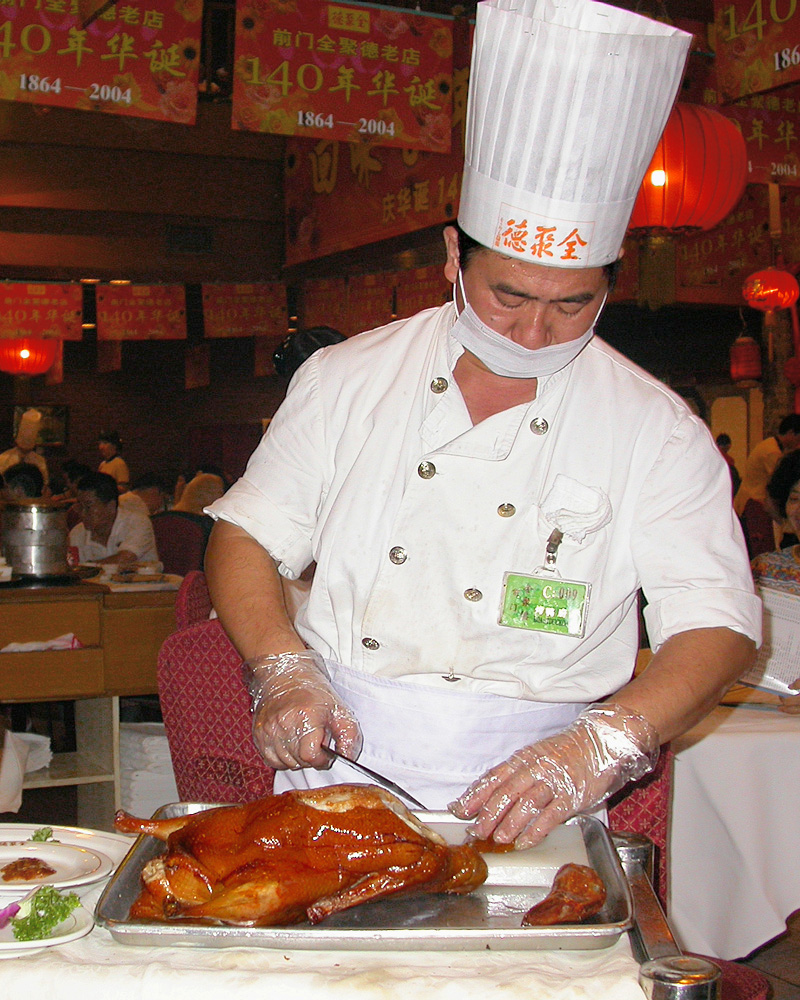
Quanjude (全聚德), founded in 1864 by a former chicken farmer named Yang Quanren, is the younger rival but the more famous institution. Yang's innovation was the adoption and perfection of the open-flame guàlú method, which produced a duck of unprecedented crispness and visual drama. The restaurant's location on Qianmen Street, near the southern gate of the Forbidden City, positioned it perfectly to serve the capital's officials, merchants, and visiting dignitaries. By the late Qing dynasty, Quanjude had become the definitive Peking duck restaurant, and its reputation only grew during the twentieth century. After the founding of the People's Republic in 1949, Quanjude was designated as the restaurant of state, responsible for preparing Peking duck for visiting heads of state. Premier Zhou Enlai personally served Peking duck from Quanjude to Henry Kissinger during the secret negotiations that preceded Nixon's historic visit to China in 1972 — a diplomatic meal that helped reshape the global order.
The rivalry between Bianyifang and Quanjude — closed oven versus open flame, subtlety versus drama, Ming tradition versus Qing innovation — has been one of the great culinary debates of Beijing for over a century. Devotees of Bianyifang prize the gentler, smokier flavor of the mènlú duck and the almost philosophical restraint of a method that trusts residual heat to do its work. Admirers of Quanjude celebrate the spectacle of the open flame, the audible crack of the perfect skin, and the bold, direct flavor of fruitwood-roasted duck. In practice, both restaurants produce ducks of extraordinary quality, and the differences, while real, are more nuanced than partisans of either side often admit. What both institutions share is an unwavering commitment to the principle that Peking duck is not merely food but performance — a theatrical event that demands the full participation of chef, server, and diner in a ritual that has been refined over six centuries of continuous practice.
"In food, never tire of refinement; in carving, never tire of precision."
Confucius, Analects (论语), 10.8The Ritual of Carving
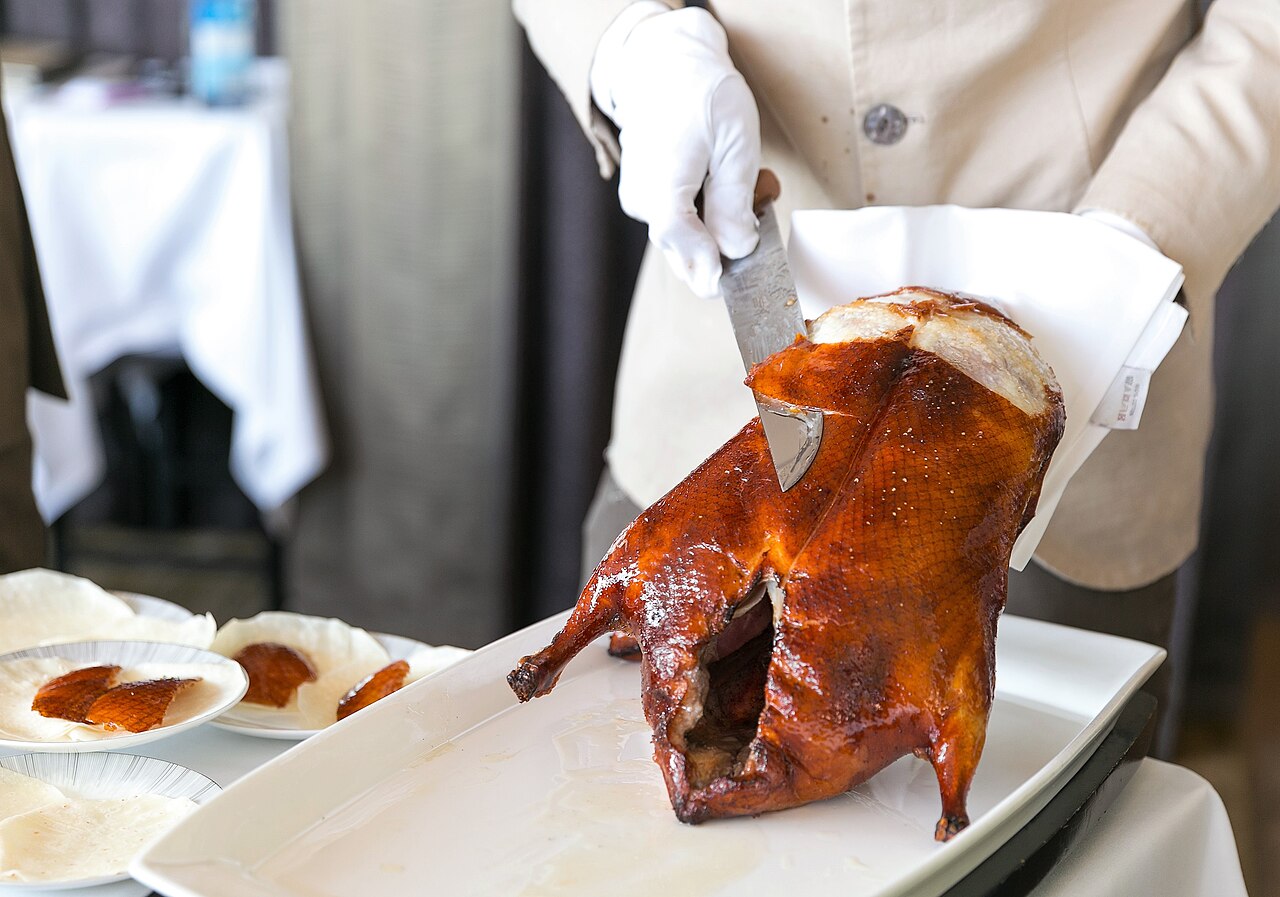
The carving of Peking duck is one of the great culinary performances in world gastronomy — a tableside ritual that transforms a whole roasted bird into precisely arranged slices with the speed and precision of a surgical operation. A master carver at a restaurant like Quanjude or Da Dong (大董) is expected to produce exactly 108 slices from a single duck, each slice containing a perfect balance of crisp skin, rendered fat, and tender meat. The number 108 is significant in Chinese culture — it represents the 108 beads of a Buddhist mala and carries connotations of completeness and perfection. While the exact count varies between restaurants and carvers, the principle is universal: every slice must be thin enough to be translucent at its edges, and the ratio of skin to meat must be precisely calibrated so that each piece delivers the full spectrum of Peking duck's flavors and textures.
The carving proceeds according to a specific choreography. The duck, fresh from the oven and still crackling with heat, is presented whole to the diners for admiration — this moment of display, when the lacquered bird gleams under the restaurant lights, is itself a ritualized act of aesthetic appreciation. The carver then begins at the breast, slicing long, thin pieces that peel away from the body in translucent sheets. The skin of the back and thighs is carved separately, and in the most traditional presentations, the first plate contains skin alone — paper-thin shards of pure crispness, served with white sugar for dipping, so that diners can appreciate the skin's extraordinary texture and sweetness in isolation. Subsequent plates combine skin and meat, and the remaining carcass is typically taken back to the kitchen to be used in a duck-bone soup that concludes the meal.
The condiments that accompany Peking duck are as carefully considered as the duck itself. The essential accompaniments are: thin wheat pancakes (薄饼, báobǐng) or lotus-leaf buns (荷叶饼, héyè bǐng), soft and slightly elastic, designed to wrap around the duck slices; sweet bean sauce (甜面酱, tiánmiànjiàng), a dark, fermented wheat paste that provides a savory-sweet counterpoint to the rich duck; and julienned scallions and cucumber, whose fresh crunch cuts through the fattiness of the meat. The assembly of the perfect bite — a pancake spread with sauce, topped with a slice of duck, a strip of scallion, and a sliver of cucumber, then rolled into a tight cylinder — is itself a participatory ritual that engages every diner at the table. As culinary journalist Jen Lin-Liu describes in Serve the People: A Stir-Fried Journey Through China (2008), the eating of Peking duck is not passive consumption but active construction — each diner is the final artist in a creative chain that stretches from the duck farm to the oven to the carving board to the pancake in one's own hands.
Peking Duck Worldwide
The international fame of Peking duck has made it arguably the single most recognizable dish in Chinese cuisine — a culinary ambassador that has introduced millions of non-Chinese diners to the sophistication and theatricality of Chinese gastronomy. The dish's global spread began in the mid-twentieth century, when Chinese restaurants in Western cities began offering "Peking duck" as a premium menu item. Early versions were often compromises — smaller ducks, oven-roasted rather than wood-fired, served without the tableside carving ritual — but they were sufficient to establish the dish's reputation as something extraordinary. By the 1970s, "Peking duck dinner" had become a byword for Chinese culinary luxury in cities from New York to London to Paris, a status it has never relinquished.
The dish's role in international diplomacy cemented its symbolic importance. Zhou Enlai's strategic use of Peking duck as a tool of statecraft during the Nixon era established a template that Chinese diplomats have followed ever since: when China wishes to honor a foreign guest, Peking duck is served. The "Peking duck diplomacy" of the 1970s paralleled and complemented the more famous "ping-pong diplomacy" of the same period, and the two together demonstrated that cultural exchange — whether through sport or food — could build bridges between nations that formal negotiations could not. In this sense, Peking duck transcended its identity as a dish and became a symbol of Chinese civilization's openness to the world: an invitation to sit, eat, and discover common ground across the widest cultural divides.
The twenty-first century has seen a remarkable renaissance in Peking duck culture, driven by a new generation of chefs who treat the dish as a canvas for innovation while respecting its classical foundations. Da Dong (大董), the Beijing restaurant founded by chef Dong Zhenxiang, has reimagined Peking duck for the contemporary era, developing a proprietary technique that produces an extraordinarily lean duck with skin of almost supernatural crispness. In London, the Michelin-starred restaurants of Chinatown and Mayfair serve Peking duck alongside wine pairings curated by sommeliers trained to match Burgundy with roast fowl. In Tokyo, Beijing-trained chefs operate high-end Peking duck restaurants that charge prices comparable to the finest sushi establishments. The globalization of Peking duck has not diluted the dish but enriched it, creating a worldwide conversation about technique, tradition, and the meaning of authenticity. The duck that began in the imperial kitchens of the Yuan dynasty has become, seven centuries later, a truly global creation — one of those rare dishes that belongs not to a single culture but to the world.
"Roast the lamb, slaughter the ox, and let us be merry — we must drink three hundred cups at a sitting."
Li Bai (李白), "Bring in the Wine" (将进酒)Quiz
What dynasty is credited with the origins of Peking duck?
What is the key characteristic of the Pekin duck breed mentioned in the article?
What innovation during the Ming dynasty contributed to the crispness of Peking duck?
Which restaurant is associated with the closed-oven roasting method?
What is the primary difference between the closed-oven and open-flame methods?
What is the significance of the number 108 in the context of Peking duck carving?
How did Peking duck play a role in international diplomacy?
What has been the impact of globalization on Peking duck?
Write your thoughts, then get feedback from Jason — you can turn any answer into a full discussion.
9. How does the preparation and presentation of Peking duck reflect Chinese cultural values?
10. In what ways might Peking duck's role in international diplomacy influence perceptions of Chinese culture?
Frequently Asked Questions
Common questions about Peking Duck: A Dish Fit for Emperors
What makes Peking duck different from regular roast duck?
Peking duck undergoes a meticulous multi-day preparation process that includes inflating the skin away from the fat with air, coating it with a maltose glaze, and drying it for up to 48 hours before roasting in a specialized oven. This technique produces an extraordinarily thin, lacquered crispy skin that is the true star of the dish, unlike ordinary roast duck where the meat is the focus.
How do you eat Peking duck traditionally?
Peking duck is traditionally served in three courses: first the prized crispy skin dipped in sugar, then sliced meat wrapped in thin wheat pancakes with scallion, cucumber, and sweet bean sauce (甜面酱), and finally a soup made from the bones. A skilled carver will produce exactly 108 slices, each with a perfect balance of skin, fat, and meat.
Why was Peking duck considered an imperial dish?
Peking duck has been served to Chinese rulers since at least the Yuan dynasty (13th century), and it became a centerpiece of imperial court banquets during the Ming and Qing dynasties. The dish's elaborate preparation requirements and the expense of maintaining specialized ovens and trained carvers made it a symbol of imperial luxury and culinary refinement.
Where did Peking duck originally come from?
Despite its name, Peking duck traces its origins to Nanjing, where roast duck was already a celebrated specialty during the Ming dynasty. When the Yongle Emperor moved the capital to Beijing in 1421, court chefs brought the dish north and refined it over centuries into the iconic preparation known today as Beijing kaoya (北京烤鸭).
What is the best restaurant for Peking duck in Beijing?
Quanjude (全聚德), founded in 1864, is the most historically famous Peking duck restaurant in Beijing and has served dignitaries including Henry Kissinger and Fidel Castro. Bianyifang (便宜坊), even older at over 600 years, uses a different closed-oven technique, and many locals prefer the more contemporary preparations at Da Dong or Siji Minfu.