
Podcast


Podcast: Chinese Silk Weaving: Threads of Empire
Listen to Jason & Amy discuss Chinese Silk Weaving: Threads of Empire
New here?
The Legend and Origins of Silk
Chinese tradition credits the discovery of silk to Lady Hsi-Ling-Shih, consort of the Yellow Emperor, around 2700 BCE. According to the legend, a silk cocoon fell into her tea, and as she lifted it out the filament unwound into a single luminous thread. Whether or not the story is literally true, it encodes a deeper truth: the Chinese understood sericulture — the cultivation of silkworms and the reeling of raw silk — as a civilizational achievement on par with the invention of writing. Archaeological evidence supports an extremely early date for silk production. Fragments of silk fabric discovered at Hemudu in Zhejiang Province have been dated to roughly 3000 BCE, and traces of silk protein on bronze artifacts from Shang dynasty tombs suggest that fine silk textiles were already associated with ritual and elite display by the second millennium BCE (Kuhn, 1988, p. 32).
The silkworm Bombyx mori is entirely domesticated; it cannot survive in the wild. This biological dependency made sericulture a carefully managed state enterprise from very early on. Neolithic communities in the Yangzi Delta region appear to have developed the full production chain — mulberry cultivation, larval rearing, cocoon harvesting, filament reeling, and loom weaving — as an integrated agricultural-industrial system. The Shijing (Book of Songs), compiled in the early Zhou period, contains numerous poems describing the annual cycle of silkworm tending, primarily performed by women. These verses confirm that silk production was deeply woven into the seasonal rhythms of Chinese agrarian life and that its oversight was considered a mark of virtuous household management (Bray, 1997, p. 206).
What set Chinese silk apart from other ancient textiles was the extraordinary fineness of the Bombyx mori filament — roughly ten to fifteen micrometers in diameter, far thinner than a human hair. This permitted weaving of astonishing density and translucency. The earliest silk fabrics discovered in archaeological contexts already show a sophistication of weave structure that implies centuries of prior experimentation. Plain weave, twill, and gauze structures all appear in pre-Han tombs, suggesting that the loom technology necessary for complex patterning was well established long before the imperial age. Sericulture was not merely an industry; it was a cultural system that organized labor, gender roles, ritual calendars, and eventually international diplomacy around a single miraculous fiber.
"Not a single thread out of place — to be meticulous in every detail."
Chinese proverbGuarded Secrets and the Silk Road
For over two thousand years, China maintained an effective monopoly on silk production. The export of silkworm eggs or mulberry seeds was punishable by death under successive dynasties. This enforcement transformed silk from a luxury textile into a strategic commodity. The Roman Empire's appetite for Chinese silk was so vast that Pliny the Elder lamented the outflow of gold to the East, estimating that Rome spent 100 million sesterces annually on silk imports (Pliny, Naturalis Historia, XII.84). Roman consumers knew the fabric intimately but had no idea how it was produced; some believed silk grew on trees. The secrecy was only broken, according to Procopius, when two Nestorian monks smuggled silkworm eggs to the Byzantine court in hollow bamboo canes around 552 CE (Liu, 2010, p. 74).
The network of overland and maritime routes that carried silk westward — collectively called the Silk Road since Ferdinand von Richthofen coined the term in 1877 — became the most consequential trade corridor in premodern history. Silk functioned as currency along these routes: bolts of standardized silk served as units of exchange, tax payments, and diplomatic gifts. The Tang dynasty government maintained enormous silk reserves and used them to pay military garrisons along the frontier. According to Xinru Liu, silk was "the universal currency of the Eurasian continent" for nearly a millennium, and its role in stimulating cross-cultural exchange in religion, art, music, and technology cannot be overstated (Liu, 2010, p. 112). Buddhist sutras, Zoroastrian motifs, and Hellenistic grape-vine patterns all traveled eastward along the same routes that carried silk westward.
The maritime silk trade eventually rivaled and then surpassed the overland routes. By the Song dynasty, Chinese silk was reaching Southeast Asia, India, the Arabian Peninsula, and East Africa by sea. Port cities like Quanzhou became cosmopolitan trading hubs where Muslim, Hindu, and Christian merchants maintained permanent communities. The sheer volume of Song-era maritime silk exports is attested by shipwreck discoveries such as the Nanhai One, which carried tens of thousands of silk and porcelain items when it sank in the South China Sea around 1180 CE. Silk was no longer merely a Chinese luxury; it was a global commodity that had fundamentally reshaped patterns of exchange, diplomacy, and cultural contact across the entire Eastern Hemisphere.
Han Dynasty Gauze and Technical Mastery
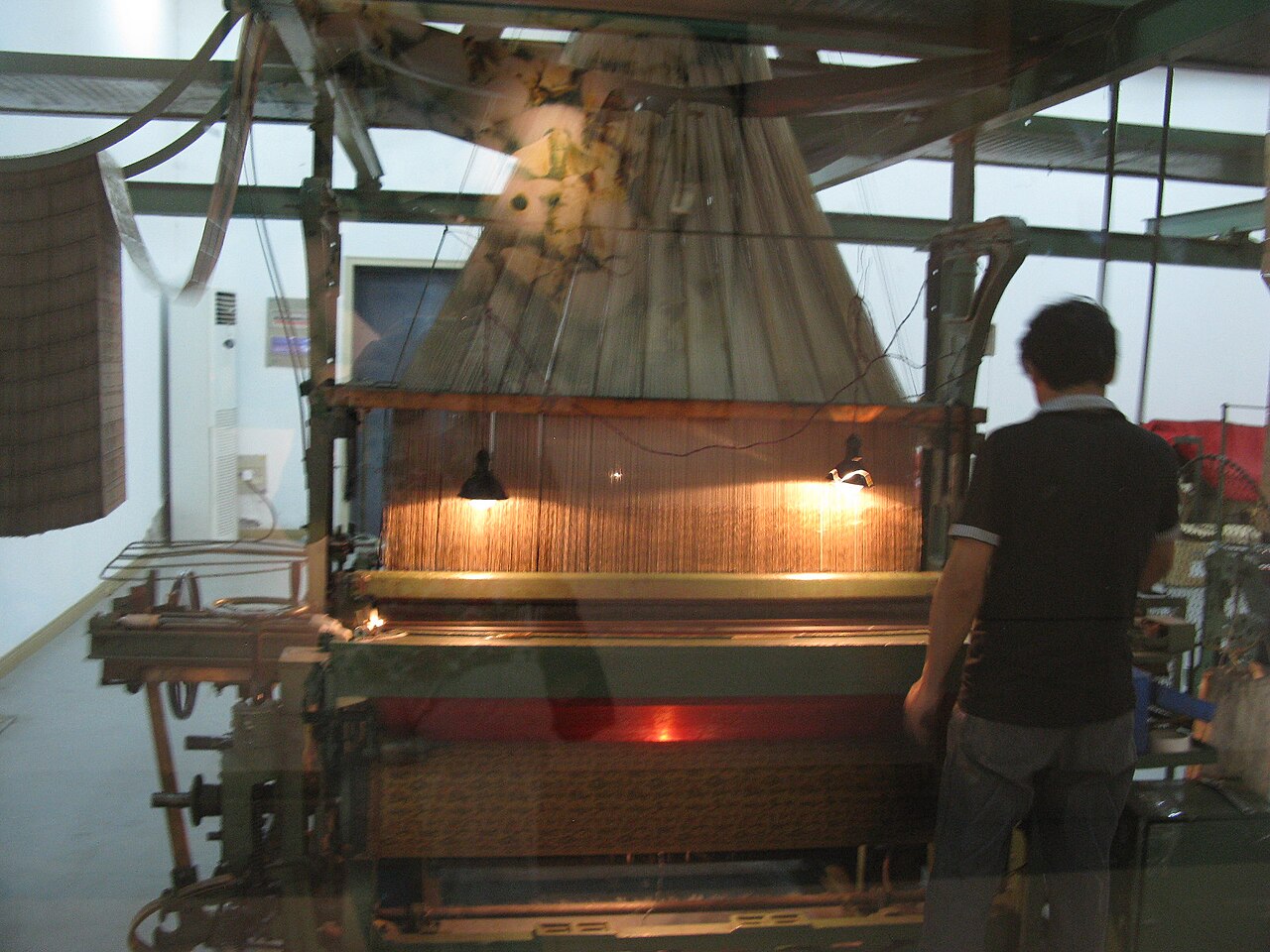
The tomb of Lady Dai at Mawangdui, sealed in 168 BCE and excavated in 1972, yielded what may be the most astonishing textile find in archaeological history: a silk gauze gown weighing just 49 grams — less than an ounce — yet measuring 128 centimeters in length with full-length sleeves. The fabric, known as susha (plain gauze), is so fine that it can be folded to fit inside a matchbox. This single garment demonstrated a level of weaving technology that modern textile engineers initially struggled to replicate. According to Dieter Kuhn, the Mawangdui gauze represents "the zenith of ancient weaving skill" and required a loom capable of controlling hundreds of individual warp threads with extraordinary precision (Kuhn, 1988, p. 156).
Han dynasty weavers produced an impressive range of silk types. In addition to plain gauze, they mastered jin (polychrome warp-faced compound tabby), qi (damask with geometric patterns), and luo (open-work gauze with twisted warps). The famous jin silks found at Niya on the southern Silk Road feature woven Chinese characters reading "Five Stars Rise in the East to Benefit the State of China" — a propagandistic slogan integrated directly into the textile structure. These technically demanding fabrics required draw looms with pattern-control mechanisms, and the Han period saw the development of the multi-shaft treadle loom that would become the foundation of Chinese weaving technology for the next fifteen centuries (Zhao, 1999, p. 89).
State-run silk workshops employed thousands of weavers and were major economic institutions. The Shang Fang Si (Imperial Workshop Office) in the Western Han capital of Chang'an reportedly employed over four thousand craftspeople. Government quality inspectors stamped bolts of official silk with seals verifying their provenance and grade. This bureaucratic apparatus reflects the degree to which silk production was integrated into the imperial fiscal system. Taxes could be paid in silk, officials received silk as salary, and foreign envoys departed with cartloads of silk as diplomatic gifts. The Han dynasty effectively ran a silk-backed economy, and the technical brilliance of its textiles was inseparable from the political and administrative machinery that sustained it.
"Silkworms spin silk, bees make honey. A person who does not study is inferior to these creatures."
San Zi Jing (Three Character Classic)Song Dynasty Brocade and Kesi Tapestry
The Song dynasty (960–1279) represented a golden age of Chinese silk weaving, driven by urban commercial demand, court patronage, and the refinement of the drawloom. Song brocades (yunjin, meaning "cloud brocade") reached an unprecedented level of chromatic complexity, incorporating dozens of colors in a single panel. The imperial Silk Bureau in Hangzhou employed specialized weavers who worked from painted cartoons provided by court artists, translating brushwork landscapes and flower compositions into thread with remarkable fidelity. According to James Watt, Song-era brocades "transformed the loom into a paintbrush" and challenged the traditional hierarchy that placed painting above the decorative arts (Watt, 2004, p. 78).
The most technically demanding Song textile form was kesi (literally "carved silk"), a tapestry-weave technique in which small bobbins of colored weft are individually passed through the warp, creating images of photographic clarity without any visible structural grid. Unlike brocade, where the pattern is determined by the loom's mechanical setup, kesi required the weaver to work freehand, building the image passage by passage like a painter working across a canvas. A single large kesi panel could take years to complete. The finest surviving examples reproduce Song landscape paintings and calligraphy with such precision that viewers must examine them closely to confirm they are woven rather than painted. Emperor Huizong, himself a painter of extraordinary skill, was a passionate collector of kesi and maintained a dedicated atelier of tapestry weavers within the palace (Kuhn, 1995, p. 214).
Song commercial silk production was equally impressive in scale. The city of Chengdu in Sichuan was famous for shu brocade, characterized by bold geometric patterns and saturated colors. Suzhou emerged as the center of refined embroidery, while Hangzhou specialized in lightweight gauzes and damasks suited to the warm southern climate. Marco Polo, visiting Hangzhou in the late thirteenth century under Mongol rule, marveled at the "incredible quantity of silk" produced in the city and noted that its citizens wore silk garments daily — an observation confirmed by contemporaneous Chinese sources. The Song silk industry was arguably the most sophisticated manufacturing sector in the medieval world, producing for a domestic market of unprecedented size and affluence while simultaneously exporting vast quantities along maritime trade routes.
Suzhou Embroidery: Painting with Thread
Suzhou embroidery (su xiu) stands alongside Hunan embroidery (xiang xiu), Guangdong embroidery (yue xiu), and Sichuan embroidery (shu xiu) as one of China's Four Great Embroidery Traditions, but it has historically been regarded as the most refined. The tradition reaches back at least to the Three Kingdoms period, but it was during the Ming and Qing dynasties that Suzhou embroiderers achieved fame for works of painterly subtlety. The key innovation was the use of split silk thread: a single filament could be divided into as many as forty-eight strands, each finer than a spider's silk, allowing the embroiderer to blend colors with the seamless gradation of a watercolor wash. According to Shelagh Vainker, this technique "dissolved the boundary between embroidery and painting" and created a form that Chinese connoisseurs ranked alongside brush painting in aesthetic value (Vainker, 2004, p. 152).
The most celebrated Suzhou embroidery works of the late imperial period reproduced famous paintings by Song and Ming masters. Shen Shou (1874–1921), widely regarded as the greatest embroiderer in Chinese history, developed the "simulated realism embroidery" (fangzhen xiu) technique that incorporated Western shading principles into traditional Chinese needlework. Her portrait of the Italian queen, presented at the 1911 Turin International Exhibition, caused a sensation in Europe and earned a first-place award. Shen Shou's innovation demonstrated that Chinese textile art could absorb foreign influences while retaining its essential character — a negotiation between tradition and modernity that would define much of twentieth-century Chinese art. She later established an embroidery school in Nantong, codifying her methods in the influential treatise Xuehuan Xiupu (Vainker, 2004, p. 168).
Today, Suzhou embroidery continues as both a living craft and a luxury art form. The Suzhou Embroidery Research Institute maintains the tradition of painting-reproduction embroidery, with some works requiring five or more years of labor by a single master embroiderer. Double-sided embroidery (shuangmian xiu), in which a different image appears on each face of the fabric, represents the pinnacle of technical virtuosity — the embroiderer must plan every stitch to contribute to two independent compositions simultaneously. A masterwork of double-sided embroidery featuring a cat on one side and a goldfish on the other has become an iconic symbol of the tradition's astonishing precision. UNESCO recognized Chinese silk weaving and embroidery traditions on the Representative List of the Intangible Cultural Heritage of Humanity in 2009, acknowledging a tradition that has endured for five millennia.
"To add flowers to brocade — to make something beautiful even more beautiful."
Chinese proverbSilk in Ritual and Court Dress
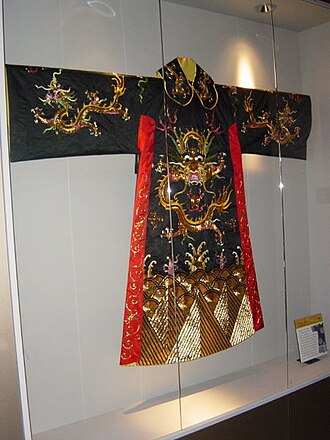
Silk was never merely a fabric in Chinese civilization; it was a medium of political and cosmological communication. From the Zhou dynasty onward, sumptuary laws dictated which colors, patterns, and weave structures could be worn by each rank of society. The emperor alone could wear robes of bright yellow silk; the five-clawed dragon (long) was reserved exclusively for the sovereign, while princes of the first rank wore four-clawed dragons (mang). These regulations, elaborated in extraordinary detail across successive dynasties, transformed every court garment into a legible statement of political hierarchy. According to John Vollmer, Chinese court dress constituted "the most complex and longest-enduring system of vestimentary regulation in human history" (Vollmer, 2002, p. 14).
The dragon robe (longpao) of the Qing dynasty represents the culmination of this tradition. A single imperial dragon robe could incorporate twelve traditional symbols of sovereignty — the sun, moon, stars, mountains, dragons, pheasants, bronze cups, water plants, grain, fire, the fu symbol, and the fu symbol of discrimination — each positioned according to cosmological principles. The robe's surface was divided into three realms: the hem represented the terrestrial ocean, the middle section the earthly realm, and the shoulders the celestial sphere. Dragons moved between these realms, symbolizing the emperor's role as mediator between heaven and earth. The production of a single dragon robe required the coordinated labor of dozens of specialized artisans — silk dyers, gold-thread makers, embroiderers, and tailors — and could take up to two years to complete (Garrett, 2007, p. 56).
Beyond court dress, silk played essential roles in Chinese ritual life. Ancestral tablets were wrapped in silk, Buddhist sutras were copied on silk scrolls, and imperial edicts were issued on silk documents stamped with vermilion seals. Bolts of silk were standard offerings at temples and ancestral shrines. In the marriage ceremony, red silk threads symbolized the binding of two destinies, and the bride's sedan chair was draped in embroidered silk panels depicting auspicious symbols. Even in death, silk maintained its ritual significance: Han dynasty jade burial suits were sewn together with gold or silver silk thread, and silk banners depicting the journey of the soul were draped over the coffin. From cradle to grave, silk accompanied the Chinese through the most significant passages of life, making it arguably the single most culturally significant material in Chinese history.
Quiz
Who is credited with the discovery of silk in Chinese tradition?
What was unique about the Bombyx mori filament?
What was the significance of the Silk Road in relation to Chinese silk?
What innovation did Shen Shou bring to Suzhou embroidery?
What role did silk play in the Han dynasty economy?
How did the Song dynasty brocades challenge traditional art hierarchies?
What was the penalty for exporting silkworm eggs under successive Chinese dynasties?
What does the existence of the dragon robe symbolize in Chinese culture?
Write your thoughts, then get feedback from Jason — you can turn any answer into a full discussion.
9. Why do you think silk was considered a 'strategic commodity' in ancient China?
10. How might the integration of silk into various aspects of life reflect the cultural values of ancient China?
Frequently Asked Questions
Common questions about Chinese Silk Weaving: Threads of Empire
How did China discover silk and keep it secret?
According to legend, Empress Leizu discovered silk around 2700 BCE when a cocoon fell into her tea and unraveled into a long, lustrous thread. China guarded the secret of sericulture for roughly 3,000 years under penalty of death, and it was only through smuggling — possibly by monks hiding silkworm eggs in hollow bamboo staffs — that the knowledge eventually reached the Byzantine Empire and beyond.
Why was the Silk Road named after Chinese silk?
The German geographer Ferdinand von Richthofen coined the term "Silk Road" in 1877 because Chinese silk was the single most valuable and iconic commodity traded along these transcontinental routes. Silk was so prized in Rome that it was literally worth its weight in gold, and it served not only as a luxury textile but as a form of currency and diplomatic gift across Eurasia.
What is the process of making Chinese silk fabric?
Silk production begins with raising silkworms on fresh mulberry leaves until they spin cocoons of a single continuous filament up to 900 meters long. The cocoons are softened in hot water, the filaments are carefully unwound and twisted together into raw silk thread, which is then dyed and woven on looms into fabric — a process that has remained fundamentally unchanged for thousands of years.
What are the different types of Chinese silk weaving?
China developed numerous silk weaving techniques, including plain weave (juan), twill (ling), damask (qi), satin (duan), and the extraordinarily complex kesi tapestry weave that could reproduce paintings in thread. The most technically demanding was cloud brocade (yunjin) from Nanjing, which required two weavers working simultaneously on a massive loom to produce just a few centimeters per day.
What did dragon robes symbolize in imperial China?
Dragon robes (longpao) were strictly regulated court garments where every detail — the number of dragon claws, the placement of clouds and waves, and the color of the silk — indicated the wearer's rank in the imperial hierarchy. Only the emperor could wear a robe with five-clawed dragons in bright yellow, and unauthorized use of imperial symbols was a crime punishable by death.