
Podcast


Podcast: Dunhuang Cave Murals: Buddhist Art on the Silk Road
Listen to Jason & Amy discuss Dunhuang Cave Murals: Buddhist Art on the Silk Road
New here?
The Mogao Caves: A Thousand Years of Devotion
The Mogao Caves, carved into the sandstone cliffs of Mingsha Mountain near the oasis town of Dunhuang in northwestern Gansu province, constitute one of the most extraordinary artistic and religious sites in the world. According to tradition, the first cave was excavated in 366 CE by a wandering monk named Le Zun, who, arriving at the cliff face at sunset, saw a vision of a thousand golden Buddhas shimmering in the light. Inspired by this apparition, he carved the first meditation cave, beginning a tradition of cave construction and decoration that would continue for over a millennium, through the Northern Wei, Sui, Tang, Five Dynasties, Song, and Yuan periods. At its peak, the site contained over a thousand caves; today, 492 survive with their wall paintings and sculptures intact, containing approximately 45,000 square meters of murals and more than 2,000 painted clay sculptures — making Mogao the single largest repository of Buddhist art in existence (Whitfield, 1999, pp. 12–25).
The caves' location at the crucial junction where the northern and southern Silk Road routes converged explains both their creation and their astonishing cultural richness. Dunhuang was a hub of international commerce, a place where Chinese, Central Asian, Indian, Tibetan, and eventually Mongol cultures met, mingled, and exchanged ideas. Merchants setting out across the Taklamakan Desert, one of the most perilous stretches of the Silk Road, would commission the painting or enlargement of caves as acts of pious merit, praying for safe passage and commercial success. Returning travelers would commission further caves in gratitude for their survival. Over centuries, this accumulation of individual acts of devotion produced a collective masterpiece of unparalleled scope, each cave a time capsule preserving the artistic styles, religious beliefs, and social conditions of its moment of creation. As Roderick Whitfield has observed, walking through the Mogao Caves is like walking through a living textbook of Chinese art history, with each century represented by works of the highest quality (Whitfield & Farrer, 1990, p. 38).
The physical conditions of the Dunhuang site, paradoxically, have been both the greatest threat to and the greatest protector of the cave paintings. The extreme aridity of the Gobi Desert environment has preserved the mineral pigments of the murals in extraordinary condition, their colors remaining vivid after more than a millennium. At the same time, sandstorms, earthquakes, water infiltration, and the slow flaking of the sandstone cliff face have caused continuous, irreversible damage. Human activity has compounded these natural threats: centuries of candle smoke from devotional practices darkened many surfaces, and the twentieth century brought a new wave of damage from tourism, humidity generated by visitors' breath, and the well-intentioned but sometimes clumsy restoration efforts of earlier decades. Today, the Dunhuang Academy, established in 1944 and one of China's most important cultural preservation institutions, oversees a comprehensive conservation program that combines traditional techniques with cutting-edge digital technology, including the systematic digital photography of every cave to create a permanent record of this irreplaceable heritage (Agnew, 2010, pp. 23–45).
"Dunhuang means "grand and magnificent"; huang means "brilliant and glorious.""
Donghan Yingshao, Fengsu Tongyi (Comprehensive Meaning of Customs)Flying Apsaras and Celestial Beings
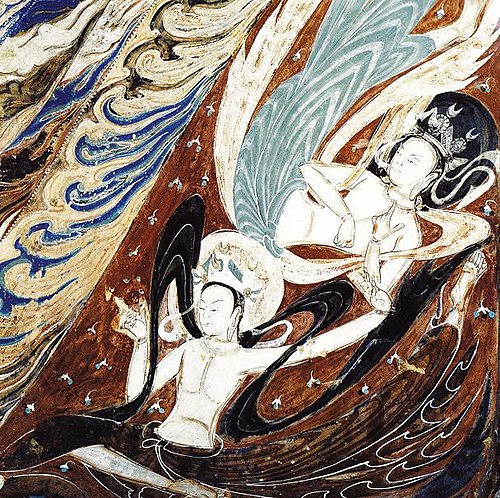
Among the most iconic and beloved images at Dunhuang are the flying apsaras (feitian) — celestial beings who soar through the painted heavens of the cave ceilings, scattering flowers, playing musical instruments, and trailing long ribbons of silk behind them in elegant, gravity-defying arcs. The feitian motif, which combines elements from Indian, Central Asian, and Chinese artistic traditions, appears in virtually every period of Dunhuang's history, making it possible to trace the evolution of Chinese pictorial style across a thousand years through this single image type. The earliest feitian, from the Northern Wei period (386–534 CE), show strong Central Asian and Gandharan influence: their bodies are heavy and muscular, their poses angular, their garments clinging to reveal the form beneath. Over time, the figure becomes progressively lighter, more elongated, and more linear, until the Tang dynasty feitian achieve a quintessentially Chinese elegance — long, flowing figures whose bodies seem to dissolve into pure movement, their garments and ribbons generating complex calligraphic rhythms across the picture surface (Duan, 1994, pp. 78–96).
The artistic achievement of the feitian lies in the painters' ability to convey a convincing sense of flight without recourse to the Western techniques of perspective and foreshortening. Instead, the Dunhuang artists relied on flowing lines, fluttering drapery, and the dynamic positioning of limbs to create an impression of weightless movement through space. The trailing scarves and ribbons that accompany each flying figure serve a crucial compositional function, creating visual vectors that guide the eye across the cave ceiling and link individual figures into larger choreographic patterns. In the most accomplished examples, the feitian seem to dance in three-dimensional space despite the inherently flat surface of the wall painting — a tour de force of linear draftsmanship that rivals the finest achievements of any pictorial tradition in the world. The Tang dynasty caves at Mogao, particularly Caves 320 and 321, contain feitian of such breathtaking grace that they have become symbols of Dunhuang itself, reproduced endlessly in books, stamps, and tourist merchandise, yet never losing their power to astonish when encountered in their original context (Whitfield, 1999, pp. 156–172).
The feitian also illuminate the process of cultural synthesis that makes Dunhuang such a remarkable historical document. The concept of celestial musicians and flower-scattering beings derives from Indian Buddhist cosmology, where apsaras and gandharvas inhabit the heavens of various Buddha-fields. As this concept traveled along the Silk Road, it absorbed artistic influences from Persia, Sogdiana, and the oasis kingdoms of the Tarim Basin before reaching China, where it merged with indigenous traditions of celestial beings — the Daoist immortals (xian) who ride on clouds and winds. The Dunhuang feitian thus embody, in a single image, the entire cultural geography of the Silk Road, carrying within their flowing forms the traces of every civilization they passed through on their journey from the Ganges to the Yellow River. No other motif so perfectly encapsulates the cross-cultural creativity that defines Dunhuang as a world heritage site (Zhao, 2008, pp. 112–134).
Jataka Tales Painted on Cave Walls
Among the richest narrative cycles at Dunhuang are the Jataka tales — stories of the Buddha's previous lives, in which he appears as a prince, a merchant, a deer, a monkey, or countless other beings, in each incarnation performing acts of extraordinary virtue that advance him toward eventual enlightenment. These stories, originating in Indian Buddhist literature and transmitted to China through Central Asian translations, provided Dunhuang artists with an inexhaustible repertoire of dramatic subjects: tales of sacrifice, compassion, wisdom, and spiritual transformation that were simultaneously entertaining narratives and profound moral teachings. The visual rendering of these stories at Dunhuang represents one of the great achievements of Chinese narrative painting, deploying sophisticated compositional strategies to compress extended literary narratives into the fixed space of a cave wall (Ning, 2004, pp. 56–78).
The Jataka paintings at Dunhuang employ several distinct narrative modes that evolved over the centuries. In the earliest caves, a continuous narrative format prevails, in which successive episodes of a story are presented within a single, unframed composition, with the same character appearing multiple times in different parts of the picture — a technique that requires the viewer to "read" the painting by following the protagonist through a sequence of scenes. Later periods developed more structured formats, including the "comic strip" approach of sequential panels and the centrally focused compositions of the Tang dynasty, in which the climactic moment of the story occupies the center of the wall while subsidiary episodes radiate outward in smaller vignettes. One of the most celebrated examples is the Deer King Jataka in Cave 257 (Northern Wei period), which tells the story of a beautiful nine-colored deer who saves a drowning man, only to be betrayed by the ungrateful wretch to a king who covets the deer's magical pelt. The painting's vivid colors, expressive figures, and dramatic pacing make it one of the masterpieces of early Chinese narrative art (Fraser, 2004, pp. 89–112).
Beyond their artistic merit, the Jataka paintings at Dunhuang served a vital didactic function, communicating Buddhist moral teachings to a population that was largely illiterate. The paintings transformed the cave walls into visual sermons, making abstract philosophical concepts — karma, compassion, the interconnectedness of all beings — accessible through vivid, emotionally engaging stories. Monks and guides would have led visitors through the caves, using the paintings as aids to explain Buddhist doctrine and inspire devotional feeling. This pedagogical function helps explain the remarkable detail and clarity of the Dunhuang narratives: they needed to be legible, emotionally compelling, and doctrinally accurate, a combination of requirements that pushed Dunhuang artists to develop visual storytelling techniques of extraordinary sophistication. The Jataka cycles at Dunhuang thus represent not only great art but great communication — a demonstration that the most complex spiritual ideas can be made vivid and accessible through the power of the visual image (Whitfield & Farrer, 1990, pp. 89–105).
"Form is emptiness; emptiness is form."
Heart Sutra (Xinjing)The Library Cave: Cave 17 and Its Treasures
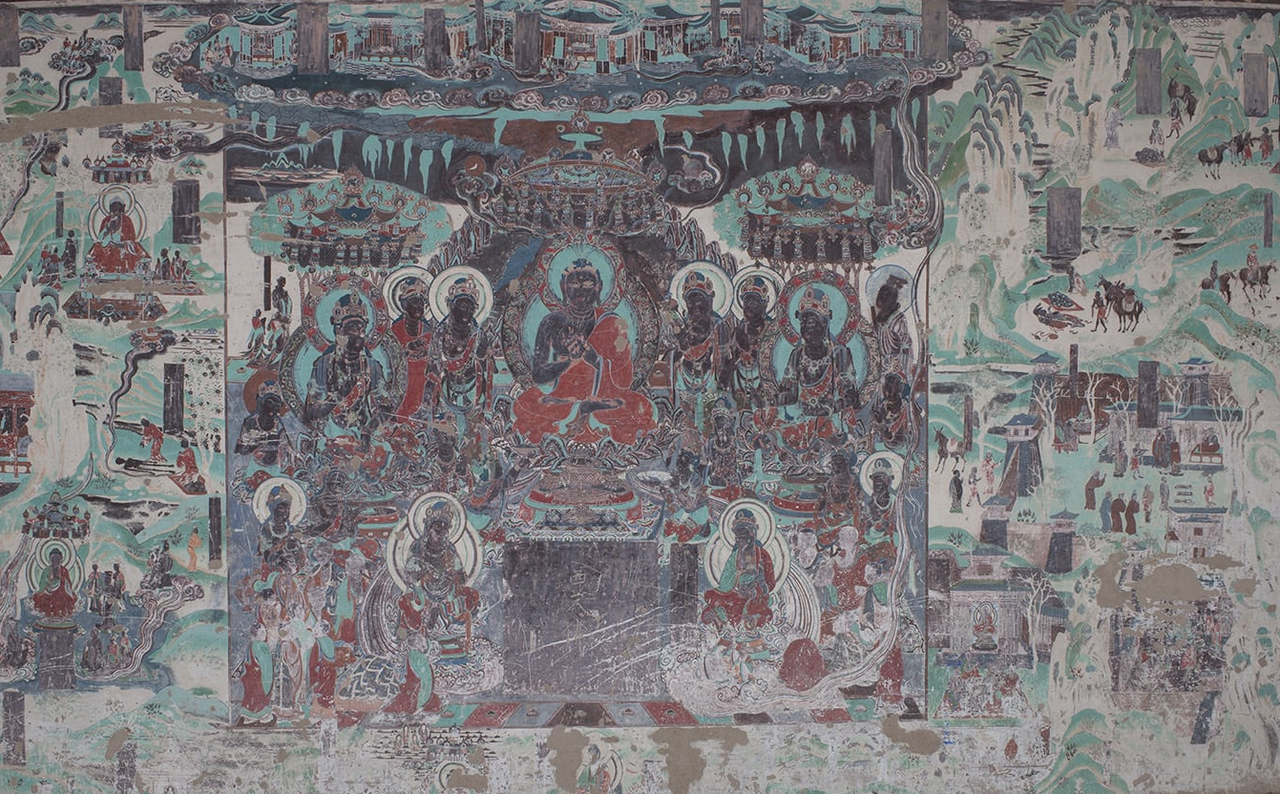
In 1900, a Daoist priest named Wang Yuanlu, who had appointed himself caretaker of the largely abandoned Mogao Caves, made one of the most significant archaeological discoveries of the twentieth century. While clearing sand from the entrance to Cave 16, he noticed a crack in the wall that revealed a sealed chamber behind — Cave 17, a small room roughly nine feet square, which had been walled up sometime in the early eleventh century and subsequently forgotten. Inside, stacked from floor to ceiling, were approximately fifty thousand manuscripts, printed documents, paintings on silk and paper, and embroidered textiles dating from the fifth to the eleventh centuries. This extraordinary cache, now known as the Library Cave, constitutes the largest single deposit of medieval documents ever discovered, a time capsule of incalculable value for the study of Chinese, Central Asian, Tibetan, and Buddhist history (Rong, 2000, pp. 34–56).
The contents of the Library Cave span an almost unbelievable range of subjects and languages. The majority of the manuscripts are Buddhist sutras in Chinese, but the collection also includes texts in Tibetan, Sanskrit, Khotanese, Sogdian, Uyghur, Hebrew, and other languages, reflecting the multilingual, multicultural character of Silk Road Dunhuang. Beyond religious texts, the cave contained administrative documents, contracts, letters, medical treatises, astronomical charts, musical scores, and literary works — including the earliest known printed book in the world, a copy of the Diamond Sutra dated 868 CE, printed using woodblock technology seven centuries before Gutenberg. The paintings and textiles found in the cave are equally remarkable, including some of the finest surviving examples of Tang dynasty painting on silk, such as the luminous image of Guanyin (Avalokiteshvara) leading a soul to the Western Paradise. Every object in the Library Cave is a primary source of the highest importance, offering direct, unmediated access to the material and intellectual culture of medieval Central Asia (Stein, 1921, pp. 789–834).
The question of why the Library Cave was sealed remains a subject of scholarly debate. One theory holds that the manuscripts were damaged or outdated materials retired from active use in a kind of "sacred waste" deposit — Buddhist practice prohibits the destruction of scripture, so worn-out texts were sometimes reverently stored rather than discarded. Another theory suggests that the cave was sealed in response to a specific historical threat, perhaps the Tangut invasion of the region in the early eleventh century, with the intention of protecting the collection until the danger had passed. Whatever the reason, the sealing of Cave 17 preserved a cross-section of medieval Eurasian civilization in conditions that could not be replicated by any deliberate archival program. The dry desert climate kept the manuscripts in remarkable condition, their ink still black, their pigments still vivid, their paper and silk still supple after nearly a millennium of entombment in darkness (Whitfield, 1999, pp. 278–302).
Stein, Pelliot, and the Great Dispersal
The rediscovery of the Library Cave in 1900 set in motion one of the most controversial episodes in the history of archaeology and cultural heritage. The first foreign scholar to reach Dunhuang was the Hungarian-born British archaeologist Aurel Stein, who arrived in 1907 and, through a combination of persistence, flattery, and modest payments to the custodian Wang Yuanlu, persuaded the priest to allow him to examine and eventually remove thousands of manuscripts and paintings. Stein transported twenty-nine crates of material to the British Museum and the India Office Library, where they remain today as the Stein Collection — one of the most important research resources for the study of Central Asian history and Buddhist art. The following year, the French sinologist Paul Pelliot arrived at Dunhuang and, drawing on his exceptional linguistic abilities, spent three weeks inside the Library Cave systematically selecting the most important manuscripts for removal to France. Pelliot's selection, now housed at the Bibliothèque nationale de France, is considered the finest single portion of the Library Cave collection (Hopkirk, 1980, pp. 156–189).
Subsequent expeditions by Japanese, Russian, and American scholars further diminished the collection, and by the time the Chinese government finally intervened to secure the remaining manuscripts in 1910, a substantial portion of the Library Cave's contents had been dispersed to institutions around the world. In China, the removal of the Dunhuang manuscripts has long been viewed as an act of cultural imperialism, a symptom of the same national weakness that permitted the looting of the Old Summer Palace and the imposition of the unequal treaties. Stein and Pelliot are routinely described in Chinese popular accounts as thieves and plunderers, and the dispersal of the Dunhuang collection remains a potent symbol of China's "century of humiliation." Western scholars, while acknowledging the ethical complexity of the situation, have sometimes argued that the removed manuscripts received better conservation and scholarly attention abroad than they would have received in the chaotic conditions of early twentieth-century China — an argument that Chinese scholars understandably reject as self-serving rationalization (Rong, 2000, pp. 123–156).
The International Dunhuang Project (IDP), launched in 1994 and headquartered at the British Library, represents a significant attempt to address the legacy of the dispersal through digital reunification. The IDP is systematically digitizing Dunhuang manuscripts held in collections worldwide and making them freely available online, creating a virtual reconstruction of the Library Cave that allows scholars and the general public to access these materials regardless of their physical location. As of the 2020s, the IDP database contains high-resolution images of over one hundred thousand items, constituting the most comprehensive online resource for Dunhuang studies in the world. While digital reunification cannot resolve the political and ethical questions surrounding the original dispersal, it has democratized access to the collection in ways that would have been unimaginable to either Stein or Pelliot, transforming Dunhuang from a contested site of colonial archaeology into a shared resource for global scholarship (Whitfield, 2004, pp. 345–367).
Conservation and the Digital Future
The conservation of the Mogao Caves presents challenges of extraordinary complexity, requiring the integration of art history, materials science, climatology, engineering, and tourism management into a unified preservation strategy. The greatest threat to the caves today is not natural erosion or seismic activity but the pressure of mass tourism: the site receives over a million visitors annually, and the carbon dioxide, moisture, and body heat generated by large groups in confined spaces can accelerate the deterioration of the fragile mineral pigments. The Dunhuang Academy, in collaboration with the Getty Conservation Institute and other international partners, has developed a visitor management system that limits access to the most vulnerable caves, rotates which caves are open to the public, and maintains strict environmental controls including temperature and humidity monitoring. These measures have significantly slowed the rate of deterioration, but they cannot halt it entirely — a reality that has driven the development of what may be the caves' most important long-term preservation strategy: comprehensive digital documentation (Agnew, 2010, pp. 78–112).
The Dunhuang Academy's digital program, which has been underway since the 1990s, aims to create photographic records of every square centimeter of every decorated cave at the highest possible resolution. Using specialized cameras, controlled lighting, and sophisticated image-processing software, the digital team produces composite images of cave walls and ceilings that capture details invisible to the naked eye, including traces of underdrawings, later overpainting, and areas of incipient damage. These digital records serve multiple purposes: they provide a baseline against which future deterioration can be measured; they allow scholars to study the caves without physical access; and they form the basis for immersive virtual reality experiences that can bring the Mogao Caves to audiences around the world. The "Digital Dunhuang" project, launched as a public website, now offers free access to high-resolution panoramic views of dozens of caves, allowing anyone with an internet connection to explore these spaces with a level of detail and intimacy that exceeds what most physical visitors experience (Fan, 2015, pp. 56–78).
The digital preservation of Dunhuang raises profound questions about the nature of cultural heritage in the twenty-first century. If a perfect digital replica of a cave painting exists, does the original retain a unique, irreplaceable value, or can the copy serve as an adequate substitute? Most scholars and conservators would argue emphatically for the irreplaceability of the original — the material presence of a thousand-year-old painting, with its specific textures, its accumulated patina, its physical relationship to the cave architecture that surrounds it, possesses a quality of authenticity that no digital reproduction can capture. Yet the digital copies are not merely surrogates for the originals; they are new objects with their own affordances, enabling forms of study, comparison, and public engagement that the physical caves could never support. The future of Dunhuang, like the future of cultural heritage more broadly, lies not in choosing between physical and digital preservation but in recognizing that each mode captures essential aspects of these remarkable works that the other cannot. The monks who first painted these caves understood that art is not a fixed object but a living transmission — and in the digital age, the transmission continues in forms they could never have imagined but would surely have recognized as acts of devotion in their own right (Zhao, 2008, pp. 278–295).
"A thousand years of Mogao, a Dunhuang for all humanity."
Fan Jinshi, Director of the Dunhuang AcademyQuiz
What inspired the creation of the first cave at the Mogao Caves?
What has contributed to both the preservation and damage of the Mogao Cave murals?
Which motif at Dunhuang illustrates the cultural synthesis along the Silk Road?
What is the significance of the Jataka tales painted in the caves?
What was discovered in the Library Cave (Cave 17) at Dunhuang?
What factor has been identified as the greatest threat to the Mogao Caves today?
What does the International Dunhuang Project aim to achieve?
How do Dunhuang artists convey the sense of flight in the feitian motifs?
Write your thoughts, then get feedback from Jason — you can turn any answer into a full discussion.
9. Why do you think the Dunhuang murals continue to captivate people around the world today?
10. How might digital technology contribute to the preservation and appreciation of the Mogao Caves?
Frequently Asked Questions
Common questions about Dunhuang Cave Murals: Buddhist Art on the Silk Road
What are the Dunhuang Mogao Caves and why are they important?
The Mogao Caves are a complex of 492 Buddhist cave temples carved into a cliff face near Dunhuang in northwestern China, containing over 45,000 square meters of murals and 2,000 painted sculptures spanning a thousand years. They represent the single greatest repository of Buddhist art in the world and provide an unparalleled visual record of Chinese art, culture, and religious practice from the 4th to 14th centuries.
How were the Dunhuang cave murals painted?
Artists applied pigments made from minerals like malachite, azurite, and cinnabar onto walls coated with layers of clay, straw, and lime plaster. The work was done by teams of monks and professional painters who worked by oil lamp in the dark cave interiors, often spending years completing a single cave's decoration following detailed iconographic programs.
Who discovered the hidden library cave at Dunhuang?
In 1900, a Daoist monk named Wang Yuanlu discovered a sealed chamber (Cave 17) containing approximately 50,000 manuscripts, paintings, and textiles dating from the 5th to 11th centuries. This hidden library, sealed around 1002 CE, contained texts in Chinese, Tibetan, Sanskrit, and other languages that revolutionized the study of medieval Asian history and religion.
Can you visit the Dunhuang caves today?
Yes, the Mogao Caves are a UNESCO World Heritage Site open to visitors, though access is carefully managed to protect the fragile murals from humidity and carbon dioxide damage. Visitors can typically see around eight caves per visit on a guided tour, and a digital exhibition center provides immersive virtual experiences of caves not open to the public.
What is the connection between Dunhuang and the Silk Road?
Dunhuang sat at the critical junction where the Silk Road split into northern and southern routes around the Taklamakan Desert, making it a vital oasis for merchants, monks, and diplomats traveling between China and Central Asia. This strategic position brought diverse artistic influences — Indian, Persian, Greek, and Turkic — that merged with Chinese traditions in the cave murals, creating a unique cross-cultural artistic heritage.