
Podcast


Podcast: Chinese Lacquerware: Layers of Time
Listen to Jason & Amy discuss Chinese Lacquerware: Layers of Time
New here?
Neolithic Origins and the Lacquer Tree
The raw material of Chinese lacquer is the sap of the lacquer tree (Toxicodendron vernicifluum), a relative of poison ivy native to the humid river valleys of central and southern China. When exposed to air in conditions of high humidity, the sap polymerizes into an extraordinarily hard, glossy, and chemically resistant surface that is impervious to water, heat, and most acids. No other natural substance combines such durability with such visual elegance. The oldest known lacquered object in the world is a red lacquer-coated bow discovered at the Kuahuqiao site in Zhejiang Province, dated to approximately 6000 BCE. Lacquered pottery from the Hemudu culture (c. 5000 BCE) in the same region confirms that Neolithic communities had already mastered the basic techniques of lacquer harvesting and application (Watt, 1991, p. 16).
Lacquer harvesting is a demanding and hazardous process. The sap is collected by making shallow incisions in the bark of trees that are at least ten years old, during the humid summer months when flow is greatest. A single tree yields only about 50 grams of raw lacquer per season — barely enough to coat a small bowl. The sap is highly toxic to human skin, causing severe contact dermatitis in most people, and lacquer workers traditionally developed immunity through gradual, painful exposure. This biological reality meant that lacquer artisans formed a specialized caste, and the knowledge of harvesting, refining, and applying lacquer was transmitted within families and guilds over generations. According to Harry Garner, the lacquer craft "demanded a commitment of body and spirit unmatched by any other decorative art" (Garner, 1979, p. 8).
The transformation of raw lacquer into a finished coating involves filtration, heating, and the incorporation of pigments — most commonly cinnabar for red and carbon for black. Each coat must be applied in extremely thin layers, and each layer requires several days to cure in a controlled humid environment before the next can be added. A fine lacquer object may receive between thirty and three hundred individual coats, a process that can extend over months or years. The resulting surface is harder than most woods and many metals, and archaeological lacquerware has survived in nearly pristine condition for millennia in waterlogged tomb environments where bronze and iron have corroded beyond recognition. This astonishing durability explains why lacquerware was valued in ancient China as a material worthy of the dead — and of the gods.
"A journey of a thousand miles begins with a single step — as a hundred layers of lacquer begin with a single coat."
Laozi, Dao De Jing, Chapter 64 (adapted)Warring States and Chu Kingdom Lacquer
The Warring States period (475–221 BCE) witnessed an explosion of lacquer artistry, centered in the southern Chu kingdom, which occupied the middle and lower Yangzi region. Chu tombs have yielded lacquerware of extraordinary sophistication: wine cups shaped like mandarin ducks, coffins painted with swirling cloud spirits, and furniture inlaid with gold, silver, and turquoise on lacquer grounds. The famous tomb of Marquis Yi of Zeng (c. 433 BCE) at Leigudui contained an entire set of lacquered ritual vessels, musical instruments, and furniture alongside the celebrated bronze bell set. The aesthetic vocabulary of Chu lacquer — dynamic, curvilinear, populated by fantastic creatures and celestial beings — represented a southern artistic tradition distinct from the rectilinear bronze art of the northern Zhou heartland (So, 2000, p. 45).
The most technically advanced Warring States lacquers employed multiple decorative techniques on a single object. Incised lines filled with gold or silver powder (qiangjin) created luminous designs against the dark lacquer ground. Painted decoration in mineral pigments — red cinnabar, yellow orpiment, green malachite — transformed vessel surfaces into pictorial narratives. Mother-of-pearl inlay (luodian) introduced iridescent accents. Some objects combined all three techniques in compositions of dazzling complexity. A single lacquer ear-cup from the Chu state might represent weeks of labor by specialized craftsmen working in sequence: the woodworker who carved the core, the lacquerer who applied the base coats, the painter who added figural decoration, and the inlay artist who set the precious materials. According to Jenny So, Chu lacquerware reveals "a system of specialized craft production that anticipated the factory division of labor by two millennia" (So, 2000, p. 78).
The Chu aesthetic exerted a profound influence on the lacquer traditions of the succeeding Qin and Han dynasties. When the First Emperor unified China in 221 BCE, he absorbed the Chu artistic legacy into the imperial workshops. The tomb of the Qin dynasty prime minister Lü Buwei contained lacquerware that blended northern restraint with Chu exuberance. This synthesis became the foundation of Han dynasty lacquer production, which would elevate the craft to an industrial scale while maintaining the aesthetic brilliance pioneered in the marshlands and river valleys of the Chu heartland. The Chu contribution to Chinese lacquer art was foundational: it established the ornamental vocabulary, the technical repertoire, and the artistic ambition that would define the tradition for the next two thousand years.
Han Dynasty Painted Lacquer
Under the Han dynasty (206 BCE – 220 CE), lacquer production reached an industrial scale without sacrificing artistic quality. The government operated enormous lacquer workshops in Sichuan Province, particularly in the cities of Chengdu and Guanghan, which employed hundreds of artisans organized into specialized teams. Inscriptions on surviving Han lacquerware sometimes list the names and roles of six or more individual craftsmen who contributed to a single object — the素工 (base-coat worker), the漆工 (lacquer applicator), the上工 (top-coat specialist), the画工 (painter), the雕工 (carver), and the清工 (finisher). This division of labor enabled mass production while maintaining quality control through individual accountability. According to Michael Loewe, "the Han lacquer industry was among the most complex manufacturing operations in the ancient world" (Loewe, 1968, p. 178).
Han painted lacquer reached its aesthetic peak in the tombs of the Mawangdui complex at Changsha, excavated in the 1970s. The tomb of Lady Dai (c. 168 BCE) contained over 180 lacquer objects, including nested food containers, cosmetic boxes, wine cups, trays, and a remarkable painted screen. The decoration combines cloud scrolls, mythical creatures, and geometric borders in a palette of red, black, yellow, and green against a vermilion ground. The fluidity and confidence of the brushwork on these objects suggests that the painters were trained artists, not merely decorators, and that painted lacquer occupied a position in the Han artistic hierarchy comparable to — and perhaps surpassing — painting on silk. Hong Kong scholar Wang Zhongshu has argued that "the finest Han lacquer painting represents the pinnacle of pictorial art in its era" (Wang, 1982, p. 205).
The economic value of Han lacquerware is attested by contemporaneous price records. A single lacquer cup could cost ten times more than its bronze equivalent. The Yantie Lun (Discourses on Salt and Iron, 81 BCE) records a debate in which Confucian scholars criticized the government's luxury lacquer production as wasteful extravagance, while Legalist officials defended it as an essential source of state revenue and diplomatic prestige. This debate reveals that lacquerware was not merely an art form but a significant economic commodity whose production and distribution were matters of imperial policy. Han lacquer traveled along the Silk Road, reaching the Xiongnu steppe and the oasis kingdoms of Central Asia, where it was treasured as a status symbol by nomadic chieftains and local rulers alike.
Ming Carved Red Lacquer (Diaoqi)
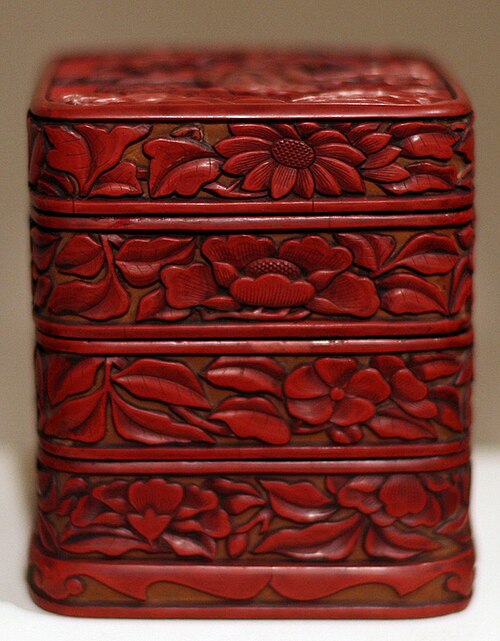
The Ming dynasty (1368–1644) elevated carved lacquer (diaoqi) to its highest artistic achievement. The technique had been practiced since the Tang dynasty, but Ming imperial workshops, particularly under the Yongle (r. 1403–1424) and Xuande (r. 1426–1435) emperors, produced carved lacquer of unmatched depth, precision, and ambition. The process was heroically labor-intensive: artisans applied between one hundred and two hundred coats of lacquer — typically cinnabar red, though yellow, green, and black were also used — onto a wooden or fabric core, allowing each coat to partially cure before adding the next. The accumulated lacquer block, sometimes over a centimeter thick, was then carved in low relief with designs of extraordinary intricacy. A single imperial carved-lacquer box might require three to five years to complete from first coat to final polish (Clifford, 1992, p. 122).
The ornamental repertoire of Ming carved lacquer was vast and codified. Imperial pieces featured five-clawed dragons amid scrolling clouds, peonies and lotuses symbolizing wealth and purity, and landscapes inspired by Song dynasty painting. The carving style was characterized by smooth, rounded forms with gently beveled edges — a tactile quality that distinguishes Ming carved lacquer from the sharper, more angular carving of later Qing dynasty work. The finest Yongle and Xuande pieces exhibit a warm, translucent quality in which the successive layers of red lacquer are visible at the carved edges, creating subtle variations in hue that animate the surface. According to Derek Clifford, Ming carved lacquer represents "the summit of a technique that demands more patience, skill, and sheer accumulated time than any other decorative art in the world" (Clifford, 1992, p. 134).
Ming carved lacquer was produced primarily for the court and for diplomatic gifts. The Orchard Factory (Guoyuan Chang) in Beijing was the principal imperial lacquer workshop, staffed by artisans selected from across the empire. Some of these objects reached foreign courts as gifts: carved lacquer boxes bearing Yongle reign marks have been found in Japanese temple collections, where they were revered as treasures of Chinese craftsmanship. The Japanese adopted and refined Chinese carved-lacquer techniques, developing the distinctive Kamakura-bori tradition. Meanwhile, the Portuguese and Spanish, arriving in East Asian waters in the sixteenth century, became enthusiastic collectors and introduced Chinese lacquer to European markets, where it sparked the "japanning" craze of the seventeenth and eighteenth centuries — a European imitation of Asian lacquer technique that, however skillful, never approached the depth and durability of the original.
"A hundred rounds of tempering makes steel — as a hundred coats of lacquer make a masterpiece."
Chinese proverbCoromandel Screens and Qing Innovation
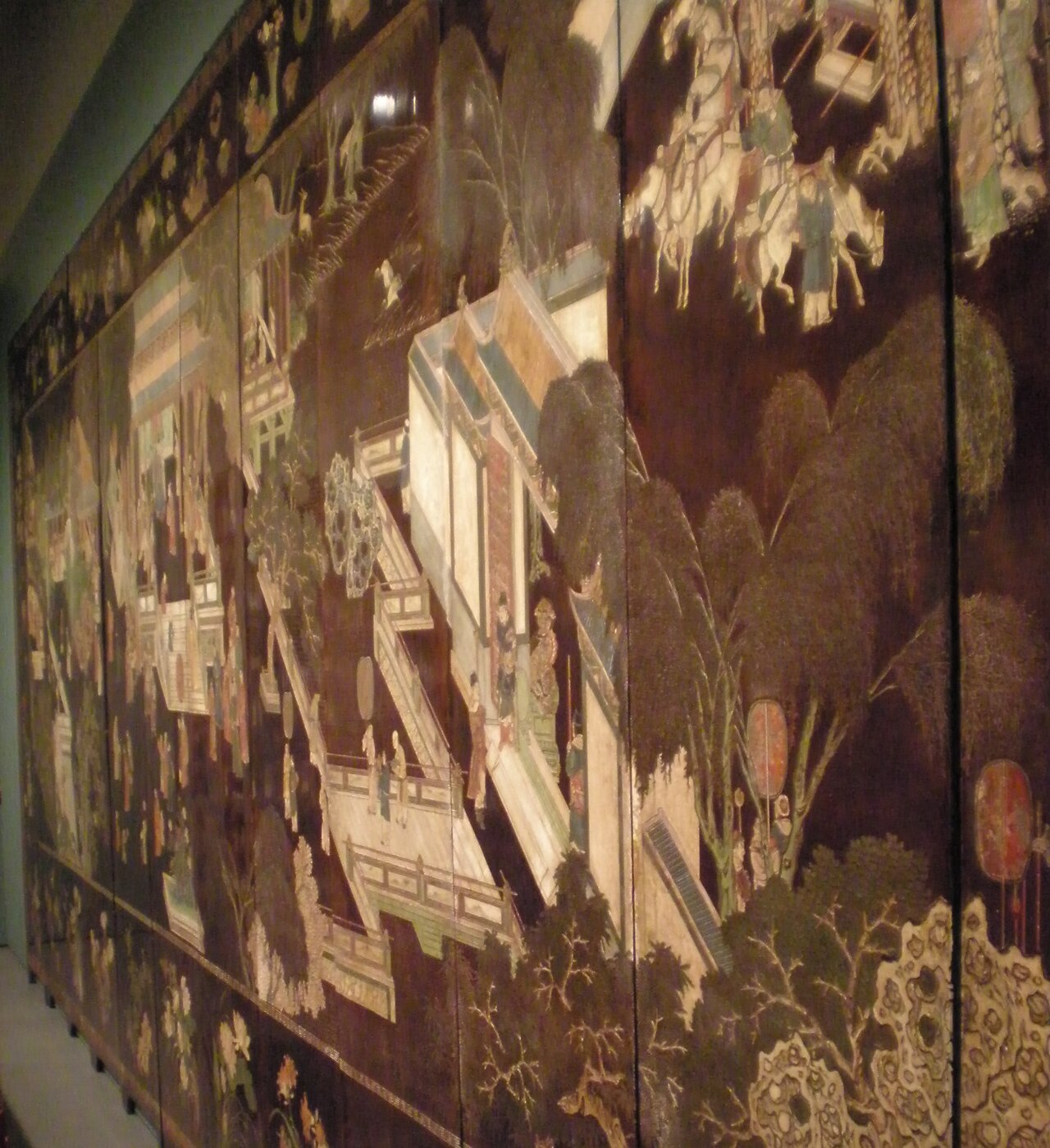
The large folding screens known in the West as "Coromandel screens" — named after the Indian coast from which they were trans-shipped to Europe — represent one of the most distinctive forms of Chinese lacquer art. Produced primarily during the Kangxi reign (1662–1722) of the Qing dynasty, these monumental screens, often twelve panels wide and over two meters tall, were decorated using the kuancai (incised polychrome) technique. The process involved applying multiple layers of dark lacquer to a wooden screen, then incising the design through the lacquer to reveal lighter-colored layers beneath, and finally filling the incised lines with colored lacquer paste and mineral pigments. The resulting surface combined the depth and sheen of lacquer with the chromatic brilliance of painting (Jacobsen, 1993, p. 46).
Coromandel screens typically depicted panoramic scenes of palace life, garden landscapes, or historical narratives populated by dozens of figures in meticulously rendered architectural settings. The largest screens presented a continuous composition across all twelve panels, creating an immersive pictorial environment when the screen was fully opened. European aristocrats and monarchs were avid collectors: Louis XIV owned several Coromandel screens, and they appear prominently in seventeenth-century Dutch interior paintings. The fashion for Coromandel screens in Europe stimulated demand for Chinese lacquer of all types and contributed to the broader chinoiserie movement that influenced European architecture, furniture, and decorative arts from the late seventeenth through the eighteenth century. Robert Jacobsen notes that "the Coromandel screen was China's single most influential export in shaping European taste for the exotic" (Jacobsen, 1993, p. 67).
The Qing dynasty also saw innovations in lacquer technique that expanded the medium's expressive range. The combination of carved lacquer with inlaid jade, coral, ivory, and semiprecious stones produced objects of extreme opulence for the Qianlong emperor's legendary collections. Rhinoceros-skin lacquer (xipi), produced by manipulating layers of different-colored lacquer to create marbled patterns, achieved new levels of refinement. Gold-speckled lacquer (saijin) and the revival of mother-of-pearl inlay (luodian) added further dimensions to the decorative palette. Despite this technical virtuosity, many connoisseurs regard the Qing lacquer aesthetic as excessively elaborate compared to the austere elegance of Song and early Ming work — a critique that mirrors broader scholarly debates about the trajectory of Chinese decorative arts under late imperial patronage.
The Painstaking Process and Modern Revival
The production of fine Chinese lacquerware remains one of the most time-intensive craft processes in the world. A single high-quality lacquer vessel may pass through more than forty distinct stages over a period of months or years. The wooden or fabric core must be shaped, sealed, and primed. Each coat of lacquer must be applied in conditions of precise temperature and humidity — ideally 25–30 degrees Celsius and 75–85 percent relative humidity — and allowed to cure for two to seven days before the next coat is applied. Between coats, the surface is polished with progressively finer abrasives, from charcoal to powdered deer horn. The final polishing, which produces the characteristic mirror-like sheen, may take as long as the lacquering itself. As the contemporary lacquer master Zeng Zhaodun has observed, "lacquer teaches patience; there is no shortcut, no way to hurry the chemistry of the sap" (Watt, 1991, p. 234).
The twentieth century was a difficult period for Chinese lacquerware. The disruptions of war, revolution, and industrialization threatened traditional workshops with extinction. During the Cultural Revolution (1966–1976), lacquer artisans were in many cases forced to abandon their craft, and the transmission of specialized knowledge was interrupted. However, since the 1980s, a concerted revival effort has restored production in several traditional centers. Beijing remains the center of carved lacquer (diaoqi), which was designated a National Intangible Cultural Heritage in 2006. Fuzhou in Fujian Province is renowned for bodiless lacquer (tuotai), a technique in which the original form is removed after lacquering, leaving a vessel of pure lacquer and fabric that is extraordinarily light. Pingyao in Shanxi Province produces lacquer decorated with gold and silver powder in a tradition dating to the Tang dynasty (Garner, 1979, p. 245).
Contemporary Chinese artists have also discovered lacquer as a fine-art medium. The Hubei Institute of Fine Arts in Wuhan maintains a lacquer painting (qihua) department that has trained several generations of artists who work with traditional lacquer materials in contemporary idioms. Lacquer painting, which combines the ancient material with modern compositional principles, has been exhibited internationally and recognized as a distinctive Chinese contribution to contemporary art. Meanwhile, Japanese urushi artists and Vietnamese lacquer painters continue parallel traditions derived from the Chinese original, creating a pan-Asian lacquer culture that spans three thousand years and a dozen countries. The ancient sap of the lacquer tree, toxic to the touch yet sublime in its final form, continues to inspire artists who are willing to submit to its demanding chemistry and its slow, unforgiving process.
"Slow work produces fine results."
Chinese proverbQuiz
What is the primary raw material of Chinese lacquerware?
Which dynasty is known for elevating carved lacquer to its highest artistic achievement?
What is a characteristic feature of Coromandel screens?
What was the primary function of lacquerware during the Han dynasty?
Which cultural period first mastered the basic techniques of lacquer harvesting and application?
How did the Chu kingdom influence Chinese lacquer art?
What technique is associated with Ming dynasty lacquerware?
What modern effort has been made to preserve the lacquer tradition?
Write your thoughts, then get feedback from Jason — you can turn any answer into a full discussion.
9. How do you think the historical significance of lacquerware in ancient China can inform our understanding of cultural value today?
10. In what ways might the labor-intensive process of creating lacquerware teach us about the values of patience and craftsmanship in modern times?
Frequently Asked Questions
Common questions about Chinese Lacquerware: Layers of Time
What is Chinese lacquerware and how is it made?
Chinese lacquerware is made from the refined sap of the lacquer tree (Toxicodendron vernicifluum), which is applied in dozens or even hundreds of paper-thin coats onto a wood, fabric, or bamboo core, with each layer requiring days to dry in a humid environment. The resulting surface is extraordinarily durable, waterproof, and resistant to heat and acid, and can be carved, inlaid, or painted to create objects of stunning beauty.
How old is the tradition of Chinese lacquer art?
Chinese lacquerwork dates back over 7,000 years, with the earliest known example being a red lacquer bowl discovered at the Hemudu site in Zhejiang province. By the Warring States period (475–221 BCE), lacquer artisans were producing elaborately decorated vessels, furniture, and musical instruments that rivaled bronze as markers of elite status and ritual importance.
What is carved red lacquer and why is it famous?
Carved red lacquer, known as "tixi" or "carved cinnabar," involves building up hundreds of layers of lacquer tinted red with cinnabar pigment, then carving intricate designs through the accumulated layers. This technique reached its peak during the Ming dynasty and became one of China's most celebrated luxury arts, with masterpieces requiring years of patient layering before a single cut could be made.
Is Chinese lacquer toxic or dangerous to work with?
Raw lacquer sap contains urushiol, the same compound found in poison ivy, and causes severe allergic skin reactions in most people who handle it. Traditional lacquer workers developed partial immunity through gradual exposure, but the process was physically demanding and hazardous, which contributed to the high value placed on finished lacquerware throughout Chinese history.
What are Coromandel screens in Chinese lacquer art?
Coromandel screens are large folding lacquer screens made using the kuancai technique, where designs are incised into a dark lacquer surface and filled with colored pigments and sometimes gold leaf. Named after the Indian coast port through which they were shipped to Europe, these spectacular screens became wildly fashionable in 17th and 18th century European interiors and remain highly prized by collectors today.