
Podcast


Podcast: Chinese Garden Design: Nature in Miniature
Listen to Jason & Amy discuss Chinese Garden Design: Nature in Miniature
New here?
Philosophy of the Chinese Garden
The Chinese garden is fundamentally different from its Western counterpart. Where the European formal garden imposes geometric order upon nature — think of the rigid parterres of Versailles — the Chinese garden seeks to distill the essence of natural landscape into a confined space. The guiding principle is not control but evocation: a single carefully placed rock can suggest a mountain range, a small pond can evoke a vast lake, and a gnarled pine can stand for the untamed wilderness beyond the garden wall. This approach is rooted in the Daoist concept of the microcosm-macrocosm relationship: the belief that the patterns of the cosmos are replicated at every scale, so that a garden can genuinely contain the universe in miniature. As the landscape theorist Rolf Stein demonstrated, the Chinese garden tradition grows directly from the ancient practice of creating miniature sacred mountains (shanjia) that served as dwelling places for immortals (Stein, 1990, p. 44).
Confucianism and Daoism both shaped the garden aesthetic, but in different registers. The Confucian tradition valued the garden as a space of moral cultivation — a retreat where the scholar-official could study, compose poetry, and refine his character away from the corruptions of public life. The Daoist tradition valued the garden as a space of spiritual liberation — a place where the artificial boundaries between self and nature could dissolve. In practice, most Chinese gardens synthesized both impulses. The typical scholar's garden contained a study for literary work (the Confucian imperative) alongside a winding path through artificial mountains and over water (the Daoist invitation to wander). According to Craig Clunas, the Chinese garden was "a technology for the production of a particular kind of subjectivity — the cultivated, aesthetically sensitive literatus" (Clunas, 1996, p. 23).
The concept of jiejing (borrowed scenery) is perhaps the most distinctive principle of Chinese garden design. Articulated systematically in Ji Cheng's Yuanye (Craft of Gardens, 1631), borrowed scenery involves incorporating views of landscape features outside the garden — distant mountains, temple pagodas, the moon rising above a neighbor's bamboo grove — into the garden's compositional framework. The garden wall thus becomes not a boundary but a frame, and the world beyond the garden becomes part of its design. This principle dissolves the distinction between the designed and the natural, the owned and the shared, creating an aesthetic experience that extends far beyond the garden's physical limits. Ji Cheng considered borrowed scenery "the highest achievement of the garden maker" and devoted an entire chapter of the Yuanye to its methods (Ji Cheng, 1631/1988, p. 112).
"Though made by human hands, it appears as if created by heaven."
Ji Cheng, Yuanye (Craft of Gardens), 1631Suzhou Gardens: UNESCO World Heritage
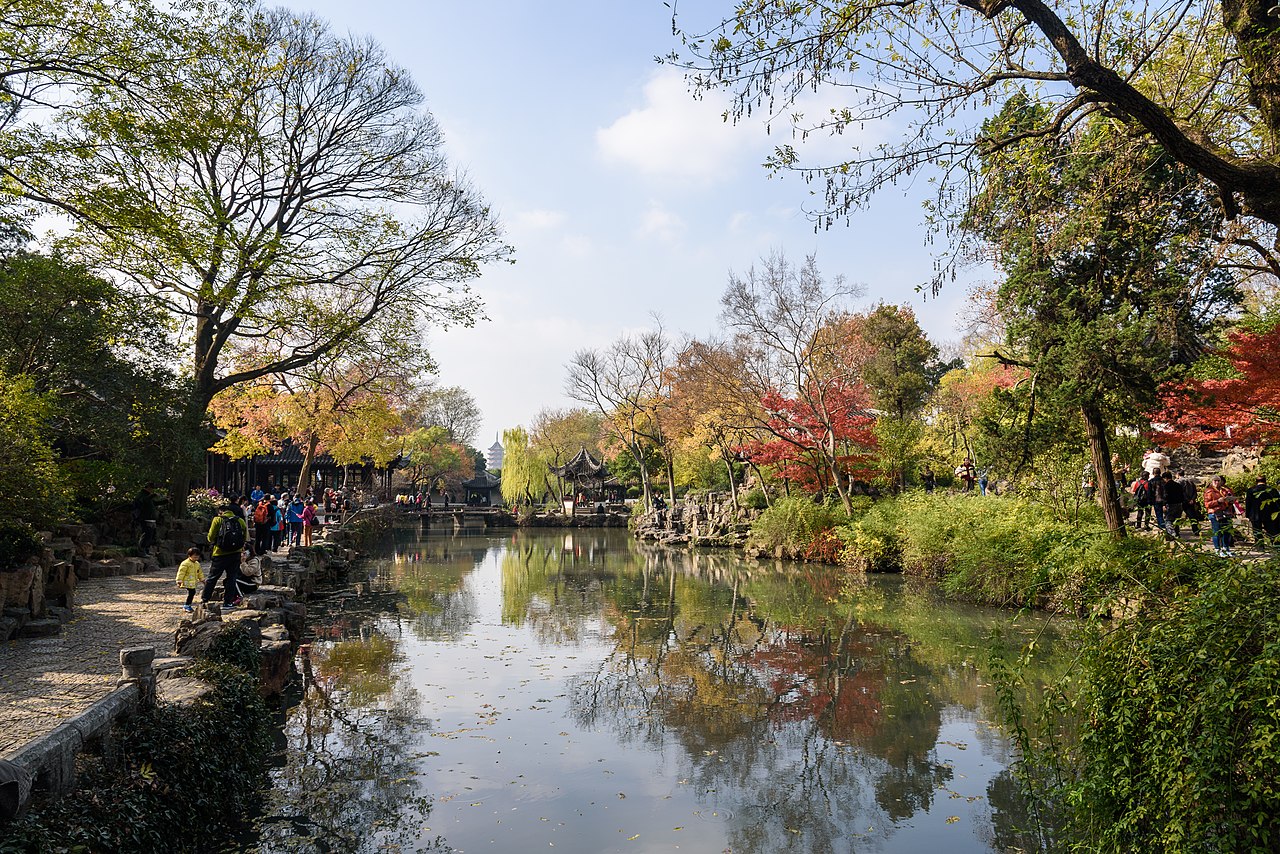
The city of Suzhou in Jiangsu Province contains the greatest concentration of classical Chinese gardens in the world. At the height of the tradition during the Ming and Qing dynasties, Suzhou possessed over two hundred private gardens; about sixty survive in some form today, and nine were collectively inscribed as a UNESCO World Heritage Site in 1997 (expanded in 2000). Suzhou's preeminence in garden art was not accidental. The city's location in the Yangzi Delta provided abundant water for pools and streams, its climate supported a rich palette of vegetation, and its prosperity as a center of silk production and scholarly culture generated a wealthy class of retired officials and literati who had both the means and the leisure to devote to garden creation. According to the garden historian Maggie Keswick, "Suzhou was to the garden what Florence was to painting — a place where economic conditions, cultural traditions, and individual genius converged to produce masterpieces" (Keswick, 2003, p. 76).
The Suzhou gardens share a common formal vocabulary despite their individual variations. Every garden combines four essential elements: rock (shi), water (shui), plants (hua mu), and architecture (jian zhu). Rockeries constructed from weathered Taihu limestone create artificial mountains with caves, ridges, and peaks. Ponds, streams, and channels provide reflective surfaces and the sound of moving water. Plantings follow elaborate symbolic codes: bamboo signifies the upright scholar, plum blossoms represent endurance through winter hardship, orchids embody hidden virtue, and chrysanthemums evoke autumn contemplation. Architectural elements — pavilions, covered walkways, moon gates, latticed windows — provide vantage points from which to contemplate specific views, each framed like a landscape painting. The interplay of these elements creates what Joseph Cho Wang calls "a sequence of revelations" as the visitor moves through the garden, with each turn of the path offering a new composition (Wang, 1998, p. 34).
What distinguishes Suzhou gardens from gardens elsewhere in China is their intimate scale and their emphasis on psychological complexity. These are not vast imperial parks but private enclosures — typically half an acre to two acres — in which every square meter is choreographed. The design strategy relies on concealment and surprise: paths that appear to lead nowhere suddenly open onto hidden courtyards, walls that seem to enclose a space actually conceal a second garden beyond, and windows of different shapes frame different views of the same scene. This spatial complexity creates the illusion of a much larger area than actually exists. The Lingering Garden (Liu Yuan), occupying barely one hectare, contains so many distinct spatial experiences that visitors often feel they have been wandering for hours. This capacity to compress infinity into intimacy is the essential achievement of the Suzhou garden tradition.
Scholar's Rocks (Gongshi)
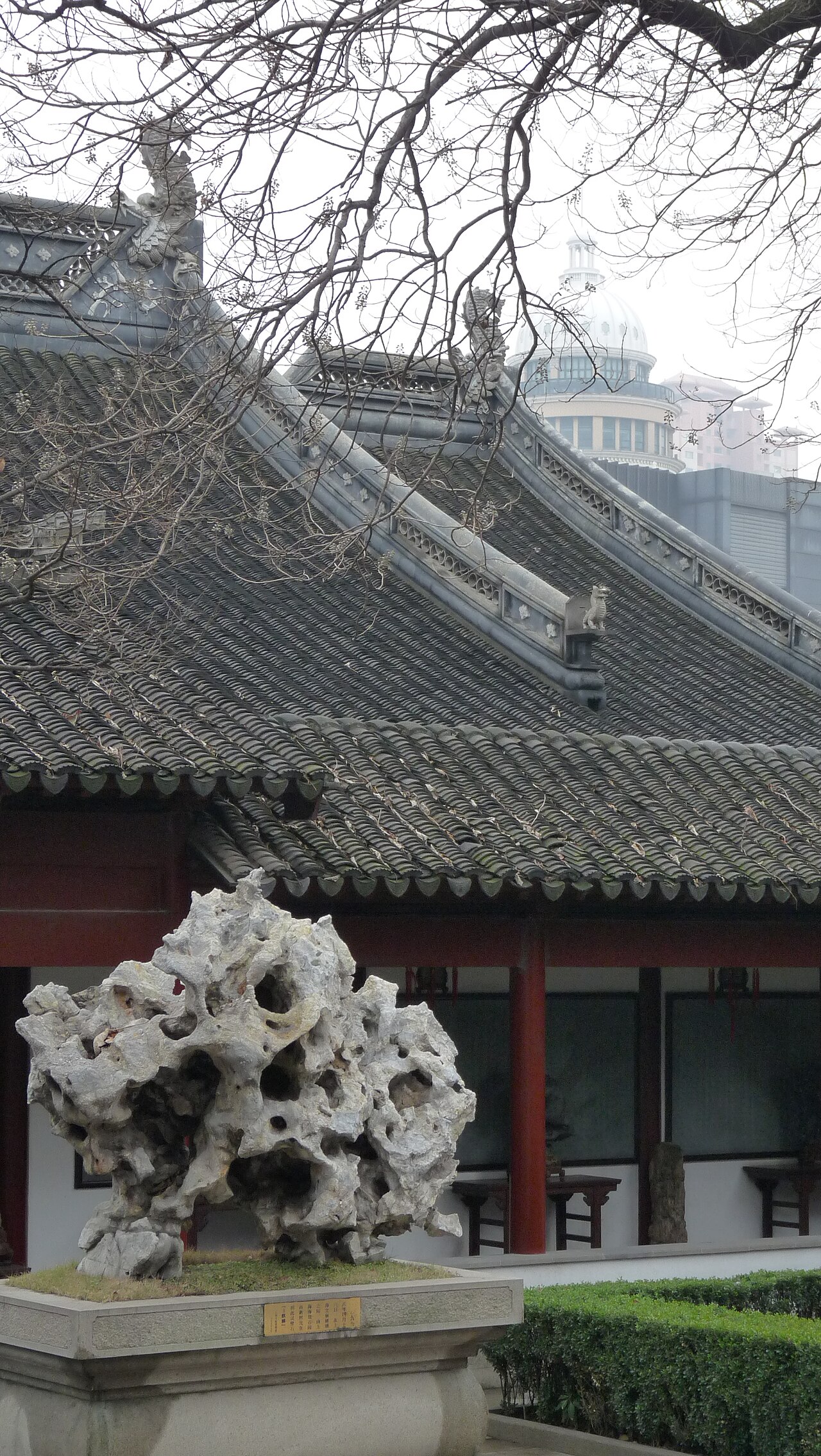
No element of the Chinese garden is more philosophically charged than the scholar's rock (gongshi or shang shi — literally "appreciation stone"). These naturally weathered limestone, basalt, or jade stones, selected for their suggestive forms and placed on carved wooden pedestals, have been collected and venerated in China for at least a thousand years. The Song dynasty painter and connoisseur Mi Fu (1051–1107) was so devoted to a particular stone that he reportedly bowed to it daily, addressing it as "Elder Brother Stone" — an anecdote that, whether literally true or not, captures the intensity of the Chinese aesthetic relationship with natural rock. The four classical criteria for evaluating scholar's rocks — shou (thinness), zhou (wrinkledness), lou (openness with perforations), and tou (transparency) — were established during the Song dynasty and remain the standard of connoisseurship today (Mowry, 1997, p. 28).
The philosophical significance of the scholar's rock lies in its embodiment of natural process. A fine gongshi is not carved by human hands but shaped by water, wind, and geological time over millions of years. It represents the creative power of the Dao acting through natural forces — the same power that shaped mountains, carved river gorges, and sculpted the landscape itself. To contemplate a scholar's rock is therefore to meditate on the fundamental processes of the cosmos, compressed into a form that can rest on a desktop. This contemplative function explains why scholar's rocks were displayed not only in gardens but in studies, libraries, and painting studios — anywhere that a literatus might wish to reconnect with the natural world. According to Robert Mowry, "the scholar's rock served as a portable landscape, a fragment of wilderness domesticated for the interior" (Mowry, 1997, p. 45).
The most prized category of gongshi is Taihu stone, quarried from the bed of Lake Tai near Suzhou. Taihu stones are characteristically grey, perforated with holes and channels created by centuries of wave action, and often assume dramatically vertical or cantilevered forms that seem to defy gravity. The most famous Taihu stone in China is the Exquisite Jade Rock (Yu Linglong) in Shanghai's Yu Garden, a five-meter masterpiece allegedly intended for the Northern Song emperor Huizong's legendary garden before being lost in transit. Today, fine antique gongshi command extraordinary prices at auction — a single stone sold for over $3.9 million at Christie's New York in 2019. Contemporary artists including Zhan Wang and Ai Weiwei have incorporated scholar's rocks into their work, drawn to the form's capacity to bridge the ancient and the modern, the natural and the artificial.
"A mountain need not be high; if an immortal dwells there, it will be famous. Water need not be deep; if a dragon inhabits it, it will be sacred."
Liu Yuxi, "The Humble Room Inscription" (Loushi Ming), Tang dynastyThe Humble Administrator's Garden
The Zhuozheng Yuan, translated as the Humble Administrator's Garden or the Garden of the Unsuccessful Politician, is the largest and most celebrated of Suzhou's classical gardens. It was created in the early sixteenth century by Wang Xianchen, a retired imperial censor who, disillusioned with court politics, retreated to Suzhou and devoted his remaining years to garden construction. The garden's ironic name is drawn from a passage in the Jin dynasty writer Pan Yue's Rhapsody on Living in Idleness, in which "watering the garden and selling vegetables" is described as the "politics of the humble man." Wang Xianchen enlisted the painter and garden designer Wen Zhengming (1470–1559) to collaborate on the design, and Wen's thirty-one surviving paintings and poems recording the garden provide an invaluable record of its original layout and the aesthetic intentions behind it (Clunas, 1996, p. 87).
The garden covers approximately 5.2 hectares and is organized around a central lake that occupies roughly one-third of its total area. Water is the dominant element: lotus ponds, willow-draped channels, and island pavilions connected by zigzag bridges create a landscape that evokes the watery terrain of the Yangzi Delta. The central section, considered the finest, is structured around three islands representing the legendary Isles of the Immortals — Penglai, Yingzhou, and Fangzhang — a cosmological reference that recurs throughout Chinese garden design. The Hall of Distant Fragrance (Yuan Xiang Tang), the principal building, is positioned to receive the scent of lotus blossoms carried across the water on summer evenings — a design decision that engages the sense of smell alongside the visual composition. According to Keswick, the Humble Administrator's Garden achieves "the quintessential Chinese garden effect: the sensation of being immersed in a natural landscape while remaining within an enclosed, humanly scaled space" (Keswick, 2003, p. 142).
The garden has undergone significant transformations since its creation. Wang Xianchen's son reportedly lost the property in a single night of gambling, and it subsequently passed through many owners, each of whom altered the layout. The present garden is largely a Qing dynasty reconstruction, though the spatial logic and water-centered design reflect the original Ming conception. Despite these changes, the garden retains its essential power to create an immersive experience of idealized landscape. Visitors moving through its covered corridors encounter a continuous sequence of framed views — each latticed window, moon gate, or pavilion opening presents a different composition, as if one were walking through a gallery of landscape paintings. This cinematic quality, achieved five centuries before the invention of cinema, remains the garden's most compelling achievement and the reason it attracts over two million visitors annually.
Ji Cheng and the Craft of Gardens
Ji Cheng's Yuanye (園冶), published in 1631, is the only comprehensive treatise on garden design to survive from the Chinese classical tradition. Its title, variously translated as "The Craft of Gardens" or "The Art of Garden Design," deliberately echoes the ancient text Kaogong Ji (Records of Crafts), positioning garden-making alongside the great technical traditions of Chinese civilization. Ji Cheng (1582–c. 1642) was a professional garden designer from Jiangsu Province who created at least three major gardens during his career. The Yuanye distills his practical experience into a systematic treatment covering site selection, layout principles, rockery construction, architectural elements, and the all-important art of borrowed scenery. The treatise was translated into English by Alison Hardie in 1988 and has since become a foundational text in comparative garden studies (Ji Cheng, 1631/1988).
The Yuanye is notable for combining technical instruction with aesthetic philosophy. Ji Cheng repeatedly emphasizes that garden design cannot be reduced to rules; it requires yijing (artistic conception), an intuitive sense of spatial poetry that transcends formulaic application. He describes the ideal garden as a place where "though made by human hands, it appears as if created by heaven" — a phrase that became the most quoted maxim in Chinese garden theory. His chapters on rockery design are particularly revealing: he describes the process of selecting and placing stones as analogous to composing a landscape painting, with each rock serving as a "brushstroke" in a three-dimensional composition. The parallels between garden design and painting were not merely metaphorical for Ji Cheng; he trained as a painter before becoming a garden designer, and his design process began with painted sketches that functioned as compositional studies (Hardie, 1988, p. 28).
The Yuanye fell into obscurity for nearly three centuries after its publication and was rediscovered by the Japanese scholar Okawa Takeo in the 1930s. Its rehabilitation was furthered by the Chinese architectural historian Chen Zhi, who produced an annotated edition in 1979 that made the text accessible to modern readers. Today the Yuanye is recognized as one of the most important works in the global literature of landscape design, comparable in stature to Vitruvius's De Architectura for Western architecture. Its influence extends beyond China: contemporary landscape architects from Peter Walker to Kongjian Yu have cited Ji Cheng's principles — particularly the concept of borrowed scenery and the insistence on site-specific design — as relevant to twenty-first-century practice. The Yuanye reminds us that the Chinese garden tradition is not merely a historical curiosity but a living body of design wisdom with continuing application.
"A winding path leads to a secluded place; the meditation chamber is deep among flowers and trees."
Chang Jian, "Visiting the Broken Mountain Temple," Tang dynastyImperial Gardens and Yuanming Yuan
While the scholar's garden sought to compress infinity into intimacy, the imperial garden pursued grandeur at the scale of the landscape itself. The greatest of all Chinese imperial gardens was the Yuanming Yuan (Garden of Perfect Brightness) in the northwestern suburbs of Beijing, created over more than a century by the Kangxi, Yongzheng, and Qianlong emperors of the Qing dynasty. At its peak in the mid-eighteenth century, the Yuanming Yuan complex covered approximately 350 hectares — roughly three and a half times the area of Versailles — and contained hundreds of buildings, temples, theaters, libraries, artificial lakes, hills, and garden vignettes that reproduced famous landscapes from across the Chinese empire. The Qianlong emperor described the garden as "a complete picture of the realm," and foreign visitors, including the Jesuit painters Giuseppe Castiglione and Michel Benoist, who designed the Western-style palaces within the complex, described it as the most magnificent estate in the world (Wong, 2001, p. 56).
The Yuanming Yuan's design embodied the concept of "garden within a garden" (yuan zhong yuan) taken to an encyclopedic extreme. Individual garden sections reproduced specific scenes from Chinese landscape painting, famous regional gardens (particularly those of Suzhou and Hangzhou), and literary references. The "Peach Blossom Spring" section recreated the utopian landscape described in Tao Yuanming's famous essay; the "Apricot Blossom Spring" section evoked a famous passage from the Tang poet Du Mu. According to Young-tsu Wong, the Yuanming Yuan was "an imperial anthology of Chinese spatial culture" that assembled the entire tradition of Chinese garden art into a single, comprehensive statement (Wong, 2001, p. 78). The garden also contained Castiglione's Western-style fountains and baroque palaces, making it a unique site of Sino-European artistic exchange.
The destruction of the Yuanming Yuan by British and French troops during the Second Opium War in October 1860 remains one of the most traumatic events in Chinese cultural memory. Over the course of three days, soldiers looted the garden's vast collections of art, books, and treasures, then deliberately set fire to the wooden structures. Victor Hugo condemned the destruction in a famous letter, calling it "the work of two bandits." The ruins of Castiglione's stone and marble European palaces survive as a monument and a memorial — their broken columns and empty fountains serving as a permanent reminder of cultural loss. Efforts to digitally reconstruct the Yuanming Yuan using historical records and archaeological surveys are ongoing at Tsinghua University, and the site remains a pilgrimage destination for Chinese visitors who come to contemplate both the magnificence of what was created and the enormity of what was destroyed. The Yuanming Yuan encapsulates the entire trajectory of the Chinese garden tradition: from philosophical aspiration to imperial grandeur to devastating loss and, perhaps, eventual renewal.
Quiz
What distinguishes the Chinese garden from its Western counterpart?
Which philosophy values the garden as a space of moral cultivation?
What is the principle of 'borrowed scenery' in Chinese garden design?
What is a defining characteristic of Suzhou gardens?
What is the primary material used for scholar's rocks?
Which garden is described as the 'Garden of the Unsuccessful Politician'?
What was the purpose of Ji Cheng's Yuanye treatise?
How did the Yuanming Yuan garden exemplify the concept of 'garden within a garden'?
Write your thoughts, then get feedback from Jason — you can turn any answer into a full discussion.
9. How does the concept of 'borrowed scenery' in Chinese gardens reflect a philosophical approach to nature and design?
10. In what ways do the Suzhou gardens utilize spatial complexity to create an illusion of larger space?
Frequently Asked Questions
Common questions about Chinese Garden Design: Nature in Miniature
What makes Chinese garden design different from Western gardens?
Chinese gardens seek to recreate the essence of nature in miniature through asymmetry, winding paths, and carefully framed views, in contrast to the geometric symmetry and imposed order of Western formal gardens. Every element — rocks, water, plants, and architecture — is arranged to evoke a sense of wandering through a natural landscape painting, guided by Daoist and Buddhist philosophical ideals.
What are the four essential elements of a traditional Chinese garden?
The four essential elements are rocks (representing mountains), water (symbolizing rivers and seas), plants (embodying the seasons and moral virtues), and architecture (providing human-scale shelter and viewing points). Together these elements create a microcosm of the natural world, with scholar's rocks and pools standing in for the grand mountains and rivers of classical landscape painting.
What are the most famous classical Chinese gardens to visit?
The classical gardens of Suzhou are the most celebrated, with the Humble Administrator's Garden and the Master of the Nets Garden both designated UNESCO World Heritage Sites. Other renowned examples include the Summer Palace and the destroyed-but-legendary Yuanming Yuan in Beijing, and the individual garden of the Couple's Retreat in Suzhou, each representing different eras and styles of garden design.
What are scholar's rocks and why are they prized in Chinese gardens?
Scholar's rocks (供石, gongshi) are naturally formed stones, often Taihu limestone, prized for their dramatic shapes featuring holes, wrinkles, and peaks that suggest miniature mountains or mythical creatures. Collected and displayed on carved wooden pedestals, they were valued according to four classical aesthetic criteria — thinness, wrinkledness, openness, and transparency — and served as objects of contemplation in both gardens and studies.
What is the philosophy behind Chinese garden design?
Chinese garden design is rooted in Daoist philosophy, which seeks harmony between humanity and nature, and the concept of "borrowing scenery" (借景) to integrate views beyond the garden walls into the overall composition. Gardens were designed as spaces for spiritual cultivation, poetry composition, and philosophical reflection, where winding paths and moon gates reveal carefully choreographed sequences of views that unfold like a scroll painting.