
Podcast


Podcast: Chinese Paper Cutting: The People's Art
Listen to Jason & Amy discuss Chinese Paper Cutting: The People's Art
New here?
Origins Linked to Papermaking
The history of Chinese paper cutting is inseparable from the history of paper itself. Although Cai Lun is traditionally credited with inventing paper in 105 CE, archaeological discoveries have pushed the date back to at least the second century BCE, with fragments of hemp-fiber paper found at Fangmatan in Gansu Province. The earliest surviving paper cuts, however, date to the Northern and Southern Dynasties period (420–589 CE). In 1959, archaeologists excavating a tomb at Turpan in Xinjiang discovered small paper cutouts depicting horses and monkeys, dated to approximately the sixth century. These simple symmetrical figures, created by folding paper and cutting through multiple layers simultaneously, represent the foundational technique of the art form. According to Zheng Shucai, a leading authority on Chinese folk art, these Turpan discoveries "establish that paper cutting was already a mature folk practice by the sixth century, implying origins at least a century earlier" (Zheng, 2005, p. 18).
The development of paper cutting was driven by practical and spiritual needs rather than purely aesthetic ones. Early paper cuts served primarily as patterns for embroidery — a function they retain in many rural areas today — and as ritual objects. Paper effigies of humans, animals, and symbolic objects were burned as offerings to the dead, a practice that continues in Chinese funerary customs. During the Tang dynasty (618–907), paper cutting expanded from ritual use into festive decoration. The Tang poet Du Fu mentions paper cutouts used to celebrate the Renri festival (the seventh day of the first lunar month), and the custom of pasting paper cuts on windows during the Spring Festival (Chinese New Year) was well established by the Song dynasty. The art form was thus born at the intersection of ritual, craft, and celebration — a convergence that defined its character for the next millennium (Hung, 2011, p. 35).
The technical requirements of paper cutting shaped its distinctive aesthetic. Working with scissors or a sharp knife on thin paper, the artist must maintain continuous connections between all parts of the design; if any element is fully detached, it falls away. This structural constraint produces the characteristic "web" quality of paper cuts, in which negative space (the cut-away areas) and positive space (the remaining paper) are interdependent. The finest paper cuts exploit this interdependence to create images of extraordinary complexity from a single unbroken sheet. Symmetrical designs are produced by folding the paper before cutting, generating mirror images that unfold into bilaterally balanced compositions. These technical constraints are not limitations but generative principles: they force the artist toward a visual language of connectivity, balance, and economy that distinguishes paper cutting from every other pictorial art form.
"With one pair of scissors and one sheet of paper, one can cut out ten thousand worlds."
Chinese folk sayingWindow Flowers (Chuanghua)

The most iconic application of Chinese paper cutting is the window flower (chuanghua), pasted onto the paper-covered lattice windows of traditional Chinese houses to celebrate the Spring Festival. In the weeks before the lunar New Year, millions of households across northern China — where the tradition is strongest — replace the window paper on their latticed frames and decorate it with freshly cut paper designs in auspicious red. The window flower transforms the domestic interior: sunlight passing through the cut paper casts intricate patterns of red and white across floors and walls, creating a warm, festive atmosphere. According to the folklorist Shu Ting, "the chuanghua was the poor family's painting — a work of art that cost nothing but skill and a scrap of paper, yet transformed the humblest dwelling into a place of beauty and good fortune" (Shu, 1993, p. 44).
The iconography of window flowers follows a highly codified symbolic vocabulary that has been transmitted across generations. Fish (yu) represent surplus and abundance, because the word is homophonous with the word for "leftover" or "extra." Pomegranates, with their many seeds, symbolize fertility and the wish for numerous sons. Peony blossoms represent wealth and honor. The character shuangxi (double happiness) is ubiquitous at weddings. Bats (fu) represent good fortune, again through homophony. These puns and visual metaphors constitute a complete symbolic language that any literate or illiterate villager could read. The window flower was thus simultaneously a decorative object and a form of visual communication — a prayer expressed in paper and scissors rather than words. As the art historian Roberta Helmer Stalberg has observed, "Chinese paper cutting is the visual equivalent of a blessing spoken aloud" (Stalberg, 1986, p. 67).
The creation of window flowers was traditionally women's work, practiced in the domestic sphere during the winter months when agricultural labor ceased. Young girls learned by watching their mothers and grandmothers, and skill in paper cutting was considered an important social accomplishment — a mark of the dexterous, cultured bride. In some villages, a young woman's paper-cutting ability was explicitly evaluated during the matchmaking process. This gendered dimension is significant: paper cutting was one of the few art forms in imperial China where women were the primary creative agents, and the designs they produced — while conforming to conventional symbolism — often encoded personal emotions, private jokes, and domestic narratives invisible to outsiders. The window flower tradition thus preserved a distinctly female artistic voice within a patriarchal culture, making it not only a folk art but a form of women's cultural expression.
Wedding and Festival Decorations
Beyond window flowers, paper cutting permeates the entire ritual calendar of traditional Chinese life. At weddings, red paper cuts bearing the double-happiness character (囍) are pasted on doors, windows, mirrors, and furniture throughout the bride's and groom's households. Elaborate paper cuts depicting mandarin ducks (symbols of conjugal fidelity), dragons and phoenixes (representing the groom and bride respectively), and lotus flowers with interlocking stems (symbolizing marital harmony) decorate the bridal chamber. The wedding paper cuts are typically made by a female relative of the bride who is known for her skill, and the quality and complexity of the cuts reflect on the family's status. According to Ellen Johnston Laing, "wedding paper cuts served as visual blessings — each motif encoded a specific wish for the couple's future happiness, prosperity, and fertility" (Laing, 2004, p. 112).
The Lantern Festival (Yuanxiao Jie), celebrated on the fifteenth day of the first lunar month, provided another major occasion for paper cutting. Lanterns were decorated with cut-paper panels that cast dramatic shadow patterns when illuminated from within. The Dragon Boat Festival (Duanwu Jie) in the fifth month featured paper cuts of Zhong Kui, the demon-quelling deity, pasted above doorways for protection. The Mid-Autumn Festival (Zhongqiu Jie) inspired paper cuts of Chang'e, the moon goddess, and her jade rabbit companion. Each festival activated a specific repertoire of imagery and symbolism, so that the annual cycle of paper cutting mapped onto the agricultural and ritual calendar with remarkable precision. The paper cuts were ephemeral by nature — exposed to sunlight, moisture, and the passage of seasons, they rarely survived more than a year — and this impermanence was part of their meaning: each new festival required fresh creations, sustaining the tradition through continuous renewal (Hung, 2011, p. 78).
Funerary paper cutting constitutes another major category of the tradition. Paper objects — houses, furniture, clothing, servants, horses, and in modern times cars, televisions, and smartphones — are cut, folded, and assembled for burning at funerals and ancestor worship ceremonies. The belief that burned paper objects are transmitted to the deceased in the afterlife has sustained an enormous industry of ritual paper goods, with specialized shops in every Chinese city and town. While mass-produced printed paper goods have largely replaced hand-cut objects in urban areas, traditional hand-cut funerary paper remains in use in rural communities. This ritual function connects contemporary paper cutting to its deepest historical roots: the sixth-century Turpan paper cuts discovered by archaeologists were almost certainly ritual offerings, suggesting that the spiritual dimension of paper cutting is as old as the art form itself.
"May there be abundance year after year — the meaning encoded in the fish motif of paper cuts."
Traditional Spring Festival blessingRegional Styles: Shaanxi, Hebei, and Guangdong
Chinese paper cutting is not a single tradition but a family of regional styles, each with distinctive aesthetic characteristics shaped by local culture, available materials, and the personalities of master artists. The most celebrated regional tradition is that of Shaanxi Province in northwestern China, where paper cutting has been practiced in rural communities for centuries with particular intensity. Shaanxi paper cuts are characterized by bold, simple forms, strong black outlines, and a robust vitality that reflects the agrarian culture of the Wei River valley. The imagery draws heavily on local folklore, shamanistic animal spirits, and agricultural themes. The most famous Shaanxi paper-cutting master, Ku Shulan (1920–2004), created monumental compositions of extraordinary complexity that incorporated human figures, animals, flowers, and architectural elements into unified designs sometimes over a meter in width. Ku Shulan, who was illiterate and had bound feet, worked entirely from memory and imagination; her works have been exhibited internationally and are held in major museum collections (Zheng, 2005, p. 134).
Hebei Province, south of Beijing, developed a paper-cutting tradition distinguished by its refinement and detail. Hebei paper cuts are typically smaller and more intricate than their Shaanxi counterparts, featuring fine lines, delicate textures, and a preference for narrative scenes drawn from opera, legend, and daily life. The city of Yuxian (Wei County) in Hebei is particularly famous for dyed paper cuts (ransejianzhi), in which the paper is cut first and then hand-colored with mineral pigments to produce multicolored images. This technique bridges the gap between paper cutting and painting, producing works of considerable chromatic richness. The Yuxian tradition was designated a National Intangible Cultural Heritage in 2006, and the annual Yuxian paper-cutting festival draws visitors from across China and abroad. According to Stalberg, Yuxian paper cuts represent "the most painterly expression of the paper-cutting tradition, where the scissors become a drawing instrument and the dye-brush adds a dimension unavailable to the monochrome cut" (Stalberg, 1986, p. 89).
Guangdong Province in southern China produces paper cuts in a markedly different style influenced by the region's proximity to Southeast Asia and its tradition of elaborate decorative art. Guangdong paper cuts (known locally as jianzhi) often use gold or silver foil rather than paper, and the designs feature the dense, ornate patterning characteristic of Cantonese decorative arts. The imagery favors auspicious themes — fish, flowers, fruits, and the characters for longevity and prosperity — rendered with a horror vacui that fills every available space with detail. The Chaozhou subregion of Guangdong is particularly famous for its wedding paper cuts, which are among the most elaborate in China, sometimes incorporating dozens of figures in scenes from opera and legend. These regional variations demonstrate that paper cutting, despite its humble materials, is a sophisticated art form with as much internal diversity and aesthetic richness as any "high" art tradition.
The Symbolism of Motifs
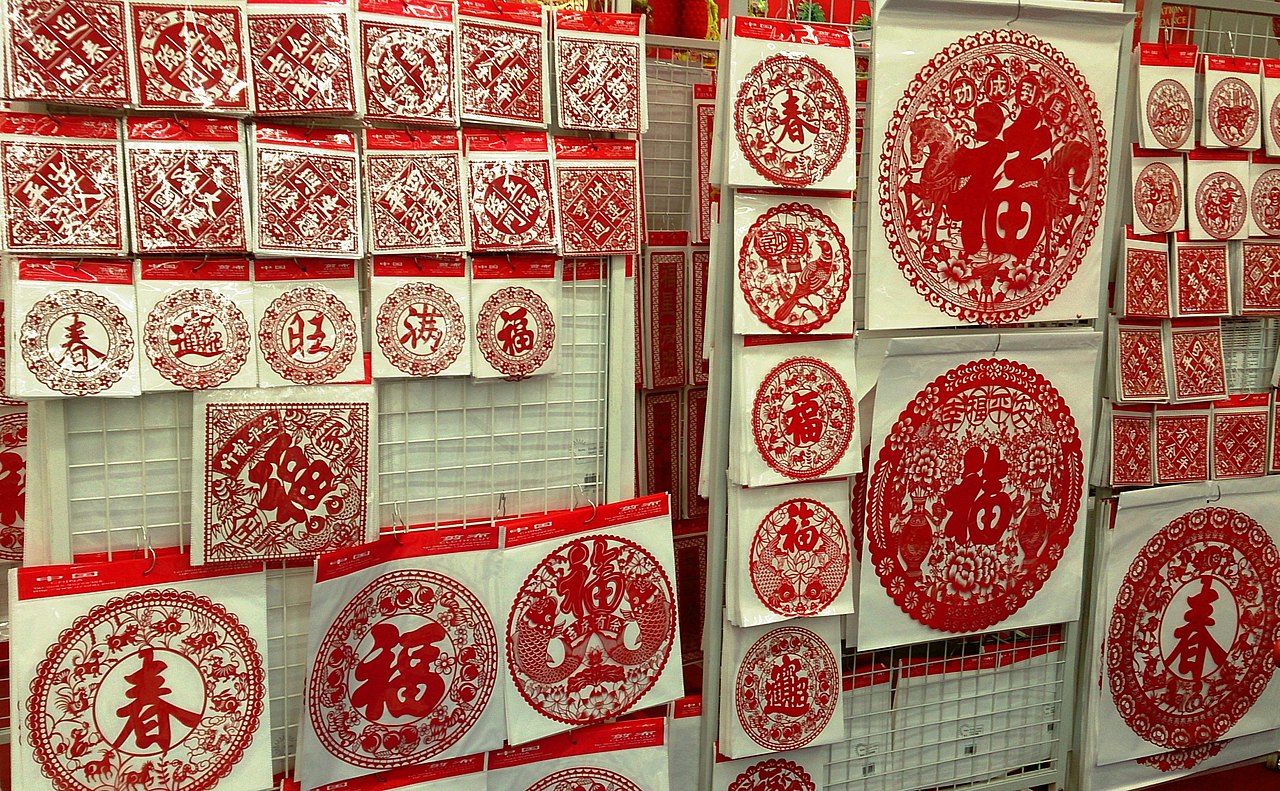
The symbolic vocabulary of Chinese paper cutting constitutes a visual language of remarkable depth and consistency. This language operates through three primary mechanisms: visual resemblance (a motif looks like what it represents), homophony (a motif's name sounds like an auspicious word), and cultural association (a motif carries meaning through literary or historical reference). Often, multiple mechanisms operate simultaneously within a single design, creating layers of meaning that reward knowledgeable reading. The fish motif, for example, works through both homophony (yu meaning fish sounds like yu meaning abundance) and visual pleasure (the sinuous, symmetrical form of a fish lends itself beautifully to the cut-paper medium). The bat motif works purely through homophony (fu meaning bat sounds like fu meaning good fortune), which explains why this otherwise unremarkable animal appears so prominently in Chinese decorative art (Bartholomew, 2006, p. 32).
The peony (mudan) is the most frequently represented flower in Chinese paper cutting, symbolizing wealth, honor, and feminine beauty. It is often paired with the phoenix to represent a woman of noble character, or with a vase (ping, homophonous with "peace") to wish for "wealth and peace." The lotus (he) represents purity because it grows from mud yet remains unstained, and it frequently appears in marriage paper cuts because the phrase "lian sheng gui zi" (continuous birth of noble sons) can be visually encoded as a connected chain of lotus seeds and pods. The dragon and phoenix together represent the union of emperor and empress, and by extension any married couple. The magpie (xi que), whose name contains the character for happiness, appears on branches of plum blossom to signify "happiness announcing spring" (xi bao chun). According to Terese Tse Bartholomew, "the symbolic repertoire of Chinese paper cutting encompasses several hundred distinct motifs, each with a specific meaning that would have been instantly recognizable to any Chinese viewer before the modern era" (Bartholomew, 2006, p. 56).
The twelve animals of the Chinese zodiac provide another rich source of paper-cutting imagery, particularly at the Spring Festival, when the incoming year's zodiac animal is featured on window flowers, door decorations, and red envelopes. Each zodiac animal carries its own associations: the dragon represents power and good fortune, the rabbit represents gentleness and longevity, the tiger represents courage and the warding off of evil. Paper-cutting masters in rural communities maintain extensive mental catalogues of these symbolic motifs and can combine them spontaneously to create compositions tailored to specific occasions and recipients. The symbolic language of paper cutting thus functions as a form of visual literacy parallel to, and independent of, written Chinese — a pictorial code that communicates blessings, wishes, and cultural values through the universal medium of cut paper.
"A clever mind and skillful hands — the traditional praise for a master paper cutter."
Chinese proverbUNESCO Recognition and Modern Revival
In 2009, Chinese paper cutting was inscribed on UNESCO's Representative List of the Intangible Cultural Heritage of Humanity, recognizing it as one of the world's most significant living folk art traditions. The UNESCO nomination documented paper-cutting practices in more than twenty provinces and identified the tradition as a pan-Chinese phenomenon with deep roots in agricultural society, domestic ritual, and female creativity. The inscription was a milestone in the recognition of Chinese folk art as cultural heritage of universal value, and it has stimulated government funding for documentation, education, and master-apprentice transmission programs. Provincial and national competitions identify and promote talented young paper-cutting artists, and several universities have established paper-cutting courses within their fine arts departments (Zheng, 2005, p. 256).
The challenge facing Chinese paper cutting in the twenty-first century is the tension between preservation and innovation. The traditional context of the art form — rural households with paper-latticed windows, seasonal festivals punctuating the agricultural calendar, extended families transmitting skills across generations — is rapidly disappearing as China urbanizes. Apartment buildings have glass windows that do not accommodate traditional chuanghua. Young women in cities have neither the time nor the social incentive to master paper cutting. Mass-produced machine-cut decorations have replaced hand-cut work at most commercial New Year celebrations. The UNESCO inscription, while valuable for raising awareness, cannot reverse these structural changes. According to the cultural policy scholar Christina Maags, "the challenge for intangible cultural heritage programs in China is that they tend to museumify living traditions, transforming daily practice into curated performance" (Maags, 2018, p. 145).
Nevertheless, a genuine creative revival is underway, driven by contemporary artists and designers who see paper cutting not as a relic to be preserved but as a living medium to be reinvented. The artist Bovey Lee creates monumental paper cuts from Chinese rice paper that depict scenes of urban life, environmental destruction, and technological change, using traditional technique to address contemporary subjects. The fashion designer Guo Pei has incorporated paper-cutting motifs into haute couture collections shown in Paris. Graphic designers routinely adapt paper-cutting aesthetics for digital media, packaging, and brand identity. These contemporary applications demonstrate that the formal language of paper cutting — its interplay of positive and negative space, its requirement of structural connectivity, its capacity for intricate detail within a unified composition — possesses an enduring vitality that transcends its folk origins. The art of the humble scissors and the red paper square, practiced by anonymous village women for a thousand years, has entered the global conversation about art, craft, and cultural identity in the modern world.
Quiz
What historical period do the earliest surviving paper cuts date back to?
What is the primary function of paper cuts in funerary customs?
Which festival is associated with using paper cuts on lanterns?
What is a significant characteristic of Shaanxi paper cuts?
What does the fish motif symbolize in Chinese paper cutting?
What role did women traditionally play in the creation of window flowers?
How has the modern revival of paper cutting been characterized?
What challenge does Chinese paper cutting face in the 21st century?
Write your thoughts, then get feedback from Jason — you can turn any answer into a full discussion.
9. Why do you think UNESCO's recognition of Chinese paper cutting as an Intangible Cultural Heritage of Humanity is significant?
10. How might the symbolic language of Chinese paper cutting be relevant to modern art and design?
Frequently Asked Questions
Common questions about Chinese Paper Cutting: The People's Art
What is Chinese paper cutting and what is it used for?
Chinese paper cutting (剪纸, jianzhi) is a folk art in which intricate designs are cut from a single sheet of paper using scissors or a knife. Traditionally used to decorate windows, doors, and lanterns during festivals like Chinese New Year, the art form features auspicious symbols such as the character 福 (fortune), zodiac animals, and scenes of prosperity and happiness.
How old is the art of Chinese paper cutting?
Paper cutting in China dates back to at least the 6th century CE, shortly after the invention of paper itself, with the earliest surviving examples found in tombs from the Northern Dynasties period. However, the practice of cutting decorative patterns from thin materials like leather and silk likely predates paper by centuries, and the art form has been passed down through generations of rural women for over 1,500 years.
Is Chinese paper cutting a UNESCO heritage art form?
Yes, Chinese paper cutting was inscribed on UNESCO's Representative List of the Intangible Cultural Heritage of Humanity in 2009. The designation recognizes the art's deep cultural significance, its role in community celebrations and rituals, and the need to preserve traditional techniques and regional styles that are increasingly threatened by modernization and mass production.
What are the different regional styles of Chinese paper cutting?
China has dozens of distinct regional paper cutting styles, with the most renowned traditions from Shaanxi, Hebei, Shandong, and Guangdong provinces. Northern styles tend to be bold and graphic with strong symbolic themes, while southern styles are often more delicate and intricate, sometimes resembling fine lace and featuring naturalistic scenes of flowers, birds, and landscapes.
What do the symbols in Chinese paper cuts mean?
Chinese paper cuts are rich in symbolic meaning, often using visual puns based on homophones in the Chinese language. For example, a fish (鱼, yu) represents surplus (余, yu) and prosperity, paired magpies symbolize marital happiness, and pomegranates with their many seeds wish fertility upon a household. Red paper is always used because red symbolizes good fortune and wards off evil spirits.