
Podcast


Podcast: Contemporary Chinese Art: Tradition Meets Revolution
Listen to Jason & Amy discuss Contemporary Chinese Art: Tradition Meets Revolution
New here?
The Stars Group and the Opening
The birth of contemporary Chinese art can be precisely dated: September 27, 1979, when a group of self-taught artists calling themselves the Xingxing (Stars) hung their paintings on the iron fence outside the National Art Museum of China in Beijing. The exhibition was unauthorized, defiant, and brief — police shut it down within two days — but its symbolic impact was seismic. The Stars, led by Ma Desheng and Huang Rui, and including the young Ai Weiwei, rejected the socialist realism mandated by the Communist Party and asserted the right of individual artistic expression for the first time since the founding of the People's Republic. Their work was stylistically diverse — ranging from expressionist woodcuts to semi-abstract sculpture — but united by a common insistence that art must address the human condition rather than serve political propaganda. According to the art historian Wu Hung, the Stars exhibition "inaugurated the contemporary period in Chinese art by establishing the principle of artistic autonomy" (Wu, 2014, p. 34).
The political context of the Stars exhibition was the Democracy Wall movement of 1978–1979, a brief period of liberalization during which citizens posted essays, poems, and demands for political reform on a wall in Beijing's Xidan district. The Stars aligned themselves explicitly with this movement, and their second exhibition in 1980 included works addressing political repression, individual freedom, and the trauma of the Cultural Revolution. When the government suppressed the Democracy Wall movement in late 1979, the Stars came under increasing pressure, and several members — including Ai Weiwei and Ma Desheng — eventually emigrated to the West. But the precedent they established proved irreversible: the idea that Chinese art could exist outside the state-sanctioned system, that it could be critical, personal, and formally experimental, became the foundation on which all subsequent developments were built (Gao, 2005, p. 56).
The early 1980s saw a cautious but accelerating engagement with Western modernism as Chinese art students gained access to reproductions of Impressionist, Cubist, Surrealist, and Abstract Expressionist works for the first time. The "Scar Art" movement of 1979–1981 used realist techniques to depict the suffering of the Cultural Revolution, while the slightly later "Rustic Realism" movement, led by painters such as Luo Zhongli and Chen Danqing, portrayed rural life with an unflinching honesty that challenged the idealized peasant imagery of Maoist art. These movements remained figurative and accessible, but they opened a critical space that more radical movements would soon occupy. The years between 1979 and 1985 constituted a period of artistic awakening in which Chinese artists rebuilt their connection to both their own suppressed tradition and the international modernist movements from which they had been isolated for three decades.
"Brush and ink must follow the times."
Shi Tao (Shitao), Qing dynasty painter-monkThe '85 New Wave
The mid-1980s witnessed an explosion of avant-garde activity known as the '85 New Wave (Bawu Xinchao), a nationwide movement of young artists who organized themselves into independent groups, published manifestos, and staged exhibitions in galleries, apartments, warehouses, and public spaces across China. The movement was fueled by the relatively liberal cultural policies of Party General Secretary Hu Yaobang and by the flood of translated Western philosophical and aesthetic texts — Nietzsche, Freud, Sartre, and Wittgenstein — that reached Chinese campuses in the early 1980s. The '85 New Wave was not a single style but a collective declaration of independence from the academic system, encompassing Neo-Expressionism, conceptual art, installation, performance, and video. According to Gao Minglu, who curated the culminating China/Avant-Garde exhibition in 1989, the '85 New Wave "was less an art movement than a cultural movement that used art as its primary vehicle" (Gao, 2005, p. 112).
Regional groups drove the '85 New Wave's energy. The Northern Art Group, based in Harbin and led by Wang Guangyi, pursued a cold, rationalist aesthetic influenced by German philosophy. The Pond Society in Hangzhou, which included Zhang Peili and Geng Jianyi, explored conceptual and installation art. The Southwest Art Group in Kunming, featuring Mao Xuhui and Zhang Xiaogang, developed a psychologically intense figurative style rooted in the surreal landscapes of Yunnan. The Xiamen Dada group, led by Huang Yongping, staged provocative actions including the public burning of their own paintings — an iconoclastic gesture that shocked even sympathetic observers. This geographic diversity was significant: unlike the Stars, who were centered in Beijing, the '85 New Wave demonstrated that avant-garde impulses existed throughout China, nurtured by local conditions and traditions that gave each regional group a distinctive character (Wu, 2014, p. 78).
The movement culminated in the landmark China/Avant-Garde exhibition at the National Art Museum of China in February 1989, organized by Gao Minglu and featuring works by nearly three hundred artists. The exhibition's logo — a "no U-turn" traffic sign — symbolized the artists' refusal to retreat into officially sanctioned art. The opening day was marked by a dramatic incident: the artist Xiao Lu fired a pistol at her own installation, leading police to close the exhibition temporarily. When it reopened, massive crowds attended, making it one of the most visited art exhibitions in Chinese history. The exhibition closed for the final time in February 1989; four months later, the Tiananmen Square protests and their violent suppression plunged Chinese cultural life into a period of intense repression. The '85 New Wave had reached its climax and its crisis simultaneously, and the generation of artists it produced would spend the next decade navigating the aftermath.
Political Pop and Cynical Realism
The two most internationally visible Chinese art movements of the 1990s — Political Pop (zhengzhi bopu) and Cynical Realism (wanshi xianshizhuyi) — emerged directly from the disillusionment that followed the Tiananmen crackdown of June 1989. Political Pop, pioneered by Wang Guangyi in his Great Criticism series (begun 1990), appropriated the visual language of Cultural Revolution propaganda posters and juxtaposed it with Western consumer brand logos — Coca-Cola, Marlboro, Swatch — creating sardonic commentaries on the collision between socialist ideology and market capitalism. The technique drew explicitly on American Pop Art, particularly Warhol, but the content was distinctly Chinese: the ironic recycling of propaganda imagery that had once demanded absolute belief but had lost all credibility. According to Li Xianting, the critic who coined the term "Cynical Realism," Political Pop artists "transformed the trauma of ideological collapse into a visual language that was simultaneously Chinese and global" (Li, 1993, p. 22).
Cynical Realism, centered on painters Fang Lijun, Yue Minjun, and Liu Wei, depicted the post-Tiananmen generation as yawning, grinning, or staring blankly into space — figures defined by boredom, alienation, and ironic detachment. Yue Minjun's paintings of laughing men with closed eyes, rendered in hyper-saturated color against empty backgrounds, became some of the most recognizable images in contemporary Asian art. Fang Lijun's bald-headed everyman figures, floating in ambiguous liquid spaces, embodied the sense of psychological dislocation experienced by young Chinese navigating between political repression and economic opportunity. These works avoided direct political statement — unlike the '85 New Wave, which had been explicitly oppositional — and adopted instead a posture of ironic disengagement that was both a survival strategy and an aesthetic position. As Karen Smith has argued, Cynical Realism "expressed the mood of an entire generation through the language of the absurd" (Smith, 2008, p. 156).
Both movements achieved their international breakthrough at the 1993 Venice Biennale, where Chinese artists were included for the first time in a major international exhibition. The curator Achille Bonito Oliva and the critic Li Xianting selected works by Wang Guangyi, Fang Lijun, Liu Wei, and others for the exhibition's Aperto section, introducing Chinese contemporary art to the European art establishment. The Venice showing launched a decade of escalating international visibility for Chinese artists, facilitated by a growing network of galleries, collectors, and curators who recognized both the artistic quality and the market potential of Chinese contemporary art. By the early 2000s, Political Pop and Cynical Realism had become the dominant international image of Chinese art — a dominance that obscured the diversity of Chinese artistic practice but brought unprecedented global attention to a generation of artists who had emerged from the crucible of Tiananmen.
"Without destruction there can be no construction."
Mao Zedong (adopted as a motto by the '85 New Wave artists)Xu Bing and the Art of Meaningful Illegibility
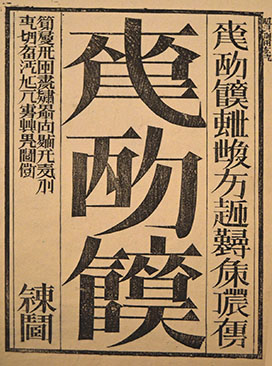
Xu Bing's Book from the Sky (Tianshu, 1987–1991) is arguably the single most important work of Chinese contemporary art. The installation consists of long scrolls and bound volumes printed with approximately four thousand invented Chinese characters — forms that look perfectly authentic to anyone familiar with Chinese writing but are in fact entirely meaningless. Xu Bing hand-carved each character into a wooden block using traditional Song dynasty printing techniques, a process that took four years of painstaking labor. The resulting installation, in which scrolls cascade from the ceiling and hand-bound books lie open on the floor, confronts viewers with the vertiginous experience of apparent meaning that dissolves upon inspection. For Chinese viewers, who recognize the formal structure of the characters but cannot read them, the effect is deeply unsettling; for Western viewers, who cannot read Chinese anyway, the work poses different but equally provocative questions about language, meaning, and cultural authority. According to Wu Hung, Book from the Sky "is the most profound meditation on the nature of written language produced by any artist in the twentieth century" (Wu, 2014, p. 142).
Xu Bing's subsequent projects continued to explore the relationship between language and meaning with extraordinary inventiveness. Square Word Calligraphy (1994–ongoing) disguises English words as Chinese characters by restructuring the Roman alphabet into square-format compositions that follow the structural logic of Chinese writing. The work functions as both an art installation and a pedagogical tool: Xu Bing has conducted workshops worldwide in which participants learn to write English in this hybrid script, experiencing firsthand the cognitive dissonance of reading their own language in an unfamiliar visual system. A Case Study of Transference (1994), in which two live pigs covered in printed text were placed together in a gallery, addressed questions of cultural translation, biological instinct, and the limits of human communication. Each project extended Xu Bing's investigation of how meaning is constructed, transmitted, and distorted across linguistic and cultural boundaries (Erickson, 2001, p. 78).
Xu Bing's work demonstrates the possibility of a contemporary art practice that is simultaneously deeply Chinese and genuinely international. His training in traditional woodblock printing and calligraphy is not incidental to his conceptual art — it is foundational. The authority of Book from the Sky depends entirely on the authenticity of the carved characters; if they looked amateurish, the work would fail. Similarly, Square Word Calligraphy works because Xu Bing understands the internal logic of Chinese character construction well enough to apply it to a foreign alphabet. This integration of traditional craft and contemporary concept distinguishes Xu Bing from both the nostalgic traditionalism that merely reproduces historical forms and the superficial internationalism that adopts Western strategies without Chinese content. He has served as vice president of the Central Academy of Fine Arts in Beijing and continues to produce work that challenges assumptions about language, culture, and the possibility of cross-civilizational understanding.
Ai Weiwei, Cai Guo-Qiang, and Global Impact
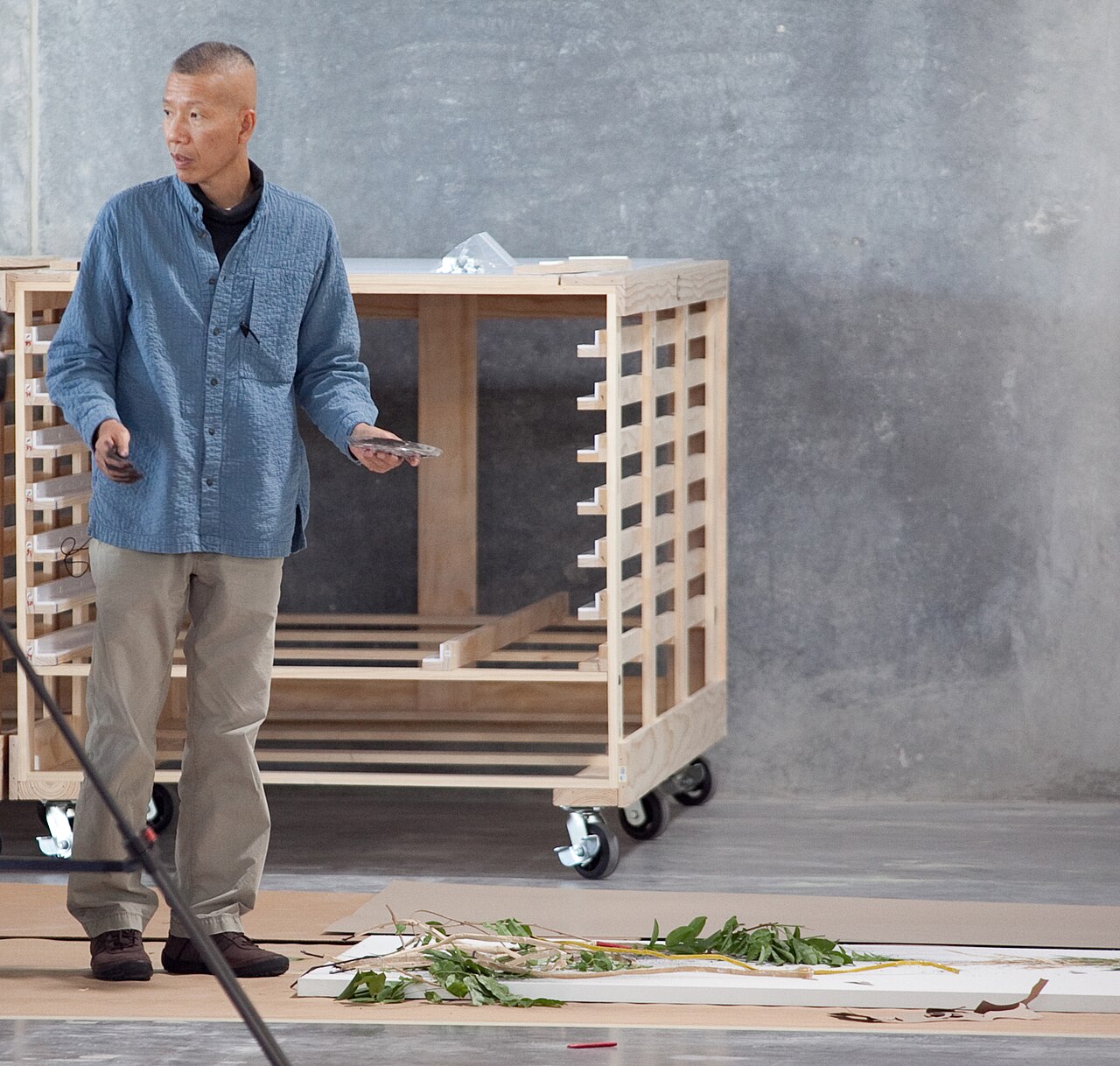
Ai Weiwei (b. 1957) has become the most internationally recognized Chinese artist of the twenty-first century, known equally for his art and his political activism. The son of the poet Ai Qing, who was persecuted during the Anti-Rightist Campaign and the Cultural Revolution, Ai Weiwei lived in New York from 1983 to 1993, absorbing the influence of Duchamp, Warhol, and Jasper Johns. Returning to Beijing, he became the center of a new generation of conceptual artists and architects, co-designing the Bird's Nest stadium for the 2008 Olympics with Herzog & de Meuron. His art consistently engages with Chinese history and politics: Dropping a Han Dynasty Urn (1995), a triptych of photographs documenting the destruction of a two-thousand-year-old artifact, provocatively questioned the reverence for cultural heritage. Sunflower Seeds (2010), an installation of 100 million hand-painted porcelain seeds at the Tate Modern's Turbine Hall, addressed themes of mass production, individuality, and the relationship between China and the West. His 81-day detention by Chinese authorities in 2011 on fabricated tax charges brought global attention to the suppression of artistic freedom in China (Smith, 2008, p. 234).
Cai Guo-Qiang (b. 1957) has created one of the most distinctive bodies of work in contemporary art through his use of gunpowder — the Chinese invention that transformed world history — as a drawing and painting medium. His "explosion events," staged at sites from the Great Wall of China to the East River in New York, use precisely choreographed detonations of gunpowder to create ephemeral drawings in smoke and fire. The permanence of these works exists only in documentation: photographs and video recordings that capture the brief, spectacular moment of creation. His gunpowder drawings on paper and canvas, created by igniting powder trails laid across the surface, combine the controlled spontaneity of action painting with the ancient Chinese association of gunpowder with festivity, warfare, and cosmological transformation. Cai's opening ceremony fireworks for the 2008 Beijing Olympics, including the famous "footprint" fireworks marching along Beijing's central axis, were seen by an estimated four billion television viewers worldwide — arguably the largest audience for any single work of art in history (Chiu, 2012, p. 89).
The international success of Ai Weiwei, Cai Guo-Qiang, and their contemporaries has transformed the global art landscape. Chinese contemporary art, virtually unknown outside specialist circles before 1993, now commands major exhibition spaces, critical attention, and market prices worldwide. The establishment of major private museums in China — including the Long Museum, the Yuz Museum, and the UCCA Center for Contemporary Art — has created domestic institutions comparable to Western contemporary art museums. The Chinese art market, driven by both international collectors and a rapidly growing class of domestic collectors, has made China the world's second-largest art market by value. This commercial success brings both opportunities and risks: the pressure to produce recognizable, marketable work threatens the experimental spirit that defined the movement's origins, while the global art system's appetite for "Chinese-ness" can reduce complex artistic practices to cultural stereotypes.
"Make the past serve the present; make foreign things serve China."
Mao Zedong, "On New Democracy," 1940 (reinterpreted by contemporary artists)Ink Painting Revival and Future Directions
One of the most significant developments in recent Chinese art is the revival of ink painting (shuimo hua) as a contemporary medium. For decades, ink painting was dismissed by avant-garde Chinese artists as irredeemably traditional — a relic of the feudal past that had no place in a modern art practice. But since the early 2000s, a new generation of artists has reclaimed ink as a vital medium capable of engaging with contemporary experience. The movement is partly a reaction against the perceived homogenization of global contemporary art: if installation, video, and conceptual art look much the same whether produced in Beijing, Berlin, or Brooklyn, ink painting offers a distinctly Chinese formal language with no Western equivalent. Artists such as Qiu Zhijie, Yang Jiechang, and Zheng Chongbin use traditional materials — ink, brush, and rice paper — in radically unconventional ways, creating works that acknowledge their debt to the Song and Yuan masters while addressing twenty-first-century concerns. According to the curator Britta Erickson, the contemporary ink movement represents "the most significant renegotiation of tradition and modernity in Chinese art since the '85 New Wave" (Erickson, 2001, p. 156).
The ink revival intersects with broader questions about Chinese cultural identity in a globalized world. As China's economic and political power has grown, so has interest in articulating a specifically Chinese modernity — one that draws on indigenous cultural resources rather than simply importing Western models. In the art world, this impulse has fueled exhibitions, publications, and institutional initiatives focused on ink painting as a living tradition rather than a museum artifact. The Metropolitan Museum of Art's landmark 2013 exhibition "Ink Art: Past as Present in Contemporary China" brought the movement to international attention, presenting works by thirty-five artists who engage with ink, calligraphy, and other traditional Chinese media. The exhibition's curator, Maxwell Hearn, argued that "the most innovative Chinese art of the twenty-first century does not reject the past but reimagines it" (Hearn, 2013, p. 12).
Looking forward, Chinese contemporary art faces the challenge of maintaining its critical edge in an environment of increasing political restriction and commercial pressure. The Xi Jinping era has seen tighter controls on artistic expression, with galleries closed, exhibitions censored, and artists detained for politically sensitive work. Yet Chinese artists continue to find ways to create meaningful work within and around these constraints, drawing on a long tradition of coded expression, allusive imagery, and strategic ambiguity that predates the Communist era by centuries. The tradition of the literati painter who expressed political dissent through the seemingly innocent depiction of bamboo or orchids has deep resonance for contemporary artists navigating similar pressures. Chinese contemporary art at its best embodies a dialogue between past and present, tradition and experiment, Chinese and global, that makes it one of the most intellectually rich and aesthetically diverse art movements of our time.
Quiz
What event is considered the birth of contemporary Chinese art?
What characterized the '85 New Wave movement?
What is the primary significance of Xu Bing's 'Book from the Sky'?
How did Political Pop artists like Wang Guangyi use imagery in their work?
What event marked the climax of the '85 New Wave?
What is a key characteristic of Cynical Realism?
What role did Ai Weiwei's art play in his international recognition?
What has the revival of ink painting in contemporary Chinese art emphasized?
Write your thoughts, then get feedback from Jason — you can turn any answer into a full discussion.
9. Why do you think the Stars exhibition had such a significant impact on contemporary Chinese art?
10. How might the integration of traditional techniques and contemporary concepts benefit Chinese contemporary artists like Xu Bing?
Frequently Asked Questions
Common questions about Contemporary Chinese Art: Tradition Meets Revolution
What is contemporary Chinese art and when did it begin?
Contemporary Chinese art broadly refers to the experimental art that emerged after the death of Mao Zedong in 1976 and the subsequent opening of China to the outside world. The landmark 1979 Stars exhibition in Beijing, organized by self-taught artists outside the state system, is widely considered the birth of China's avant-garde, which has since grown into one of the most dynamic and commercially significant art movements in the world.
Who are the most famous contemporary Chinese artists?
Ai Weiwei is perhaps the most internationally recognized for his politically charged installations and activism, while Xu Bing is celebrated for his conceptual works exploring language and meaning, such as "Book from the Sky." Other major figures include Cai Guo-Qiang, known for his explosive gunpowder art, Zhang Xiaogang for his haunting family portraits, and Yue Minjun for his iconic laughing figures.
How does contemporary Chinese art blend tradition with modern themes?
Many contemporary Chinese artists deliberately engage with traditional materials and techniques — ink painting, calligraphy, porcelain, and lacquer — while addressing modern issues like urbanization, censorship, and globalization. This dialogue between past and present is a defining characteristic of the movement, producing works that are simultaneously rooted in thousands of years of Chinese artistic heritage and critically engaged with 21st-century life.
Why did contemporary Chinese art become so expensive at auction?
The Chinese contemporary art market exploded in the mid-2000s as China's economic boom created a new class of wealthy collectors, coinciding with growing Western institutional interest in non-Western art. Auction records were shattered repeatedly, with works by Zhang Xiaogang, Zeng Fanzhi, and others selling for tens of millions of dollars, though the market has since become more measured after a speculative bubble in 2008.
What was the 85 New Wave art movement in China?
The '85 New Wave (八五新潮) was a nationwide avant-garde art movement in mid-1980s China in which young artists, newly exposed to Western philosophy and modernism, formed experimental groups across the country to break free from Socialist Realism. The movement culminated in the landmark China/Avant-Garde exhibition at the National Art Gallery in Beijing in February 1989, which was shut down twice by police and remains a pivotal moment in Chinese art history.