
A lesson is the unit of study here — not a video, not a wordlist, but ten sections that take one topic from first hearing to being able to use it. This article is what each section is for and the order that gets the most out of them.
Without a plan: Seven full lessons, one at every HSK level, plus the podcast of every other
Pro adds: Every lesson, HSK 1-9, in full
How the lessons are organised
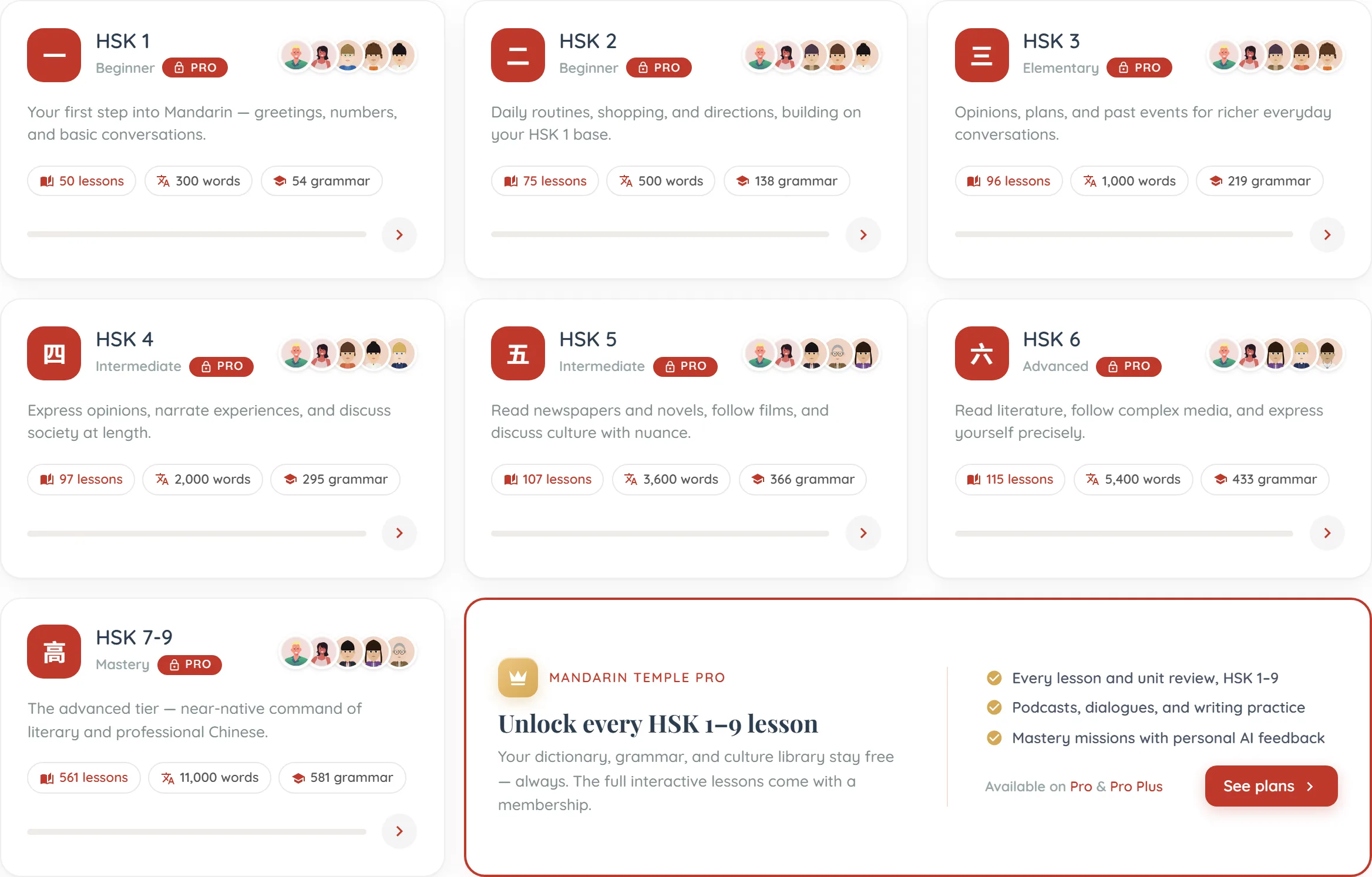
Nine levels, each split into units, each unit into lessons and ending with an exam. You do not have to follow the order — every lesson stands on its own — but the vocabulary is cumulative, so a lesson assumes the ones before it.
Your study plan picks the next one for you. Browse the ladder if you would rather choose.
The ten sections
- Podcast — A spoken introduction to the topic. Free on every lesson at every level, and the one section that stays open without a plan.
- Understanding — What this lesson is about and why it matters, before any Chinese is thrown at you.
- Dialogue — The conversation the lesson is built around, with audio. Tap any character for its meaning.
- Vocabulary — Every new word, banded and with audio. This is where words enter your flashcard deck.
- Teacher’s Notes — The things a teacher would say out loud — the exceptions, the false friends, the bit that trips everyone.
- Grammar — The patterns introduced here, with structure templates and graded examples.
- Culture — What a native speaker knows that the words alone do not carry. Optional, and often the most interesting part.
- Writing — Stroke order for the new characters, with tracing practice.
- Exercises — Interactive practice on everything above — the part that turns recognition into recall.
- Mastery Mission — A short applied task that asks you to use the lesson rather than answer questions about it.
What is free
The opening of every lesson, including its podcast, is free at every level — so you can read into any lesson at any band before deciding whether to pay. Everything from Understanding onward needs a plan.
Locked sections stay listed in the contents rather than being hidden, so you can see what a lesson covers either way. Full detail in what Pro unlocks.
Why a lesson stays inside its level
Every sentence in a lesson — dialogue, examples, exercise prompts — is checked against the vocabulary of its own HSK band before it is published. An HSK 2 lesson does not quietly contain HSK 5 words.
That is the reason the whole thing hangs together. You are never asked to guess at something the course has not taught you, and "I finished HSK 2" means the same thing here as it does on the exam.
How progress is recorded
Each section is a checkpoint. Completing one ticks it in the contents bar and adds XP; the lesson counts as done when its core sections are. Podcast and Culture are optional and do not hold a lesson back.
Nothing expires and nothing needs re-doing. A section you finished stays finished.
Common questions
Twenty to forty minutes to do properly, depending on level and how much of the exercises you work through. Your study plan budgets one per session at the daily minutes you set.