
A plan unlocks content. That is the whole of it: the parts of a lesson past the opening, the exams, the practice studios and the specialised modules. It is a separate thing from AI credits, which pay per-use for the features that call a live model. This article is the feature-by-feature boundary, including the large amount that stays free.
What is free, permanently
The reference half of the site needs no account and no plan. It is not a trial and it does not expire.
- The dictionary — 21,000+ entries with pinyin, meanings and audio, plus stroke order and example sentences wherever the data carries them. Read the whole thing. Open it.
- Grammar — Every grammar point, with structures, examples, common mistakes and exercises. Open it.
- Culture — History, art, philosophy, traditions and festivals. Open it.
- Learning materials — Radicals, the pinyin table, stroke order, tones, calendars, names and numbers. Open them.
- One full mock test per level — Mock Test 1 of every HSK level is free — a complete paper in the official format, sat under real exam conditions. Browse them.
- The first part of every lesson — Each HSK lesson opens for free, including its podcast — which is recorded audio, free to play, and costs you no credits. You can read a lesson at any level before deciding whether the rest is worth paying for.
- Spaced-repetition flashcards — The review deck itself is free with an account — 20 cards a day, scheduled by FSRS, costing no credits on any plan. Pro lifts the daily ceiling. Open it.
- Your progress — Checkpoints, XP, streaks and stats are yours regardless of plan.
What a Pro plan adds
Pro opens the rest of the course and the practice surfaces built on top of it.
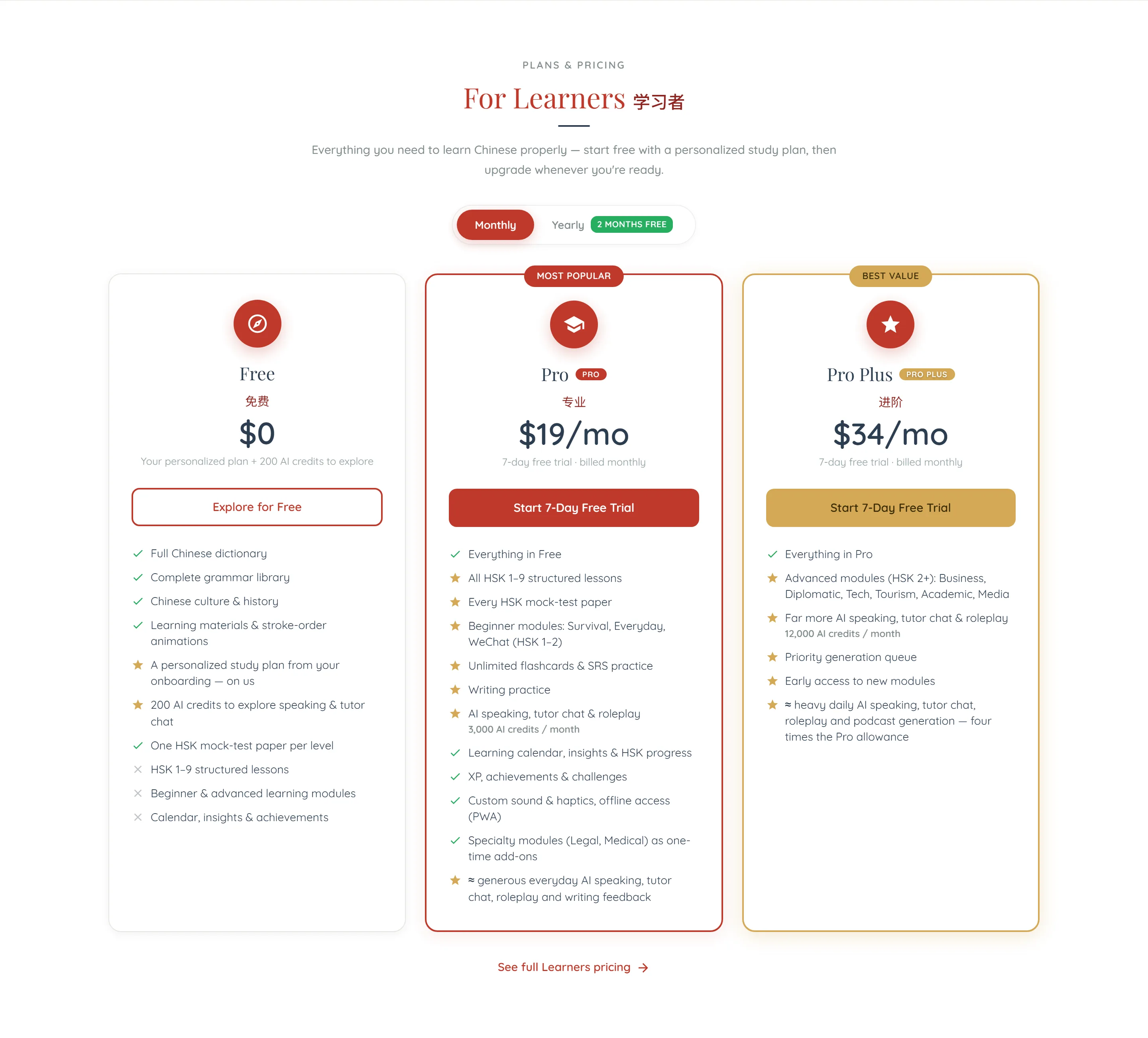
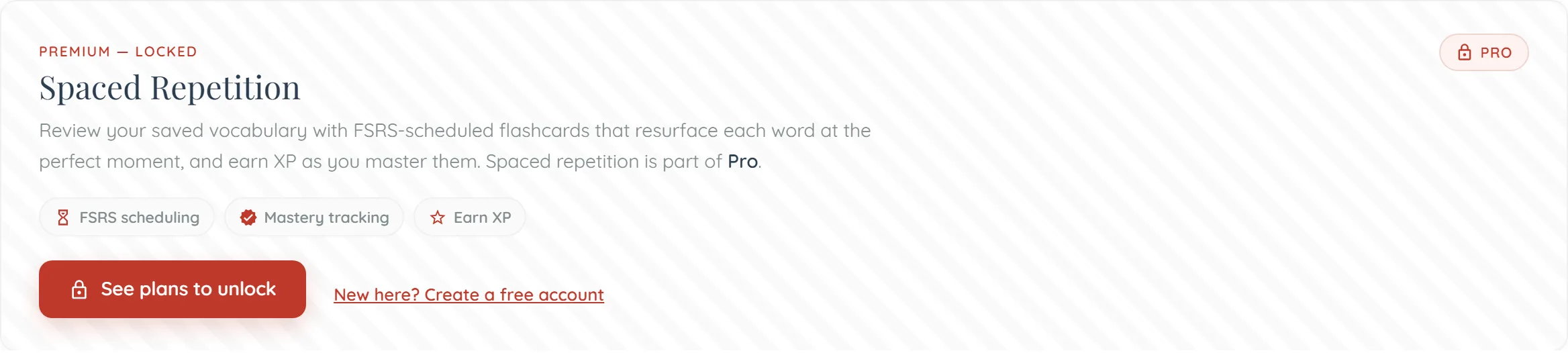
- The full lesson — Every section from Understanding onward — the explanation, the deeper vocabulary and grammar treatment, the cultural notes and the practice. On a free account these are locked; the opening and the podcast are the taster.
- The rest of the unit exams — Unit 1’s exam is free at every level; the other 117 are Pro. They check whether a unit actually landed, in the official format.
- The rest of the mock tests — Mock Test 1 of each level is free; Mock Tests 2 and up are Pro. Every paper is original content written to the official structure, sittable in timed exam mode or untimed practice mode. Browse them.
- Unlimited flashcard reviews — The scheduled review deck is free with any account, capped at 20 cards a day. Pro takes the ceiling off, which is what a real backlog needs — words come back at the point you are about to forget them, however many of them there are.
- The speaking studio and AI tutor — Conversation practice with a tutor that talks back, plus the free-form discussion space.
- The pronunciation trainer — Recording yourself and getting scored on tones and syllables, attempt by attempt.
What Pro Plus adds on top
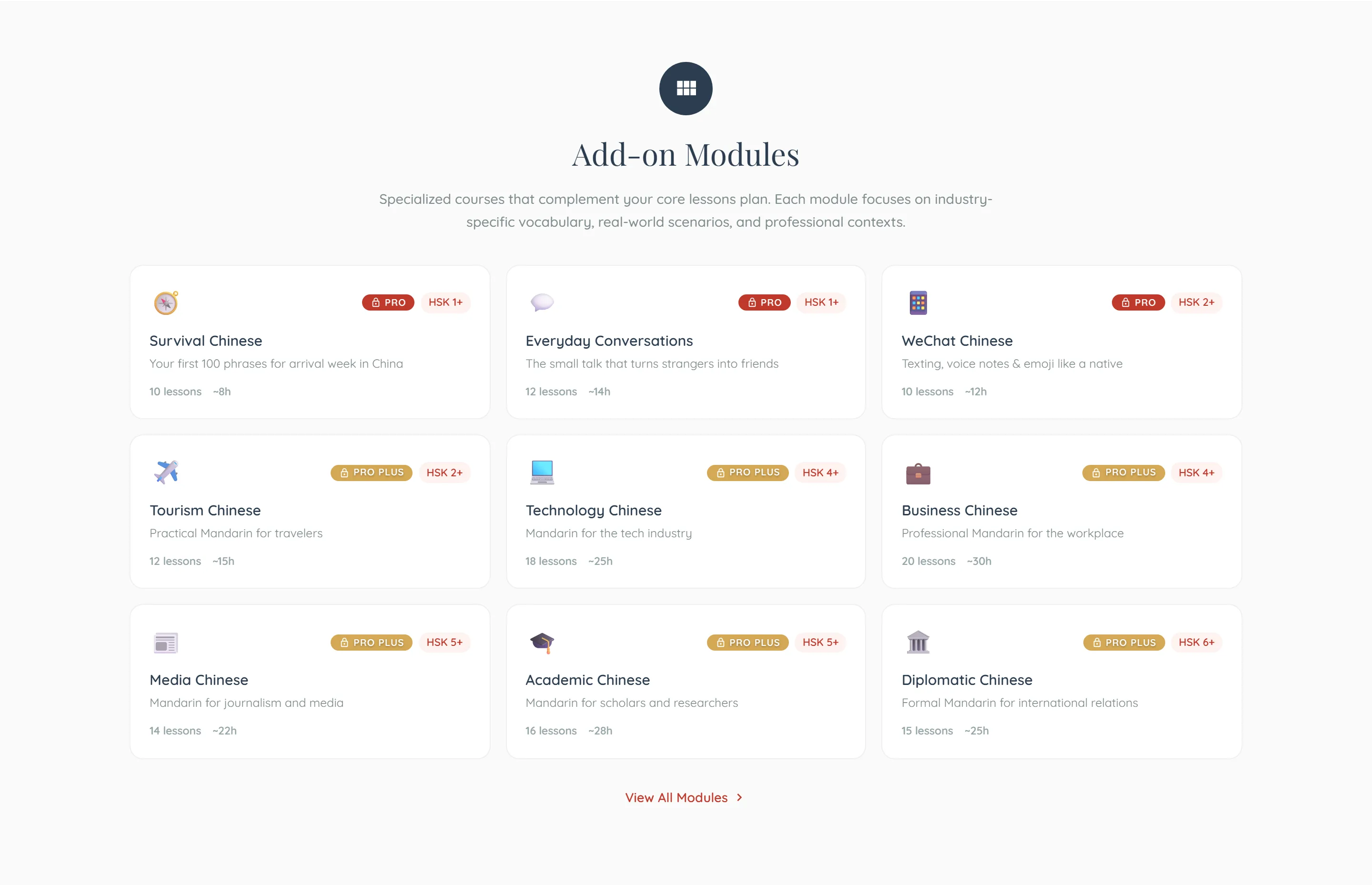
Pro Plus is Pro plus the specialised material and a much larger credit allowance — 12,000 a month against Pro’s 3,000. If you use the AI features heavily, that difference is the main reason to consider it.
- The specialised modules — Chinese for business, technology, tourism, media, academia and diplomacy — six subject modules outside the HSK lesson ladder, though each sets an HSK floor. Browse them.
- A four-times larger credit allowance — Enough to talk to your tutor daily, score every pronunciation attempt and rebuild your plan whenever you want, without watching the balance.
What a plan does not cover
Worth being explicit, because it is the most common misunderstanding. A plan does not buy unlimited AI. The AI tutor, pronunciation scoring, handwriting checks, exam grading and study-plan generation are paid for in credits, per use, on every plan including Pro Plus.
The reasoning is in AI credits explained, and the per-feature prices are in what each AI feature costs. The short version: content costs the same to serve however many people read it, and AI does not, so the two are billed differently.
If you are teaching, parenting or buying for a school
Tutor, parent and institution accounts are priced separately, because what they add is seats and oversight rather than content. A tutor or parent account is also a full learner account — you keep your own lessons and progress alongside the people you are following.
Common questions
You can read the opening of every lesson at every level, including its podcast, on a free account. Everything from the Understanding section onward needs a plan. The contents list still shows you what those sections are.