
Podcast


Podcast: Feng Shui: The Ancient Science of Space and Harmony
Listen to Jason & Amy discuss Feng Shui: The Ancient Science of Space and Harmony
New here?
Cosmological Foundations: Qi, Yin-Yang, and the Five Elements
Feng shui rests upon a cosmological foundation that is among the most sophisticated and enduring frameworks for understanding the relationship between human beings and their environment ever developed. At its core lies the concept of qi (气, qì) — a term variously translated as vital energy, life force, or cosmic breath — which is understood as the fundamental substance of the universe, flowing through all things and connecting the human body, the natural landscape, and the celestial sphere in a single, dynamic system. The goal of feng shui is to identify, cultivate, and direct the flow of beneficial qi toward human habitations while deflecting or transforming harmful qi, known as sha qi (煞气, shàqì). The concept of qi is not unique to feng shui; it pervades Chinese medicine, martial arts, meditation practice, and philosophical thought, providing a common vocabulary for understanding health, harmony, and vitality across multiple domains of Chinese culture (Bruun, 2008). In feng shui, qi is understood to flow through the landscape along pathways determined by topography, hydrology, and geological formations, accumulating in certain configurations and dispersing in others.
The binary principle of yin and yang (阴阳, yīnyáng) provides the fundamental grammar of feng shui analysis. Every aspect of the built and natural environment is classified according to its yin or yang character: south-facing slopes are yang (bright, warm, active), while north-facing slopes are yin (dark, cool, passive); mountains are yin (still, solid), while water is yang (moving, fluid); odd numbers are yang, even numbers yin. The ideal feng shui configuration achieves a dynamic balance between yin and yang forces, creating an environment that is neither excessively stimulating nor oppressively still. This balance is not static but rhythmic, reflecting the fundamental Chinese insight that harmony arises not from the absence of tension but from the productive interplay of complementary opposites (Feuchtwang, 2002). The Five Elements (五行, wǔxíng) — Wood, Fire, Earth, Metal, and Water — add another layer of complexity, with each element associated with specific directions, colors, shapes, materials, and qualities. A feng shui practitioner must assess the elemental composition of a space and adjust it to achieve a harmonious balance, using color, material, and spatial arrangement as tools of cosmic calibration.
The integration of these cosmological principles into a practical system of spatial analysis represents a remarkable intellectual achievement. Feng shui transforms abstract philosophical concepts into concrete, actionable guidelines for the design of living spaces: a south-facing door invites yang energy and prosperity; a water feature in the correct position nourishes the element associated with wealth; sharp corners and straight lines channel sha qi and should be softened or deflected. The system's comprehensiveness — its ability to analyze and prescribe for every element of the built environment, from the orientation of a city to the placement of furniture in a bedroom — has ensured its persistence across millennia and its adaptability to radically different architectural traditions (Bruun, 2008). Critics, both Chinese and Western, have questioned the empirical validity of feng shui's claims, noting the absence of controlled experimental evidence for its effects. Defenders respond that feng shui operates through mechanisms that Western science has not yet adequately investigated, pointing to research on the psychological effects of spatial design as partial validation of feng shui's intuitions about the relationship between environment and wellbeing.
"Qi rides the wind and scatters, but halts at the boundary of water."
Guo Pu, Zangshu (Book of Burial, c. 300 CE)The Form School and the Compass School
The history of feng shui practice is marked by a creative tension between two major schools of thought, each emphasizing different aspects of the tradition's cosmological foundations. The Form School (形势派, xíngshì pài), which originated in the mountainous landscape of Jiangxi province, focuses on the visible features of the natural environment — the shapes of mountains, the courses of rivers, the contours of the terrain — as indicators of qi flow and quality. Form School practitioners read the landscape like a text, interpreting geological formations as manifestations of cosmic forces: a mountain with a rounded summit is classified as a Metal mountain, a pointed peak as Fire, an undulating ridge as Water (Feuchtwang, 2002). The four cardinal directions are associated with mythological guardian animals — the Azure Dragon (east), White Tiger (west), Black Tortoise (north), and Vermillion Bird (south) — whose presence or absence in the landscape determines the suitability of a site for habitation or burial. An ideal site is one where the four guardians are all present in the surrounding topography, creating a protective embrace that concentrates beneficial qi at the center.
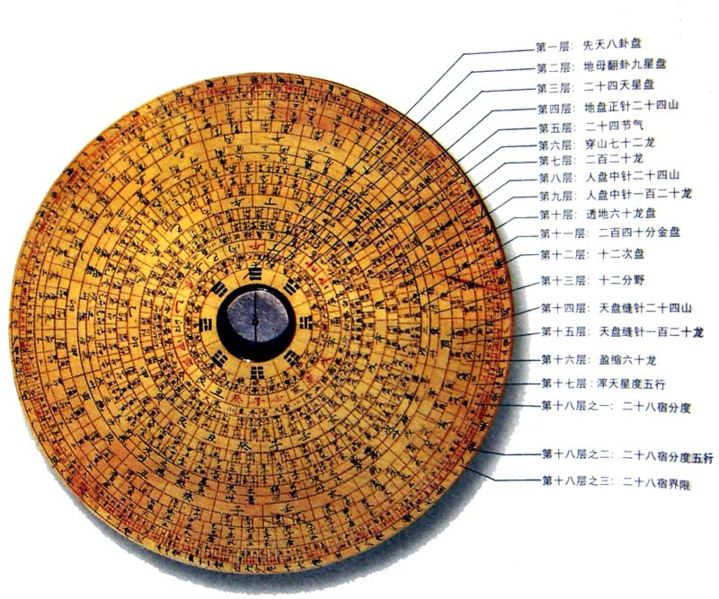
The Compass School (理气派, lǐqì pài), which developed in the flat terrain of Fujian province where dramatic topographical features were less available for analysis, emphasizes mathematical calculation and astronomical observation over visual landscape assessment. Its primary tool is the luopan (罗盘, luópán), a specialized compass consisting of a magnetic needle surrounded by up to forty concentric rings of cosmological data: the Eight Trigrams, the Ten Heavenly Stems, the Twelve Earthly Branches, the twenty-four compass points, the sixty-four hexagrams of the Yijing, and various other correlative systems (Bruun, 2008). A Compass School practitioner uses the luopan to determine the precise orientation of a building or burial site and then consults the concentric rings to assess the astrological and elemental influences associated with that orientation. The calculations involved are extraordinarily complex, involving the interaction of multiple temporal and spatial variables, and mastering the luopan requires years of study under an experienced teacher. The Compass School introduced the concept of time-dependent feng shui — the idea that the quality of a site's feng shui changes over time as cosmic forces shift — creating a dynamic system in which buildings and graves might require periodic adjustment.
In practice, most feng shui practitioners today employ elements of both schools, combining landscape reading with compass analysis to produce a comprehensive assessment. The distinction between the two schools is more a matter of emphasis than fundamental disagreement: both accept the existence of qi, the importance of yin-yang balance, and the influence of the Five Elements; they differ primarily in their methods of detecting and analyzing these forces. The historical rivalry between the schools has generated a rich body of theoretical literature and a culture of vigorous intellectual debate that has kept feng shui evolving across centuries (Feuchtwang, 2002). Modern feng shui education typically includes training in both approaches, and practitioners may favor one school or the other depending on the specific context of their work — Form School methods may be more appropriate for evaluating a rural burial site, while Compass School techniques may be more useful for analyzing an urban apartment with limited landscape features. This methodological pluralism has contributed to feng shui's remarkable adaptability and its capacity to remain relevant across dramatically different environments and historical periods.
Feng Shui in Architecture and City Planning
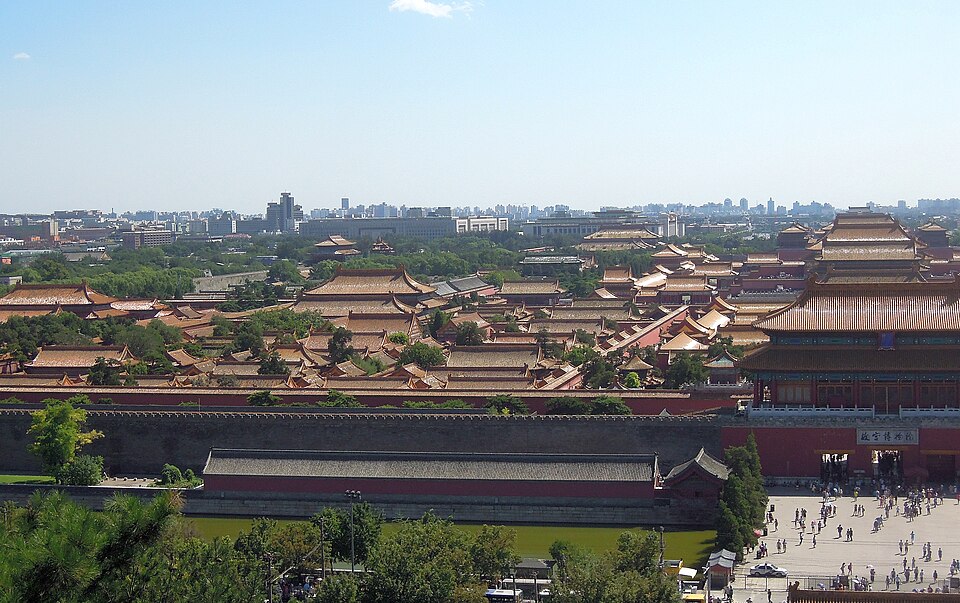
The influence of feng shui on Chinese architecture and urban planning is so pervasive that it is virtually impossible to study the built environment of traditional China without encountering its principles at every turn. The Forbidden City (紫禁城, Zǐjìnchéng) in Beijing, the imperial palace complex that served as the seat of Chinese government for nearly five centuries, is perhaps the most magnificent example of feng shui principles applied at the architectural scale. The entire complex is oriented on a precise north-south axis, with the most important ceremonial halls facing south to receive the maximum yang energy of the sun. An artificial hill (Jingshan, 景山) was constructed to the north of the palace using earth excavated from the moat, creating the "mountain backing" that feng shui prescribes as protection against the cold northern winds and the malevolent forces associated with that direction (Bruun, 2008). The Golden Water River (金水河, Jīnshuǐ Hé) flows in a carefully designed curve across the front of the palace, its gentle arc believed to accumulate and retain beneficial qi that might otherwise flow past the site. Every dimension, color, and decorative motif within the Forbidden City was selected in accordance with feng shui principles, creating an environment designed not merely for human comfort but for cosmic harmony.
The application of feng shui to city planning extends far beyond individual buildings to encompass entire urban landscapes. The layout of traditional Chinese cities typically followed feng shui prescriptions: the city center was positioned at a site of optimal qi concentration, major thoroughfares were oriented to channel beneficial energy through commercial and residential districts, and temples and government buildings were placed at cosmologically significant locations. The city of Xi'an, China's ancient capital, was planned according to feng shui principles during the Tang dynasty, with its grid layout aligned to the cardinal directions and its imperial palace positioned to command the most auspicious site within the urban grid (Feuchtwang, 2002). Even in the modern era, feng shui considerations have influenced major architectural and planning decisions. Hong Kong's extraordinary skyline offers numerous examples: the HSBC headquarters building famously features an open ground floor that allows qi to flow from the hillside behind the building to Victoria Harbour in front; the Bank of China Tower, designed by I. M. Pei with sharp angular edges, was widely criticized for directing sha qi toward neighboring buildings, reportedly prompting some of those buildings to install reflective surfaces to deflect the negative energy.
The tension between feng shui beliefs and modern urban development has produced fascinating conflicts and accommodations across contemporary Asia. In Hong Kong, property developers routinely consult feng shui masters before finalizing building designs, and some residential complexes include "dragon gates" — openings in the building facade that allow mythological dragons to pass through on their way from the mountains to the sea. In Singapore, the Suntec City development was designed as a giant feng shui device, with five office towers representing the five fingers of a hand reaching for a golden globe (representing wealth) at the center (Bruun, 2008). In mainland China, official attitudes toward feng shui remain ambivalent: the practice is technically classified as "feudal superstition" and is not officially endorsed, yet government buildings, including many Communist Party offices, are widely reported to incorporate feng shui considerations into their design. The persistence of feng shui in one of the world's most rapidly modernizing societies suggests that its appeal goes beyond mere superstition, addressing a deeply felt human need to live in harmony with one's surroundings and to believe that the spaces we inhabit actively influence our health, happiness, and fortune.
"Store the wind, gather the qi."
Classical feng shui principleThe Luopan: Instrument of Cosmic Navigation
The luopan (罗盘, luópán), the specialized compass used by feng shui practitioners, is one of the most sophisticated analog instruments ever devised, encoding an entire cosmological system in a portable disc of lacquered wood and magnetized metal. At the center of the luopan sits a magnetic compass needle, oriented to magnetic south (the traditional Chinese convention, in contrast to the Western orientation to magnetic north). Surrounding this needle are concentric rings of data — typically between eight and forty, depending on the complexity of the instrument — each ring containing a different set of cosmological correspondences. The innermost rings typically display the Eight Trigrams (八卦, bāguà) of the Yijing and the Twenty-Four Mountains (二十四山, èrshísì shān), a system that divides the compass into twenty-four segments of fifteen degrees each, combining the Twelve Earthly Branches, the Ten Heavenly Stems, and four of the Eight Trigrams (Feuchtwang, 2002). Outer rings may include the sixty-four hexagrams, the twenty-eight lunar mansions, the seventy-two dragon points, and various other classificatory systems that allow the practitioner to correlate spatial orientation with temporal, elemental, and astrological factors.
The manufacture of traditional luopans is a specialized craft centered in the town of Xiuping in Anhui province, where families of luopan makers have practiced their trade for generations. The construction of a high-quality luopan requires meticulous attention to detail: the wooden base must be seasoned and cut from a single piece to prevent warping; the concentric rings must be inscribed with absolute precision, as even minor errors can produce significant misreadings at the scales involved in feng shui analysis; and the magnetic needle must be properly magnetized and balanced to ensure accurate readings (Bruun, 2008). A master-grade luopan is a work of artisanal craftsmanship as well as a functional instrument, and antique examples command significant prices from collectors. The relationship between a feng shui practitioner and his luopan is personal and often deeply emotional — some masters are buried with their luopans, and traditions exist about the proper rituals for consecrating a new instrument and for retiring an old one. The luopan represents, in material form, the accumulated cosmological knowledge of the feng shui tradition, making its physical presence a source of authority and legitimacy for the practitioner who wields it.
The use of the luopan in practice involves a structured sequence of measurements and calculations that can take hours or even days to complete for a complex site. The practitioner first establishes the "sitting" and "facing" directions of the structure under analysis — the sitting direction being the direction the building's back faces and the facing direction being its front orientation. These two directions, read from the luopan's Twenty-Four Mountains ring, establish the building's fundamental character and determine which cosmological influences affect it (Feuchtwang, 2002). Subsequent readings from the outer rings assess the temporal dimension — how the building's feng shui will change over the twenty-year periods of the feng shui calendar — and identify specific auspicious and inauspicious zones within the structure. The practitioner synthesizes these readings into a comprehensive assessment and prescription, recommending adjustments such as changes in room function, the addition or removal of water features, the placement of specific objects or materials, and the use of particular colors. The luopan analysis is typically combined with Form School assessment of the surrounding landscape, producing a holistic evaluation that considers both the visible physical environment and the invisible cosmological forces that pervade it.
Feng Shui in Interior Design and Personal Space
While the grandest applications of feng shui involve city planning and monumental architecture, its most intimate and perhaps most impactful domain is the design of personal living spaces. The feng shui of a home is believed to directly influence the health, relationships, financial fortunes, and emotional wellbeing of its occupants, making interior feng shui a matter of intense personal concern for millions of people across East Asia and, increasingly, around the world. The basic principles of interior feng shui begin with the commanding position (命位, mìngwèi): the most important pieces of furniture — the bed, the desk, and the stove — should each be positioned so that the user can see the door of the room while not being directly in line with it (Bruun, 2008). This principle, which feng shui practitioners describe in terms of qi flow and security, corresponds to what environmental psychologists have independently identified as a universal human preference for positions that combine prospect (a wide view of the surroundings) and refuge (protection from behind), suggesting that feng shui has, through centuries of observation, codified genuine insights about the relationship between spatial arrangement and psychological comfort.
The application of the bagua (八卦, bāguà) — an octagonal diagram mapping eight life areas to spatial zones — to interior spaces is one of the most widely practiced and accessible forms of feng shui. In the simplified "Black Hat" or "Western" feng shui system popularized by Lin Yun in the 1980s, the bagua is aligned with the front door of a room or home, dividing the space into zones corresponding to career, knowledge, family, wealth, fame, relationships, children, and helpful people, with health at the center (Bruun, 2008). Each zone is associated with specific elements, colors, and materials that can be used to strengthen or activate the corresponding life area: the wealth zone (far left corner from the entrance) benefits from the presence of the Wood element — plants, green colors, vertical shapes — while the relationship zone (far right corner) responds to the Earth element — ceramics, yellow and pink colors, square shapes. This system, while considerably simplified from traditional Compass School feng shui, provides an intuitive and actionable framework for thinking about the relationship between spatial design and life goals.
The practice of feng shui in interior design has generated an enormous industry of products, publications, and professional services. Feng shui consultants — ranging from traditionally trained masters who have studied for decades under lineage holders to self-taught practitioners with weekend certification courses — offer services for residential and commercial clients at every price point. The global feng shui market encompasses books (thousands of titles in dozens of languages), home accessories marketed with feng shui claims (fountains, crystals, mirrors, bamboo plants), and digital services including apps that analyze room layouts and recommend adjustments (Feuchtwang, 2002). The scientific community has generally been skeptical of feng shui's specific claims, though researchers in environmental psychology and neuroarchitecture have noted that many feng shui recommendations — favoring natural light, avoiding clutter, maintaining clear sightlines to exits, incorporating natural elements — align with evidence-based principles of healthy space design. This convergence suggests that feng shui, whatever the validity of its cosmological framework, has accumulated pragmatic wisdom about human spatial preferences that deserves respectful attention from designers and architects. The challenge for contemporary feng shui lies in distinguishing between insights supported by experience and evidence and prescriptions based solely on cosmological theory — a discernment that responsible practitioners increasingly acknowledge as necessary for the tradition's continued credibility.
"Blessed land is inhabited by blessed people; blessed people inhabit blessed land."
Traditional feng shui proverbWestern Adoption and Modern Feng Shui Practice
The introduction of feng shui to Western audiences, beginning in earnest during the 1970s and accelerating through the 1990s and 2000s, represents one of the most significant episodes of cultural transmission between East and West in modern history. The Western feng shui movement was catalyzed by several converging trends: the counterculture's interest in Eastern philosophy, the rise of environmental awareness and ecological thinking, the influence of the New Age movement with its openness to non-Western spiritual traditions, and the practical appeal of a system that promised to improve one's life through the relatively simple act of rearranging one's surroundings. Thomas Lin Yun, a Buddhist monk and feng shui teacher who settled in the United States in the 1970s, played a pivotal role by developing a simplified system — Black Hat Sect Tantric Buddhist Feng Shui — that stripped away the complex calculations of traditional Compass School feng shui and made the practice accessible to Westerners with no background in Chinese cosmology (Bruun, 2008). This simplified approach proved enormously popular and became the dominant form of feng shui practiced in the West, though it was often criticized by traditional Chinese practitioners as a superficial distortion of a profound system.
The corporate adoption of feng shui has been one of the most visible signs of its mainstreaming in Western culture. Major corporations including Apple, Coca-Cola, Procter & Gamble, and numerous Fortune 500 companies have reportedly consulted feng shui practitioners for office design and site selection. In the commercial real estate markets of Hong Kong, Singapore, and increasingly in Western cities with significant Asian populations, feng shui can materially affect property values: apartments with auspicious feng shui — good orientation, favorable views, absence of sha qi sources — command premium prices, while properties with inauspicious features may be discounted (Bruun, 2008). The integration of feng shui into mainstream interior design practice is reflected in the proliferation of feng shui segments in home improvement television programs, feng shui columns in lifestyle magazines, and feng shui features in real estate listings. This commercial success has been accompanied by controversy, with critics arguing that Western feng shui has been commodified and trivialized, reduced from a comprehensive cosmological system to a set of decorating tips marketed to affluent consumers seeking spiritual meaning through consumption.
The future of feng shui practice is being shaped by technological innovation, scientific scrutiny, and cross-cultural dialogue. Digital tools — from smartphone compass apps to artificial intelligence systems that analyze floor plans and generate feng shui recommendations — are making feng shui analysis more accessible and standardized, though traditionalists worry that algorithmic approaches cannot replicate the intuitive sensitivity of an experienced human practitioner. Academic researchers in fields including environmental psychology, biophilic design, and neuroarchitecture are investigating whether feng shui principles correspond to measurable effects on human cognition, emotion, and physiology, with preliminary results suggesting that some feng shui recommendations — such as the importance of natural light, the benefits of organized spaces, and the calming effect of water features — align with empirical findings about human environmental preferences (Feuchtwang, 2002). In China itself, the twenty-first century has seen a significant revival of interest in feng shui among the educated urban middle class, part of a broader cultural movement to reconnect with traditional Chinese knowledge systems. Whether feng shui is best understood as a science, an art, a philosophy, or a cultural practice remains a subject of lively debate; what is beyond dispute is that it continues to influence how hundreds of millions of people around the world conceive of, construct, and inhabit their physical spaces — a testament to the enduring power of the Chinese insight that the arrangement of our surroundings profoundly shapes the quality of our lives.
Quiz
What is the primary goal of feng shui according to the article?
Which of the following is associated with the yin aspect in feng shui?
What tool is primarily used by the Compass School of feng shui?
What is a key feature of the Form School of feng shui?
How does the article describe the relationship between feng shui and Western science?
What is one reason for feng shui's persistence in modern times, according to the article?
What is the significance of the 'commanding position' in feng shui for interior design?
How has feng shui been adapted for Western audiences?
Write your thoughts, then get feedback from Jason — you can turn any answer into a full discussion.
9. Why do you think feng shui has maintained its relevance across different cultural contexts and historical periods?
10. How might the principles of feng shui apply to modern urban planning?
Frequently Asked Questions
Common questions about Feng Shui: The Ancient Science of Space and Harmony
What does feng shui mean and what are its basic principles?
Feng shui literally translates to "wind and water" and is the ancient Chinese practice of arranging spaces to harmonize with the flow of qi (life energy). Its basic principles involve balancing yin and yang forces, aligning with the Five Elements (wood, fire, earth, metal, water), and orienting buildings and rooms to optimize the circulation of beneficial energy.
How does feng shui affect home layout and interior design?
Feng shui influences home design through guidelines on room placement, furniture arrangement, color selection, and the positioning of doors and windows to encourage positive qi flow. Common practices include placing the bed and desk in a "command position" facing the door, avoiding mirrors facing the bed, and ensuring the front entrance is uncluttered to welcome energy into the home.
What is the feng shui bagua map and how is it used?
The bagua is an octagonal energy map used in feng shui to divide a space into eight areas, each corresponding to a different life domain such as wealth, relationships, career, and health. By overlaying the bagua onto a floor plan, practitioners identify which areas of a home or room correspond to each life aspect and make adjustments to enhance energy flow in those zones.
Is there any scientific evidence that feng shui works?
While traditional feng shui is rooted in cosmological beliefs rather than Western empirical science, some of its principles align with findings in environmental psychology and biophilic design. Research has shown that natural light, air circulation, connection to nature, and spatial organization, all central concerns of feng shui, can measurably affect mood, productivity, and well-being.
What is the difference between Form School and Compass School feng shui?
The Form School is the older tradition, focusing on the natural landscape, such as the shape of mountains, the flow of rivers, and the contour of terrain, to determine auspicious sites. The Compass School, developed later, relies on precise directional measurements using the luopan compass and complex calculations involving birth dates and the Chinese calendar to determine optimal orientations.