
Podcast


Podcast: The Art of Chinese Calligraphy: More Than Beautiful Writing
Listen to Jason & Amy discuss The Art of Chinese Calligraphy: More Than Beautiful Writing
New here?
The Four Treasures of the Study
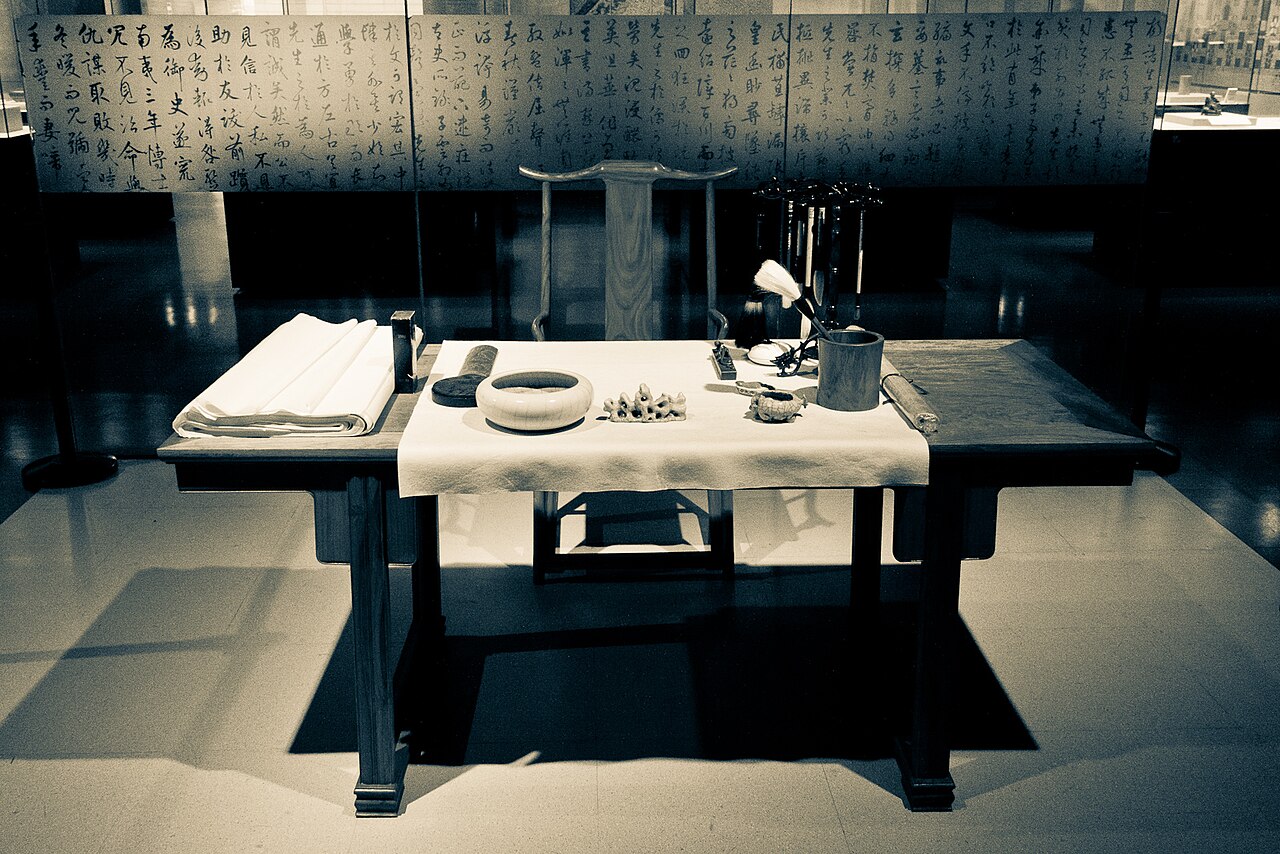
The materials of Chinese calligraphy — collectively known as the Four Treasures of the Study (文房四宝, wénfáng sìbǎo) — are themselves objects of connoisseurship and reverence, elevated by centuries of refinement from simple writing tools into cultural artifacts of the highest order. The brush (毛笔, máobǐ), the most personal of the four treasures, is crafted from animal hair — goat, wolf, rabbit, or combinations thereof — bound to a bamboo or wooden handle. The choice of hair determines the brush's character: soft goat hair produces flowing, absorbent strokes suited to cursive styles, while stiff wolf hair enables the sharp, precise lines demanded by regular script. Master brush-makers, particularly those in Huzhou, Zhejiang province — the historic center of brush production — are regarded as artisans of the highest caliber, and their finest products command prices comparable to those of the artworks they help create (Ledderose, 2000). A calligrapher's relationship with a favored brush is intimate and personal; the brush becomes, in the words of the Tang dynasty calligraphy theorist Sun Guoting, an extension of the calligrapher's arm, heart, and spirit.
Ink (墨, mò), the second treasure, is traditionally produced in solid stick form from pine soot or lampblack bound with animal glue, shaped in carved molds, and often decorated with gold-leaf designs and literary inscriptions. The finest ink sticks, produced in Huizhou (Anhui province) during the Ming and Qing dynasties, are collected as art objects in their own right, prized for their density, luster, and the depth of tone they produce when ground with water. The act of grinding ink on an inkstone (砚, yàn) — the fourth treasure — is itself a meditative preparation for calligraphy, a ritualized transition from the mundane world to the focused state of artistic creation. Premium inkstones, carved from specific geological formations such as the Duan stone of Guangdong or the She stone of Anhui, are evaluated for their texture (which should grind ink smoothly and efficiently), their resonance when tapped, and the beauty of their natural markings (Harrist, 1999). Collectors have paid extraordinary sums for antique inkstones associated with famous calligraphers or scholars, and the imperial court maintained collections of thousands of curated examples.
Paper (纸, zhǐ), the third treasure and China's most transformative gift to world civilization, was invented during the Han dynasty and perfected over subsequent centuries into a dazzling variety of forms. Xuan paper (宣纸, xuānzhǐ), produced in Jing County, Anhui province, using the bark of the blue sandalwood tree (Pteroceltis tatarinowii), is considered the supreme medium for calligraphy and ink painting. Its extraordinary absorbency means that each brushstroke is permanent and unforgivable — the ink is absorbed instantly into the fibers, leaving a record not only of the stroke's shape but of the calligrapher's speed, pressure, and confidence. This characteristic makes Chinese calligraphy a uniquely revealing art form: hesitation, fear, or loss of concentration are permanently recorded in the quality of the line, visible to any educated viewer (Ledderose, 2000). The Four Treasures together constitute a complete aesthetic system in which the quality of materials and the skill of the artist are inseparable, each treasure influencing and being influenced by the others in an ongoing dialogue between human intention and material response.
"Calligraphy is the painting of the heart."
Yang Xiong (53 BCE – 18 CE), FayanThe Evolution of Script Styles
The history of Chinese writing encompasses a remarkable sequence of script transformations, each reflecting the technological, social, and aesthetic priorities of its era. The earliest known Chinese writing appears on oracle bones (甲骨文, jiǎgǔwén) dating to the Shang dynasty (c. 1300–1046 BCE): tortoise shells and ox scapulae inscribed with sharp tools in a script that, while already highly developed, retains a pictographic vitality that later scripts would gradually abstract away. Oracle bone script characters often preserve recognizable images of the objects they represent — a person, a tree, an ox, the sun — rendered in angular strokes dictated by the hardness of the bone surface and the rigidity of the carving tool (Ledderose, 2000). The approximately 4,500 distinct characters identified in oracle bone inscriptions demonstrate that Chinese writing was already a sophisticated system by the late second millennium BCE, capable of recording complex divination questions addressed to ancestral spirits and deities. The discovery of oracle bones near Anyang in 1899 revolutionized the study of early Chinese civilization, providing direct evidence of Shang dynasty literacy and religious practice.
Seal script (篆书, zhuànshū), which emerged during the Zhou dynasty and was standardized under the Qin dynasty's imperial unification of writing in 221 BCE, represents the first stage in the evolution from pictographic to abstract writing. The Qin standardization, overseen by the chancellor Li Si, produced Small Seal Script (小篆, xiǎozhuàn), a regularized, symmetrical script that unified the variant writing systems of the former Warring States into a single national standard. Clerical script (隶书, lìshū), which developed during the late Qin and Han dynasties, marked a revolutionary break with the curvilinear seal script tradition: its angular, horizontal strokes, ending in distinctive flared tails, were better suited to the demands of an expanding bureaucracy that required speed and legibility over elegance (Harrist, 1999). The transformation from seal to clerical script — known as the "clerical transformation" (隶变, lìbiàn) — is the most significant structural change in the history of Chinese writing, establishing the basic architecture of character forms that persists to the present day. Regular script (楷书, kǎishū), which crystallized during the late Han and Wei-Jin periods, refined clerical script into the precise, balanced form that remains the standard for printed and formal handwritten Chinese.
The cursive scripts — running script (行书, xíngshū) and grass script (草书, cǎoshū) — represent the artistic liberation of Chinese writing from the constraints of legibility. Running script, which allows connected strokes and simplified forms while remaining generally readable, emerged as the preferred medium for personal correspondence, literary composition, and artistic expression. Grass script takes this liberation to its extreme, reducing characters to fluid, often barely recognizable gestures that prioritize rhythm, energy, and emotional expression over communicative clarity (Ledderose, 2000). A masterpiece of grass script calligraphy is not meant to be read so much as experienced — its swooping lines, dramatic contrasts of thick and thin, and dynamic spatial composition convey meaning through aesthetic rather than semantic channels. The six script styles — oracle bone, seal, clerical, regular, running, and grass — are not merely successive historical stages but coexisting artistic options available to the modern calligrapher, each carrying its own associations, challenges, and expressive possibilities.
Calligraphy as Spiritual Practice and Meditation
Chinese calligraphy has been understood since antiquity as far more than a practical skill or decorative art — it is a practice of self-cultivation that integrates body, mind, and spirit in the act of writing. The Confucian scholar-official tradition, which dominated Chinese high culture for over two thousand years, regarded calligraphy as one of the "Six Arts" (六艺, liùyì) essential to a gentleman's education, alongside ritual, music, archery, chariot-driving, and mathematics. Proficiency in calligraphy was not merely an accomplishment but a moral indicator: the quality of one's writing was believed to reflect the quality of one's character, a principle encapsulated in the ancient saying "writing reveals the person" (字如其人, zì rú qí rén). This belief invested the act of writing with ethical significance, transforming every brushstroke into a statement about the writer's inner state (Harrist, 1999). Imperial examination candidates were judged not only on the content of their essays but on the quality of their calligraphy, and a brilliant argument expressed in poor handwriting could result in failure.
The meditative dimension of calligraphy practice resonates with both Daoist and Buddhist contemplative traditions. The preparation ritual — grinding ink, selecting paper, arranging the workspace — serves as a transition from ordinary consciousness to the focused, receptive state required for good calligraphy. The act of writing demands a paradoxical combination of intense concentration and relaxed spontaneity: the calligrapher must plan the composition in advance, visualizing each character's position and proportions before the brush touches paper, yet execute each stroke with the fluid responsiveness that comes only from a mind free of anxiety and self-consciousness (Ledderose, 2000). This state of engaged effortlessness (无为, wúwéi in Daoist terminology) is precisely the condition that meditation traditions seek to cultivate, and many Chinese and Japanese practitioners have explicitly linked calligraphy practice to Zen Buddhist training. The breath, posture, and mental focus required for calligraphy practice parallel those of seated meditation, and the results — a heightened awareness of the present moment, a dissolution of the boundary between self and activity — are strikingly similar.
The theoretical literature on Chinese calligraphy, which spans nearly two millennia, is among the most sophisticated bodies of aesthetic philosophy produced by any civilization. Sun Guoting's seventh-century treatise Shu Pu (Manual of Calligraphy) analyzes the art in terms that anticipate modern discussions of creativity, embodied cognition, and the relationship between technique and expression. He describes the ideal calligraphic state as one in which "the brush responds to the heart, and the heart forgets the brush" — a formulation that captures the essential paradox of artistic mastery in any medium. Later theorists developed elaborate metaphorical vocabularies for describing the qualities of brushwork: a stroke might be compared to "a crossbow bolt at the moment of release," "an old vine hanging from a cliff," or "a flock of geese descending on a flat sandbar" (Harrist, 1999). These comparisons are not merely decorative; they encode precise information about the speed, weight, angle, and energy of specific brushstroke types, transmitting technical knowledge through aesthetic imagery in a characteristically Chinese fusion of the practical and the poetic.
"The use of the brush lies in the heart; when the heart is upright, the brush will be upright."
Liu Gongquan (778–865 CE)Famous Calligraphers: Wang Xizhi, Yan Zhenqing, and Beyond
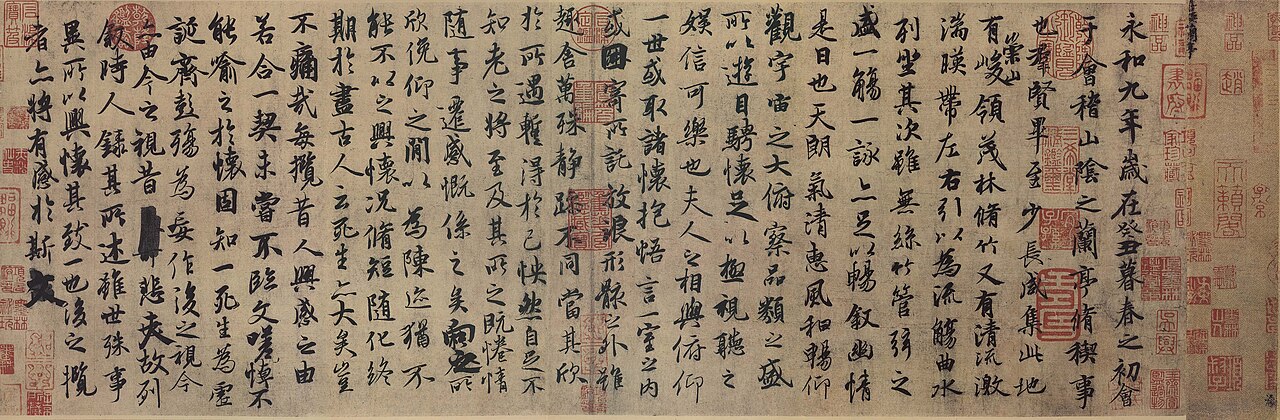
The history of Chinese calligraphy is populated by a pantheon of legendary practitioners whose works have defined artistic standards for centuries. Wang Xizhi (303–361 CE), universally recognized as the "Sage of Calligraphy" (书圣, shūshèng), holds a position in Chinese art comparable to that of Shakespeare in English literature or Beethoven in Western music — the supreme exemplar against whom all others are measured. His masterwork, the Preface to the Orchid Pavilion Gathering (兰亭集序, Lántíng Jí Xù), composed in 353 CE during a springtime gathering of scholars and poets at the Orchid Pavilion near Shaoxing, is often described as the single greatest work of Chinese calligraphy ever produced. Written in running script while Wang was in a state of wine-enhanced inspiration, the Preface combines philosophical reflection on the transience of life with brushwork of such naturalness and grace that it has served as the primary model for running script calligraphy for over sixteen centuries (Ledderose, 2000). The original work was reportedly buried with the Tang Emperor Taizong, who was so devoted to Wang Xizhi's calligraphy that he had the original interred in his tomb; all surviving versions are copies, yet even these copies are treasured as masterpieces.
Yan Zhenqing (709–785 CE), the other towering figure in Chinese calligraphy history, represents a dramatic contrast to Wang Xizhi's elegant refinement. Yan's calligraphy is characterized by powerful, muscular strokes, generous proportions, and an architectural solidity that reflects his reputation as a man of unwavering moral courage — he was martyred for his loyalty to the Tang dynasty during the An Lushan Rebellion. His most celebrated work, the Draft Eulogy for Nephew Ji Ming (祭侄文稿, Jì Zhí Wéngǎo), written in a state of grief and anger after learning of his nephew's death in battle, is remarkable for its raw emotional power: crossed-out characters, smeared ink, and increasingly agitated brushwork create a document that is simultaneously a literary composition and a direct record of its creator's psychological state (Harrist, 1999). Later critics ranked this work alongside Wang Xizhi's Orchid Pavilion Preface as one of the supreme achievements of Chinese calligraphy, demonstrating that artistic greatness could emerge from anguish as powerfully as from serenity. The contrast between these two masters — Wang's graceful spontaneity and Yan's passionate intensity — established the two poles of the Chinese calligraphic tradition.
Subsequent centuries produced a rich succession of distinctive calligraphic voices. The Song dynasty painter and calligrapher Mi Fu (1051–1107) developed an idiosyncratic style marked by dramatic tilts and unconventional structures that influenced centuries of subsequent practitioners. The Yuan dynasty master Zhao Mengfu (1254–1322) championed a return to the classical elegance of Wang Xizhi, producing works of such polished beauty that they became the standard for official and commercial calligraphy throughout the late imperial period. During the Qing dynasty, epigraphic studies (金石学, jīnshí xué) inspired a revival of interest in archaic seal and clerical scripts, with calligraphers such as Deng Shiru and He Shaoji producing monumental works that drew on the austere power of ancient stone inscriptions (Ledderose, 2000). In the twentieth century, masters such as Qi Baishi, who combined calligraphy with painting, and Yu Youren, who modernized grass script, extended the tradition into the modern era. Each generation of calligraphers faces the same fundamental challenge: how to honor the accumulated tradition while finding an authentic personal voice — how to be both faithful and free.
Calligraphy in Daily Life: Couplets, Scrolls, and Ceremony
While Chinese calligraphy reaches its highest expression in the masterworks of individual artists, its deepest cultural significance may lie in its pervasive presence in everyday Chinese life. The most visible manifestation of this presence is the Spring Festival couplet (春联, chūnlián), a pair of poetic phrases written in bold calligraphy on red paper and pasted on either side of the front door during Chinese New Year. This tradition, which dates to at least the Song dynasty and possibly earlier, transforms the act of calligraphy from an elite artistic practice into a communal cultural ritual in which virtually every Chinese household participates. The couplets, composed in parallel syntax with matching tonal patterns, express wishes for prosperity, health, harmony, and good fortune in the coming year (Ledderose, 2000). In many families, writing the couplets is the province of the household's most accomplished calligrapher — often a grandfather or uncle — whose annual performance of this task is both a display of skill and an assertion of cultural authority. In recent decades, commercially printed couplets have become common, but many families continue to prize hand-written versions, and community calligraphy events at which volunteer calligraphers write couplets for neighbors remain popular throughout China during the New Year period.
Calligraphy accompanies Chinese life from birth to death, marking every significant transition and ceremony. A newborn's name, carefully chosen by parents and often approved by a fortune-teller, is formally written in calligraphy and presented to the family. Wedding ceremonies feature calligraphic scrolls bearing the double happiness character (囍, shuāng xǐ) and auspicious phrases wishing the couple longevity, harmony, and fertility. Business openings are marked with calligraphic banners, and the name boards of shops, restaurants, and public buildings are traditionally written by calligraphers of distinction — in some cases, famous historical figures whose brushwork confers prestige and legitimacy on the establishment (Harrist, 1999). Even in death, calligraphy is present: funeral banners, memorial tablets, and epitaphs are written or carved in scripts appropriate to their solemn purpose. The omnipresence of calligraphy in Chinese ceremonial life means that virtually every Chinese person, regardless of education or social class, develops an intuitive appreciation for the qualities of good brushwork — a cultural literacy that has no direct equivalent in alphabetic writing cultures.
The architectural integration of calligraphy into Chinese physical spaces extends the art's influence beyond paper into the built environment. Temples and palaces display calligraphic inscriptions on plaques (匾额, biǎn'é), pillars, and walls, often the work of emperors, famous scholars, or renowned monks. The calligraphic plaques of the Forbidden City, many written by the Kangxi and Qianlong emperors, are both artistic treasures and assertions of imperial authority — the emperor's brush conferring legitimacy on the spaces it names. Garden architecture incorporates calligraphy into rock inscriptions, pavilion names, and poetic verses carved into doorways and windows, creating a dialogue between text and landscape that is fundamental to the Chinese garden aesthetic. In the scholar's study (书房, shūfáng), calligraphic scrolls hang on the walls and change with the seasons, each one selected for its artistic merit, literary content, and emotional appropriateness to the time of year (Ledderose, 2000). This practice of living with calligraphy — of surrounding oneself with beautiful writing as a source of inspiration, comfort, and aesthetic pleasure — represents a relationship between art and daily life that Chinese civilization has cultivated with unparalleled devotion.
"In learning calligraphy, one must first study regular script; in practicing characters, one must first write large characters."
Traditional calligraphy teaching maximThe Modern Calligraphy Revival
The twentieth century posed existential challenges to the art of Chinese calligraphy. The abolition of the imperial examination system in 1905 removed the institutional requirement for calligraphic proficiency among the educated class. The May Fourth Movement of 1919 championed vernacular Chinese and Western-style education, marginalizing classical literary skills. The simplification of Chinese characters, implemented in mainland China in the 1950s and 1960s, altered the visual forms that calligraphers had practiced for centuries. And the ubiquitous adoption of ballpoint pens and, later, keyboards and touchscreens appeared to threaten the very survival of brush-based writing as a living practice. Yet calligraphy has not only survived these challenges but has experienced a remarkable renaissance in the late twentieth and early twenty-first centuries, driven by a combination of cultural nationalism, wellness trends, and artistic innovation (Harrist, 1999). The Chinese government has included calligraphy in the national school curriculum, public parks host spontaneous calligraphy gatherings where enthusiasts practice writing characters on the pavement with water-brushes, and calligraphy classes have become one of the most popular forms of adult education in Chinese cities.
The contemporary calligraphy scene in China and East Asia encompasses a spectrum from rigorous traditional practice to radical experimentation. At the traditional end, master calligraphers maintain the classical techniques and aesthetic standards transmitted through centuries of teacher-student lineage, producing works that deliberately echo and engage with the historical canon. Calligraphy competitions, judged by panels of established masters, attract thousands of participants and serve as gateways to professional recognition. At the experimental end, artists such as Xu Bing, Gu Wenda, and Qiu Zhijie have deconstructed and reimagined calligraphy in ways that challenge the boundary between writing and visual art (Ledderose, 2000). Xu Bing's "Book from the Sky" (天书, tiānshū), a monumental installation featuring thousands of invented pseudo-characters printed from hand-carved blocks, interrogates the nature of meaning and the authority of the written word. Gu Wenda's installations, incorporating calligraphic elements made from human hair, explore the relationship between the body and cultural production. These avant-garde practitioners are sometimes criticized by traditionalists as disrespectful of the canon, but they also attract international attention and demonstrate that calligraphy remains a vital and evolving art form capable of engaging with contemporary intellectual concerns.
The global spread of interest in Chinese calligraphy has created new audiences, new contexts, and new possibilities for the art. Calligraphy workshops and exhibitions are now regular features of cultural programming at museums and cultural centers worldwide, from the Metropolitan Museum of Art in New York to the British Museum in London. The meditative aspects of calligraphy practice have found receptive audiences in the global wellness and mindfulness movements, with calligraphy positioned as a form of "moving meditation" alongside yoga and tai chi. Digital calligraphy tools — tablet applications that simulate the behavior of brush, ink, and paper with increasing fidelity — have introduced the art to users who lack access to traditional materials, though purists debate whether digital tools can truly replicate the tactile experience of grinding ink and feeling the brush respond to paper (Harrist, 1999). Social media platforms, particularly Instagram, Douyin (TikTok), and Xiaohongshu, have created new communities of calligraphy enthusiasts who share their practice, offer instruction, and celebrate the beauty of the written Chinese character. In this digital landscape, calligraphy has found a paradoxical new relevance: in a world saturated with machine-generated text, the handwritten character — imperfect, personal, and unmistakably human — has become a powerful symbol of authenticity and cultural depth.
Quiz
What are the Four Treasures of the Study in Chinese calligraphy?
Which script style emerged during the Zhou dynasty and was standardized under the Qin dynasty?
What is a significant feature of Xuan paper used in Chinese calligraphy?
What role does calligraphy play in Chinese cultural rituals?
What is the significance of Wang Xizhi's 'Preface to the Orchid Pavilion Gathering'?
How did the simplification of Chinese characters in the 20th century affect calligraphy?
Which dynasty saw the development of clerical script?
What is a key characteristic of grass script in Chinese calligraphy?
Write your thoughts, then get feedback from Jason — you can turn any answer into a full discussion.
9. How does Chinese calligraphy reflect both personal expression and cultural tradition?
10. In what ways might the practice of calligraphy be considered a form of meditation?
Frequently Asked Questions
Common questions about The Art of Chinese Calligraphy: More Than Beautiful Writing
What are the Four Treasures of the Study in Chinese calligraphy?
The Four Treasures of the Study (wenfang sibao) are the essential tools of Chinese calligraphy: the brush (bi), ink (mo), paper (zhi), and inkstone (yan). Each has its own rich history of craftsmanship, with the finest brushes made from weasel or goat hair, ink ground from pine soot, paper from mulberry bark, and inkstones carved from prized regional stones.
What are the five main scripts in Chinese calligraphy?
The five major script styles in Chinese calligraphy are seal script (zhuanshu), clerical script (lishu), regular script (kaishu), running script (xingshu), and cursive or grass script (caoshu). These styles developed sequentially over centuries, from the formal and archaic seal script used on bronze vessels to the fluid, expressive strokes of cursive script.
Why is Chinese calligraphy considered an art form rather than just writing?
Chinese calligraphy transcends mere writing because each brushstroke expresses the artist's inner character, emotional state, and years of disciplined practice. The balance of strength and delicacy, speed and control, ink saturation and white space creates a visual art form that has been revered alongside painting and poetry as one of the highest cultural achievements in Chinese civilization.
Who is Wang Xizhi and why is he famous in Chinese calligraphy?
Wang Xizhi (303-361 CE) is universally regarded as the greatest calligrapher in Chinese history, earning the title "Sage of Calligraphy." His masterwork, the Preface to the Orchid Pavilion Gathering (Lanting Xu), is considered the most celebrated piece of Chinese calligraphy ever created, though the original was reportedly buried with Emperor Taizong of Tang and only survives through copies.
How long does it take to learn Chinese calligraphy?
Traditional Chinese calligraphy training requires years of dedicated practice, beginning with mastering basic strokes and progressing through increasingly complex characters and script styles. Students typically spend months on regular script (kaishu) alone before advancing to running and cursive styles, and accomplished calligraphers often describe the art as a lifelong pursuit of refinement.