
Podcast


Podcast: The Chinese Tea Ceremony: From Medicine to Meditation
Listen to Jason & Amy discuss The Chinese Tea Ceremony: From Medicine to Meditation
New here?
Lu Yu and the Classic of Tea
The history of tea in China stretches back thousands of years, but it was the Tang dynasty scholar Lu Yu who transformed tea drinking from a regional folk practice into a codified art with philosophical underpinnings. Born an orphan around 733 CE and raised by Buddhist monks at the Dragon Cloud Monastery in Hubei province, Lu Yu spent decades traveling through the tea-growing regions of southern China, observing cultivation methods, water sources, and preparation techniques with the meticulous eye of a naturalist. The result of his lifelong study was the Chajing, or Classic of Tea, completed around 760 CE — the world's first comprehensive treatise on tea. In three concise volumes comprising just over seven thousand characters, Lu Yu covered every aspect of tea culture: the botany of the tea plant, the manufacture of tea cakes, the selection of water, the design of brewing implements, and the proper etiquette of tea service. As Benn (2015) demonstrated, the Chajing was not merely a practical manual but a work of aesthetic philosophy that elevated tea to the same plane as calligraphy, poetry, and music in the hierarchy of Chinese refined arts.
Lu Yu's influence extended far beyond the written word. He designed a complete set of twenty-four tea implements, from the wind furnace for boiling water to the bamboo tongs for handling charcoal, each crafted with attention to both function and beauty. His method of tea preparation — grinding compressed tea cakes into powder, then whisking the powder into boiling water seasoned with a pinch of salt — established the template for Tang dynasty tea culture and deeply influenced the Japanese tea ceremony that would develop centuries later. Lu Yu insisted that the quality of water was as important as the quality of the leaf, and he famously ranked twenty water sources across China, placing the spring at Nanling in Jiangxi province first. This emphasis on water quality reflected a broader philosophical commitment: tea was not simply a drink but a medium through which one could cultivate sensitivity to the subtle distinctions that separate the excellent from the merely adequate (Mair & Hoh, 2009, pp. 38–45).
The cultural impact of the Chajing was immediate and enduring. Within a generation of its publication, tea merchants across China were enshrining ceramic figurines of Lu Yu in their shops, treating him as a patron deity of the trade. The Tang court adopted elaborate tea rituals, and tea taxation became a significant source of imperial revenue. Lu Yu's insistence that tea drinking was a practice requiring knowledge, skill, and refined sensibility helped establish tea as a marker of cultural sophistication — a status it has never lost. The discovery of the Famen Temple tea set in 1987, a trove of exquisite gold and silver tea implements buried in 874 CE as an offering to the Buddha, confirmed the extraordinary prestige that tea culture had achieved within little more than a century of Lu Yu's death. Today, Lu Yu is venerated as the Tea Sage (Cha Shen), and his Chajing remains the foundational text for anyone seeking to understand the deep roots of Chinese tea culture (Benn, 2015, pp. 102–118).
"Tea is a magnificent tree of the south."
Lu Yu, "The Classic of Tea" (Chajing, 760 CE)The Gongfu Tea Method
While Lu Yu's whisked powder method defined Tang dynasty tea culture, the most celebrated Chinese tea tradition practiced today is the Gongfu tea ceremony, which emerged in the Chaoshan region of eastern Guangdong and southern Fujian during the late Ming and early Qing dynasties. The term gongfu cha literally means "tea made with skill," and the name is apt: the method demands precise attention to leaf quantity, water temperature, steeping time, and pouring technique, all calibrated to extract the maximum flavor and aroma from high-quality loose-leaf tea. Unlike the Japanese tea ceremony, which follows a rigidly prescribed sequence of movements, Gongfu tea is characterized by a more informal, conversational atmosphere — the host adjusts each infusion in response to the tea's evolving character, and the small cups encourage frequent refills and unhurried conversation. As Heiss and Heiss (2007) observed, Gongfu tea is less a performance than a practice, a daily discipline through which the tea maker develops an ever-deeper understanding of leaf, water, and fire.
The Gongfu method is built around the principle of multiple short infusions rather than a single long steeping. A generous quantity of leaf — typically filling one-third to one-half of the brewing vessel — is steeped in near-boiling water for just a few seconds on the first infusion, with each successive steeping slightly longer than the last. A fine oolong or aged pu-erh tea can yield eight to twelve distinct infusions, each revealing different facets of the tea's character: the first wash might offer bright floral top notes, the middle infusions a deep mineral sweetness, and the final steepings a gentle, lingering warmth. This progressive revelation is one of the great pleasures of Gongfu tea, transforming what might seem like a simple cup of tea into an extended meditation on impermanence and change. The practice also demands a cultivated palate: experienced Gongfu practitioners speak of huigan, the "returning sweetness" that rises in the throat after swallowing, and chaqi, the subtle physical sensation of warmth and well-being that a fine tea produces in the body (Heiss & Heiss, 2007, pp. 215–230).
The social dimension of Gongfu tea is equally important. In the teahouses of Chaozhou and Shantou, Gongfu tea service is the essential medium of hospitality, business negotiation, and friendship. Refusing a cup of tea offered in the Gongfu style is considered a serious breach of etiquette, while offering tea is an expression of respect and goodwill that transcends differences of age, status, and opinion. The host's attentiveness to each guest's cup — ensuring that every pour is equal in strength and volume — embodies the Confucian virtue of fairness and consideration for others. In recent decades, the Gongfu method has spread far beyond its Chaoshan heartland, adopted by tea enthusiasts across China and around the world as the optimal way to appreciate fine Chinese teas. The rise of dedicated Gongfu tea studios in cities like Shanghai, Beijing, and Chengdu reflects a broader cultural movement to reclaim traditional Chinese aesthetics in an era of rapid modernization (Mair & Hoh, 2009, pp. 178–192).
Tea Ware and the Art of Yixing
No discussion of Chinese tea culture is complete without attention to the remarkable tradition of tea ware that has developed over centuries to serve and enhance the tea-drinking experience. At the pinnacle of this tradition stands the Yixing teapot, crafted from the unique zisha (purple sand) clay found only in the hills near Yixing in Jiangsu province. Yixing clay possesses a naturally porous microstructure that absorbs the oils and flavors of tea with each use, so that a well-seasoned Yixing pot gradually develops a patina of accumulated flavor that enriches every subsequent brewing. Serious tea drinkers dedicate individual pots to single tea types — one for Tieguanyin oolong, another for aged pu-erh, a third for Wuyi rock tea — understanding that the pot's memory of past infusions becomes an integral part of the tea's character. The finest Yixing pots, particularly those by renowned Ming dynasty potters such as Gong Chun and Shi Dabin, are prized as art objects and command prices comparable to major paintings and calligraphy works (Lo, 2008, pp. 67–89).
The gaiwan, a lidded bowl without a handle, represents a different approach to tea ware that is equally central to Chinese tea culture. Consisting of three pieces — saucer, bowl, and lid — the gaiwan symbolizes the traditional Chinese cosmological triad of earth, humanity, and heaven. Its open form allows the drinker to observe the unfurling of the leaves, appreciate the color of the liquor, and inhale the aroma captured beneath the lid, engaging multiple senses simultaneously. The gaiwan is favored by professional tea tasters and competition judges because its glazed porcelain surface, unlike the absorbent Yixing clay, does not retain flavors from previous steepings, allowing each tea to be evaluated purely on its own merits. The Jingdezhen kilns in Jiangxi province have produced gaiwans of extraordinary quality for centuries, and the thin, translucent porcelain bowls from this region remain the gold standard for the form. As Lo (2008) noted, the choice between Yixing pot and porcelain gaiwan reflects a fundamental aesthetic tension in Chinese tea culture: between the accumulation of experience and the purity of each individual moment.
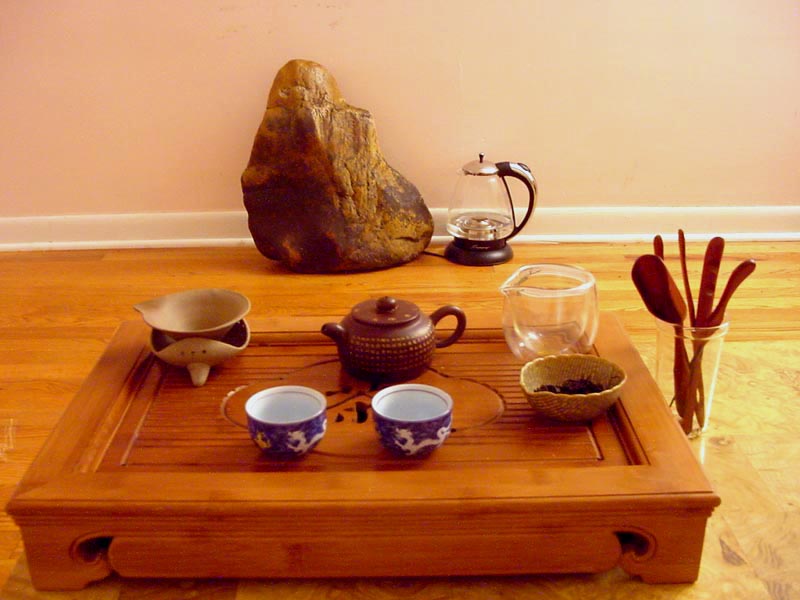
Beyond pots and gaiwans, the full Gongfu tea set includes a constellation of smaller implements, each serving a specific function in the ceremony. The cha hai, or fairness pitcher, receives the tea liquor from the brewing vessel and ensures that each guest's cup is poured from a uniformly blended infusion. The wen xiang bei, or aroma cup, is a tall, narrow vessel used exclusively for appreciating the tea's fragrance — the drinker pours the tea from the aroma cup into the tasting cup, then lifts the empty vessel to the nose, inhaling the lingering scent that clings to the warm porcelain. Tea pets, small clay figurines placed on the tea tray, are ritually bathed in discarded tea with each session, developing a glossy patina over years of use that serves as a visible record of the owner's dedication to the practice. The tea tray itself, traditionally carved from a single piece of wood or stone, incorporates a drainage system that catches the copious overflow of water and tea that characterizes the Gongfu method. Together, these implements create a complete aesthetic environment that transforms simple tea drinking into a multisensory ritual of remarkable depth and sophistication (Heiss & Heiss, 2007, pp. 241–258).
"A vessel earns its fame only through tea; guests come happily, drawn by the fragrance."
Traditional Chinese tea coupletTea in Diplomacy and Friendship

Throughout Chinese history, tea has served as a powerful instrument of diplomacy, trade, and political alliance, its significance extending far beyond the intimate setting of the teahouse. The Tang dynasty established the tea-horse trade with Tibetan and Central Asian peoples, exchanging compressed tea bricks for the warhorses that were essential to imperial defense. This exchange, formalized during the Song dynasty through dedicated Tea-Horse Offices (Cha Ma Si) along the Sichuan-Tibet frontier, created one of the most enduring trade relationships in Asian history, persisting for nearly a thousand years. The famous Tea-Horse Road (Cha Ma Gu Dao), a network of caravan trails stretching from Yunnan and Sichuan into Tibet, Southeast Asia, and beyond, carried not only tea and horses but also ideas, religions, and cultural practices across vast distances. As Benn (2015) documented, the control of tea production and distribution became a matter of state security, with imperial governments periodically imposing monopolies and export restrictions to maintain leverage over neighboring peoples who had become dependent on Chinese tea.
At the interpersonal level, tea has functioned as the essential medium of Chinese social life for over a millennium. The act of offering tea to a guest is the most basic expression of hospitality in Chinese culture, a gesture so deeply embedded in social practice that it transcends differences of region, class, and dialect. In business negotiations, the initial tea service establishes the tone of the meeting: the quality of the tea signals respect for the counterpart, while the unhurried pace of the ceremony creates space for relationship-building before substantive discussion begins. Wedding tea ceremonies, in which the bride and groom serve tea to their parents and in-laws, formalize the joining of two families and express filial gratitude — a tradition that remains nearly universal in Chinese weddings today, even those that have adopted otherwise Western formats. The Cantonese tradition of yum cha, literally "drinking tea," has evolved into the elaborate dim sum culture that represents one of China's most successful culinary exports, demonstrating how tea service can anchor an entire gastronomic tradition (Mair & Hoh, 2009, pp. 125–148).
Tea also played a pivotal role in China's encounter with the wider world during the age of European expansion. The insatiable British demand for Chinese tea in the eighteenth and nineteenth centuries created a massive trade imbalance that the East India Company attempted to redress through the export of Indian opium to China — a policy that led directly to the Opium Wars and one of the most traumatic chapters in modern Chinese history. The British theft of tea plants and manufacturing knowledge from China, accomplished through the industrial espionage of Robert Fortune in the 1840s, enabled the establishment of tea plantations in India and Ceylon that eventually broke China's monopoly on the global tea trade. This episode remains a sensitive subject in Chinese historical memory, serving as a reminder that tea — seemingly the most peaceful and contemplative of commodities — has been entangled with some of the most consequential power struggles of the modern era. Today, China has reclaimed its position as the world's largest tea producer and is actively promoting tea culture as an element of its soft power diplomacy, establishing Confucius Institute tea programs and hosting international tea expositions that present tea as a bridge between civilizations (Benn, 2015, pp. 198–215).
Regional Tea Cultures of China
China's vast geographic and climatic diversity has given rise to a remarkable array of regional tea cultures, each with its own preferred tea types, preparation methods, and social customs. In the mountainous terrain of Fujian province, the production of oolong tea — particularly the legendary Tieguanyin of Anxi and the robust rock teas (yancha) of the Wuyi Mountains — has shaped a local culture of extraordinary tea connoisseurship. Wuyi rock teas, grown in the mineral-rich soils of narrow gorges and steep cliffs, are prized for their "rock bone floral fragrance" (yan gu hua xiang), a unique combination of deep mineral intensity and ethereal perfume that tea lovers attribute to the specific microclimate and geology of individual growing sites. The concept of terroir, so central to European wine culture, finds its most developed Chinese expression in the Wuyi tea tradition, where experienced practitioners can identify the specific cliff face or stream valley where a tea was grown solely by tasting the brewed liquor. Annual Wuyi rock tea competitions draw thousands of entries and serve as important events in the local social calendar, reinforcing community identity around shared tea culture (Heiss & Heiss, 2007, pp. 155–178).
In Yunnan province, China's southwestern frontier, the ancient tradition of pu-erh tea represents an entirely different approach to tea production and appreciation. Pu-erh is made from the broad leaves of large-leaf tea trees, some of which are several hundred years old, growing in the misty mountains along the borders with Laos, Myanmar, and Vietnam. Unlike other Chinese teas, which are valued for their freshness, pu-erh undergoes a process of microbial fermentation that allows it to improve with age, much like fine wine or cheese. Aged pu-erh cakes from reputable producers have become significant investment vehicles, with rare vintage examples from the 1950s and 1960s selling for tens of thousands of dollars at auction. The pu-erh market experienced a speculative bubble in 2007 that saw prices crash dramatically, but demand has since recovered and the tea continues to command devoted followings in Guangdong, Hong Kong, Taiwan, and Malaysia, where tropical humidity provides ideal conditions for aging. The culture of pu-erh collecting has generated its own specialized vocabulary, aesthetic criteria, and social networks, constituting a distinct subculture within the broader world of Chinese tea (Mair & Hoh, 2009, pp. 200–218).
The green tea traditions of eastern China offer yet another dimension of tea culture. West Lake Longjing (Dragon Well) tea, produced in the hills surrounding Hangzhou in Zhejiang province, is perhaps the most famous Chinese green tea, prized for its flat, sword-shaped leaves, chestnut aroma, and sweet, vegetal flavor. Longjing production is governed by strict standards that specify picking dates, leaf grades, and roasting techniques, and the most prized lots — harvested before the Qingming Festival in early April — command extraordinary prices. The tradition of drinking Longjing tea while visiting the scenic West Lake has been a fixture of Chinese literary and tourist culture since the Song dynasty, when the poet Su Shi compared the lake to the legendary beauty Xi Shi and praised the local tea in verse. In northern China, jasmine tea (molihua cha) dominates the tea landscape, its fragrant blend of green tea base and fresh jasmine blossoms reflecting the region's historical preference for strongly scented teas that can cut through the rich, hearty flavors of northern cuisine. Beijing's traditional teahouses, though diminished in number, continue to serve jasmine tea in large lidded cups, preserving a tea culture that emphasizes generous hospitality and lively conversation over the quiet contemplation of the southern Gongfu tradition (Lo, 2008, pp. 112–135).
"Firewood, rice, oil, salt, sauce, vinegar, and tea — the seven necessities of daily life."
Song dynasty proverbModern Tea Culture Revival
The late twentieth and early twenty-first centuries have witnessed a remarkable revival of Chinese tea culture, driven by rising prosperity, growing cultural confidence, and a widespread desire to reconnect with traditional practices in an era of rapid social change. During the decades of revolutionary upheaval from the 1950s through the 1970s, traditional tea culture was largely suppressed as a feudal relic, and many of China's finest tea gardens fell into neglect or were converted to other agricultural uses. The economic reforms of the 1980s and 1990s gradually created conditions for a tea renaissance, as a new generation of entrepreneurs and enthusiasts began reviving abandoned tea gardens, recovering traditional processing techniques, and establishing specialty tea shops that catered to a growing middle class eager to explore its cultural heritage. By the early 2000s, the revival had gathered unstoppable momentum, with new teahouses opening in every major Chinese city and tea culture magazines, websites, and television programs proliferating rapidly. As Benn (2015) noted, this revival was not simply a matter of nostalgia but represented a genuine cultural movement that sought to adapt traditional tea practices to contemporary life while preserving their essential spirit.
The contemporary Chinese tea scene is characterized by a creative tension between tradition and innovation. On one hand, a passionate community of purists dedicates itself to preserving historical tea varieties, traditional processing methods, and classical brewing techniques, often traveling to remote mountain villages to source teas from ancient tree groves and family-run workshops. These connoisseurs prize provenance, authenticity, and the subtle variations that distinguish hand-processed teas from industrial production, and they have created sophisticated online communities for sharing knowledge, reviews, and sourcing information. On the other hand, a vibrant new-wave tea culture has emerged in China's major cities, blending traditional Chinese tea with contemporary aesthetics, specialty coffee culture sensibilities, and innovative preparation methods. Brands like Heytea and Nayuki have created a booming market for cheese-topped fruit teas and other inventive concoctions that would be unrecognizable to Lu Yu but that have introduced tea culture to millions of young Chinese consumers who might otherwise have defaulted to coffee or soft drinks (Mair & Hoh, 2009, pp. 280–295).
China's government has actively supported the tea culture revival as an element of national cultural strategy. The designation of traditional tea processing as a UNESCO Intangible Cultural Heritage in 2022 was the culmination of years of diplomatic effort and reflected a broader commitment to positioning Chinese tea as a vehicle for cultural diplomacy and international exchange. State-sponsored tea research institutes conduct extensive studies on tea chemistry, health benefits, and sustainable cultivation methods, lending scientific authority to traditional claims about tea's medicinal properties. Tea tourism has become a significant industry in provinces like Fujian, Zhejiang, and Yunnan, with dedicated tea trails, harvest festivals, and immersive tea-making experiences attracting both domestic and international visitors. The revival of Chinese tea culture represents one of the most successful examples of cultural reclamation in the contemporary world — a tradition that nearly disappeared under the pressures of revolution and modernization has been reborn as a living practice that continues to evolve while honoring its ancient roots. Lu Yu's vision of tea as a practice that cultivates sensitivity, builds community, and connects humanity to the natural world remains as relevant in the twenty-first century as it was when he first set brush to paper in the mountains of Tang dynasty China (Heiss & Heiss, 2007, pp. 310–325).
Quiz
What was the primary contribution of Lu Yu to Chinese tea culture?
What is a key characteristic of the Gongfu tea method?
Why is the Yixing teapot highly regarded in Chinese tea culture?
What was a significant historical role of tea in Chinese diplomacy?
What distinguishes pu-erh tea from other Chinese teas?
What is the cultural significance of the gaiwan in Chinese tea culture?
How has modern Chinese tea culture adapted traditional practices?
What role does tea play in Chinese social customs?
Write your thoughts, then get feedback from Jason — you can turn any answer into a full discussion.
9. How does the Gongfu tea ceremony reflect broader cultural values in Chinese society?
10. In what ways has the modern revival of Chinese tea culture influenced contemporary society?
Frequently Asked Questions
Common questions about The Chinese Tea Ceremony: From Medicine to Meditation
What is the Chinese tea ceremony called and what does it involve?
The Chinese tea ceremony is known as gongfu cha, which translates to "making tea with skill." It involves carefully preparing and serving tea using small clay teapots, precise water temperatures, and multiple short infusions to draw out the fullest flavor and aroma from the leaves.
How did tea go from medicine to everyday drink in China?
Tea was originally consumed as a medicinal herb during the Shang dynasty, valued for its stimulating and healing properties. Over centuries, particularly during the Tang and Song dynasties, it evolved from a pharmacological remedy into a refined cultural beverage associated with scholarly pursuits, Buddhist meditation, and social hospitality.
Why are Yixing clay teapots considered the best for Chinese tea?
Yixing purple clay (zisha) teapots are prized because the porous clay absorbs the flavor and oils of tea over time, enhancing each subsequent brew. Artisans in Yixing have been crafting these teapots since the Song dynasty, and seasoned pots are considered family heirlooms that improve with decades of use.
What role did Lu Yu play in Chinese tea culture?
Lu Yu, who lived during the Tang dynasty, authored the Cha Jing (Classic of Tea) around 760 CE, the world's first comprehensive treatise on tea cultivation, preparation, and appreciation. His work elevated tea drinking from a casual habit to a codified art form and earned him the posthumous title "Sage of Tea."
How is the Chinese tea ceremony different from the Japanese tea ceremony?
The Chinese gongfu cha emphasizes the sensory appreciation of the tea itself, with focus on aroma, flavor, and multiple infusions from a single set of leaves. The Japanese tea ceremony (chanoyu) places greater emphasis on Zen Buddhist aesthetics, choreographed movement, and the spiritual atmosphere of the tea room.