
Podcast


Podcast: Buddhism's Chinese Transformation: From India to Chan
Listen to Jason & Amy discuss Buddhism's Chinese Transformation: From India to Chan
New here?
Arrival Along the Silk Road

Buddhism first reached China through the network of trade routes known collectively as the Silk Road, probably arriving during the first century CE under the Eastern Han dynasty. The earliest Buddhist communities in China were composed primarily of Central Asian merchants and missionaries who brought with them texts, images, and practices from the Gandharan and Kushan Buddhist traditions. The first historically documented Chinese engagement with Buddhism is traditionally dated to 67 CE, when Emperor Ming of the Han dynasty supposedly dreamed of a golden figure and dispatched envoys westward, who returned with Buddhist scriptures and two Indian monks. While this legend is almost certainly apocryphal, it reflects the genuine historical process by which Buddhism entered China through imperial curiosity and commercial contact (Zurcher, 2007).
The cultural obstacles facing Buddhism in China were formidable. Chinese civilization already possessed sophisticated philosophical traditions in Confucianism and Daoism, a deep reverence for family and ancestors, and a social order built on filial piety and hierarchical relationships. Buddhism, with its emphasis on monastic celibacy, its rejection of worldly attachments, and its Indian metaphysical categories, seemed to contradict fundamental Chinese values at nearly every point. The Buddhist monk who shaved his head, left his family, and refused to bow before the emperor appeared to Chinese critics as a profound threat to the social and cosmic order. Anti-Buddhist polemicists argued that a teaching that encouraged men to abandon their parents and refuse to produce heirs was morally monstrous by Chinese standards (Ch'en, 1964).
Despite these obstacles, Buddhism gradually gained adherents among both the Chinese elite and the common people, aided by several factors. The collapse of the Han dynasty in 220 CE plunged China into centuries of political fragmentation, social upheaval, and warfare that discredited the Confucian claim that moral cultivation and proper governance could ensure social harmony. In this environment of suffering and uncertainty, Buddhism's teachings about the nature of suffering, the impermanence of worldly things, and the possibility of liberation through spiritual practice offered genuine consolation. The non-Chinese dynasties that ruled northern China after the Han were often more receptive to Buddhism than their Chinese predecessors, seeing in this foreign religion a counterweight to the Confucian establishment that had supported the fallen dynasty (Zurcher, 2007).
"Bodhi originally has no tree; the bright mirror also has no stand. Originally there is not a single thing; where could dust alight?"
Huineng, Platform Sutra of the Sixth PatriarchTranslation and Adaptation
The translation of Buddhist texts from Sanskrit and other Indic languages into Chinese was one of the most ambitious translation projects in human history, spanning several centuries and producing thousands of translated texts. The challenge was not merely linguistic but conceptual. Sanskrit and Chinese are so different in structure and vocabulary that translating philosophical concepts required extraordinary creativity. Early translators adopted a strategy called geyi, or "matching concepts," in which Buddhist terms were rendered using existing Daoist vocabulary. Sunyata (emptiness) was translated as wu (non-being), a term from the Daoist lexicon. Dharma was translated as dao (the Way). Nirvana was rendered as wuwei (non-action). These translations made Buddhism initially comprehensible to Chinese readers but also systematically distorted its meaning by filtering it through Daoist categories (Ch'en, 1964).
The greatest translator in Chinese Buddhist history was Kumarajiva (344-413 CE), a Kuchean monk of Indian descent who was brought to the Chinese capital Chang'an after a military campaign. Kumarajiva assembled a translation bureau of hundreds of monks and scholars and produced translations of such literary brilliance and philosophical precision that many remain the standard Chinese versions to this day. His translations of the Heart Sutra, the Lotus Sutra, and Nagarjuna's Middle Way treatises established the textual foundation for Chinese Buddhist philosophy. Kumarajiva's achievement demonstrated that Buddhist thought could be expressed in Chinese without fatal distortion, though the translation process inevitably emphasized certain aspects of Buddhism while minimizing others (Wright, 1959).
The translation process was not merely passive reception but active transformation. Chinese translators and editors made choices that shaped the development of Buddhism in China in ways that diverged significantly from Indian precedents. They tended to emphasize texts that resonated with Chinese philosophical concerns, particularly those dealing with the universal Buddha-nature inherent in all beings, a concept that harmonized with the Mencian doctrine of innate moral goodness. They also favored texts that presented Buddhism as compatible with filial piety and social responsibility rather than as a purely world-renouncing path. Over time, these translation choices created a distinctively Chinese version of Buddhism that would have been only partially recognizable to Indian Buddhists (Zurcher, 2007).
The Perfection of Wisdom
The Prajnaparamita, or Perfection of Wisdom, literature entered China and catalyzed a philosophical revolution that transformed both Buddhism and Chinese thought more broadly. These texts, which include the Heart Sutra and the Diamond Sutra, develop the concept of sunyata, or emptiness, to its radical conclusion: all phenomena, including the self, the Buddha, and even emptiness itself, lack inherent, independent existence. Nothing exists on its own; everything arises in dependence on conditions and relationships. This doctrine of radical interdependence resonated powerfully with Chinese thinkers who had already encountered similar ideas in Daoist philosophy, particularly in Zhuangzi's deconstruction of fixed categories and perspectives (Wright, 1959).
The Chinese philosophical engagement with Prajnaparamita thought produced several distinctive schools, the most influential of which was the Sanlun, or Three Treatise, school founded by Sengzhao (384-414 CE), a disciple of Kumarajiva. Sengzhao's brilliant essays, particularly "The Emptiness of the Non-Absolute" and "Things Do Not Move," used the philosophical resources of both Buddhism and Daoism to articulate a vision of reality as fundamentally dynamic, relational, and resistant to fixed conceptual categories. His writing combined the analytical precision of Nagarjuna's Madhyamaka philosophy with the literary elegance of Chinese classical prose, creating a new philosophical style that was neither purely Indian nor purely Chinese but genuinely synthetic (Ch'en, 1964).
The Tiantai school, founded by Zhiyi (538-597 CE), developed the most comprehensive philosophical system in Chinese Buddhism by synthesizing the entire Buddhist canon into a coherent hierarchical framework. Zhiyi classified all Buddhist teachings according to the five periods and eight teachings schema, arguing that the different and sometimes contradictory Buddhist texts represented progressive levels of the Buddha's teaching, adapted to audiences of different capacities. The ultimate teaching, according to Zhiyi, was the Lotus Sutra's doctrine that all beings possess Buddha-nature and will eventually achieve awakening. This inclusive, synthetic approach was characteristically Chinese in its preference for harmonizing apparent contradictions rather than choosing between competing positions. Tiantai philosophy also developed the remarkable doctrine of the "three thousand worlds in a single moment of thought," which held that every moment of consciousness contains the totality of all possible states of existence (Gregory, 1991).
"Form is not different from emptiness; emptiness is not different from form. Form is emptiness; emptiness is form."
Heart Sutra (Xin Jing), translated by KumarajivaChan Buddhism: Sudden Awakening
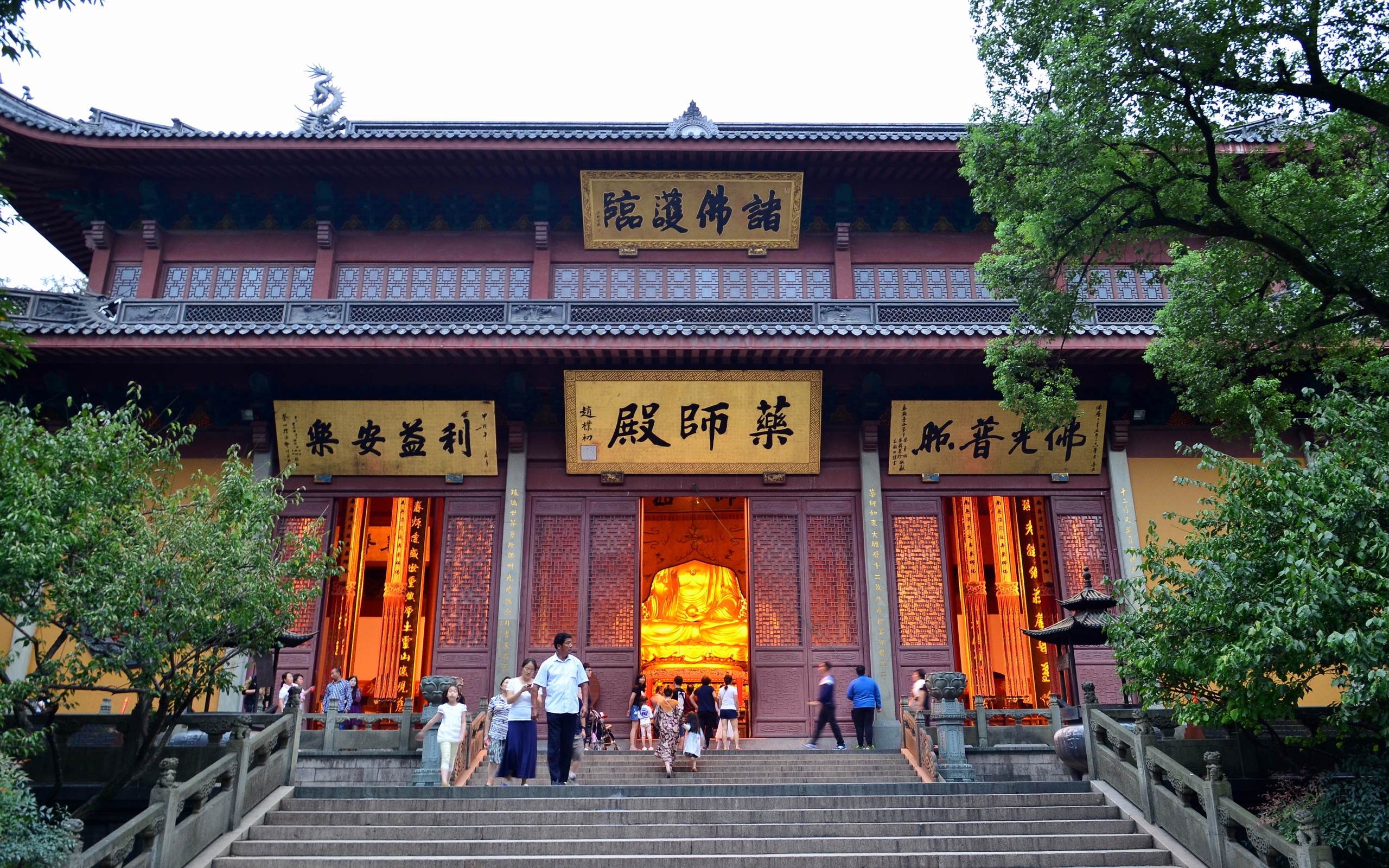
Chan Buddhism, known as Zen in Japan, represents the most radically Chinese transformation of Indian Buddhist thought. While its legendary origins trace back to the Indian monk Bodhidharma, who supposedly arrived in China around 520 CE and spent nine years in silent meditation facing a wall, the historical development of Chan as a distinct school occurred during the Tang dynasty (618-907 CE). Chan's defining innovation was its insistence that enlightenment is not achieved through the gradual accumulation of merit, the study of scriptures, or the performance of rituals, but through a sudden, direct awakening to one's own Buddha-nature. This emphasis on immediacy and directness reflected the influence of Daoist naturalism on Buddhist practice (McRae, 2003).
The split between the Northern and Southern schools of Chan, dramatized in the famous Platform Sutra attributed to the Sixth Patriarch Huineng (638-713 CE), crystallized the central debate within Chan Buddhism. The Northern school, associated with Shenxiu, taught gradual enlightenment through progressive purification of the mind, comparing the practice to polishing a mirror until it reflects clearly. The Southern school, associated with Huineng, rejected this metaphor entirely. Huineng's famous verse declared that there is no mirror to polish, because the mind is originally pure and enlightenment consists in recognizing what has always been the case. The Southern school's doctrine of sudden awakening eventually prevailed and became the defining characteristic of Chinese Chan, though in practice most Chan monasteries combined sudden insight with sustained meditative discipline (Gregory, 1991).
Chan's most distinctive pedagogical innovations, the gong'an (Japanese: koan) and the encounter dialogue, emerged during the Tang and Song dynasties as tools for provoking sudden awakening. Gong'an are paradoxical statements or questions, such as "What is the sound of one hand clapping?" or "Does a dog have Buddha-nature?", designed to frustrate rational thinking and push the student beyond conceptual categories into direct experience. Encounter dialogues record dramatic confrontations between Chan masters and students in which the master uses shocking, irrational, or even violent behavior, shouting, hitting, or making absurd statements, to shatter the student's reliance on intellectual understanding. These methods, which have no precedent in Indian Buddhism, reflect the characteristically Chinese impatience with abstract theorizing and preference for concrete, experiential knowledge (McRae, 2003).
Pure Land: Salvation for All
While Chan Buddhism appealed to the intellectual and monastic elite, Pure Land Buddhism became the most widely practiced form of Buddhism among the Chinese masses. Pure Land devotion centers on Amitabha Buddha, known in Chinese as Amituofo, who according to Mahayana sutras created a Western Paradise, or Pure Land, where anyone who sincerely calls upon his name at the moment of death will be reborn. This practice of nianfo, the recitation of Amitabha's name, was so simple that it required no literacy, no philosophical training, and no monastic commitment. A farmer in the field, a merchant at the market, or an elderly woman at home could practice nianfo and aspire to rebirth in the Pure Land (Ch'en, 1964).
The theological foundations of Pure Land Buddhism were laid by the patriarchs Tanluan (476-542 CE), Daochuo (562-645 CE), and Shandao (613-681 CE), who developed the concept of "other-power" (tariki in Japanese) as opposed to "self-power" (jiriki). They argued that in the degenerate age of the Dharma's decline, or mofa, human beings lack the capacity to achieve enlightenment through their own efforts. Only by relying on the compassionate vow of Amitabha Buddha, who pledged to save all beings who call upon him, can ordinary people escape the cycle of rebirth. This doctrine of salvation through faith and devotion rather than personal achievement represented a radical departure from both Indian Buddhist emphasis on individual spiritual effort and Confucian emphasis on self-cultivation through moral practice (Gregory, 1991).
Pure Land Buddhism's democratization of salvation gave it enormous popular appeal and cultural influence. Pure Land imagery permeated Chinese art, with magnificent depictions of Amitabha's Western Paradise adorning temple walls across the country. The deathbed practice of nianfo shaped Chinese attitudes toward dying and the afterlife for centuries, and the greeting "Amituofo" became a common Chinese expression used in contexts far beyond its original religious meaning. Unlike Chan, which remained largely confined to monastic communities and intellectual circles, Pure Land Buddhism became woven into the fabric of everyday Chinese life. In practice, most Chinese Buddhists combined elements of both traditions, practicing meditation in the Chan style while also reciting Amitabha's name, a synthesis that would have puzzled Indian Buddhists but that reflected the characteristically Chinese preference for practical inclusivism over doctrinal exclusivism (McRae, 2003).
"Homage to Amitabha Buddha."
Pure Land invocation (nianfo)The Three Teachings Merge
The concept of sanjiao heyi, the "unity of the three teachings" of Confucianism, Daoism, and Buddhism, became one of the most distinctive features of Chinese intellectual and religious life from the Tang dynasty onward. Rather than viewing these three traditions as mutually exclusive competitors, Chinese thinkers increasingly treated them as complementary perspectives, each addressing different dimensions of human experience. Confucianism governed social ethics and political life. Daoism provided techniques for physical health, spiritual cultivation, and communion with nature. Buddhism offered insights into the nature of mind, the problem of suffering, and the possibility of transcendence. An educated Chinese person might study Confucian texts for the civil service examinations, practice Daoist breathing exercises for health, and visit a Buddhist temple to pray for deceased relatives, without perceiving any contradiction (Wright, 1959).
This syncretistic tendency was facilitated by genuine philosophical convergences that had developed through centuries of mutual influence. Buddhist concepts of emptiness resonated with Daoist ideas of wu (non-being) and ziran (naturalness). The Buddhist doctrine of Buddha-nature could be harmonized with the Confucian-Mencian teaching of innate moral goodness. Chan meditation practices drew on Daoist techniques of breath control and mental stillness. Confucian ethics of compassion and benevolence paralleled Buddhist ideals of karuna (compassion) and the bodhisattva's vow to liberate all beings. These parallels were not mere superficial similarities but reflected deep structural affinities that Chinese thinkers recognized and cultivated (Gregory, 1991).
The legacy of Buddhism's Chinese transformation extends far beyond the boundaries of formal Buddhist institutions. Buddhist vocabulary pervades the Chinese language, with common words and phrases such as shijie (world), jueding (decision), and pingjun (average) all deriving from Buddhist translation terminology. Buddhist concepts of karma, rebirth, and compassion are deeply embedded in Chinese popular culture regardless of formal religious affiliation. The architectural landscape of China is marked by Buddhist temples, pagodas, and cave complexes that represent some of the greatest achievements of Chinese art and engineering. Perhaps most profoundly, the encounter between Buddhism and Chinese civilization demonstrated that a radically foreign intellectual tradition could be absorbed, transformed, and made native without destroying either the host culture or the guest tradition. This capacity for creative synthesis remains one of the most remarkable features of Chinese intellectual history (Ch'en, 1964).
Quiz
How did Buddhism first arrive in China?
What was a major challenge for early Buddhist translators in China?
What role did Kumarajiva play in the history of Chinese Buddhism?
How did Chan Buddhism differ from traditional Indian Buddhist practices?
What was a key feature of Pure Land Buddhism that contributed to its popularity?
What concept is central to the Prajnaparamita literature that influenced Chinese Buddhism?
What does the term 'sanlun' refer to in the context of Chinese Buddhism?
What is the significance of sanjiao heyi in Chinese religious life?
Write your thoughts, then get feedback from Jason — you can turn any answer into a full discussion.
9. How did the translation of Buddhist texts influence the development of Chinese Buddhism?
10. In what ways did the concept of sanjiao heyi reflect broader trends in Chinese intellectual history?
Frequently Asked Questions
Common questions about Buddhism's Chinese Transformation: From India to Chan
How did Buddhism come to China?
Buddhism arrived in China along the Silk Road trade routes during the 1st century CE, carried by Central Asian merchants and missionaries who brought Sanskrit and Pali texts into a civilization with its own deep philosophical traditions. The process of translation and adaptation took centuries, as Chinese scholars worked to render Indian Buddhist concepts into terms drawn from Daoism and Confucianism.
What is Chan Buddhism and how did it develop?
Chan (known as Zen in Japan) is a distinctly Chinese school of Buddhism that emerged around the 6th-7th century CE, emphasizing direct, experiential awakening over textual study and elaborate ritual. It blended Indian Buddhist meditation practices with Daoist naturalism and Confucian pragmatism, producing a tradition centered on sudden enlightenment, paradoxical teaching methods (gongan/koan), and finding awakening in everyday activities.
What is the difference between Chan and Zen Buddhism?
Chan and Zen are the same Buddhist tradition — Chan is the Chinese name (from the Sanskrit dhyana, meaning meditation) and Zen is its Japanese pronunciation, adopted when the tradition spread to Japan in the 12th-13th centuries. While they share the same philosophical roots and emphasis on meditation and direct awakening, Japanese Zen developed its own distinctive cultural expressions in tea ceremony, garden design, and martial arts.
What is Pure Land Buddhism in China?
Pure Land Buddhism is the most widely practiced form of Chinese Buddhism, centered on devotion to Amitabha Buddha and the aspiration to be reborn in his Western Paradise (Pure Land) through faith and the recitation of his name (nianfo). It became enormously popular because it offered a path to salvation accessible to ordinary people without the demanding meditation practices required by other Buddhist schools.
How did Chinese culture transform Buddhism?
Chinese civilization reshaped Buddhism by reinterpreting Indian concepts through the lens of Confucian ethics and Daoist naturalism, emphasizing filial piety, this-worldly engagement, and harmony with nature in ways foreign to original Indian Buddhism. Chinese Buddhists also created entirely new schools — including Chan, Tiantai, and Huayan — and developed the idea of sudden enlightenment, which had no direct precedent in Indian Buddhist thought.