
Podcast


Podcast: Zheng He and the Voyages of the Treasure Fleet
Listen to Jason & Amy discuss Zheng He and the Voyages of the Treasure Fleet
New here?
The Treasure Fleet Sets Sail
In the summer of 1405, a fleet of approximately 317 ships carrying nearly 28,000 men sailed from the port of Nanjing down the Yangtze River and into the open sea. It was the largest naval expedition in human history — a record that would stand for over five centuries. The flagship alone, a nine-masted treasure ship called a baochuan, was reportedly over 120 meters long, dwarfing any vessel that Europe would produce for another four hundred years. At its helm stood one of history's most extraordinary figures: a Muslim eunuch named Zheng He (Dreyer, 2007).
The fleet carried silk, porcelain, gold, silver, and iron implements — not as trade goods in the commercial sense, but as diplomatic gifts intended to demonstrate the overwhelming wealth and generosity of the Ming dynasty. The Yongle Emperor, who commissioned the voyages, sought not profit but prestige. He wanted every kingdom bordering the Indian Ocean to acknowledge China's supremacy and to enter the tribute system that the Middle Kingdom considered the natural order of international relations.
Over the next twenty-eight years, Zheng He would lead seven major expeditions, reaching Southeast Asia, India, the Persian Gulf, the Red Sea, and the eastern coast of Africa. His fleet visited over thirty countries and brought back ambassadors, exotic animals including giraffes, and detailed knowledge of distant lands. These voyages represent the high-water mark of Chinese maritime power — and their abrupt termination remains one of the great turning points in world history.
"The sea admits a hundred rivers — its capacity makes it great."
Lin Zexu, adapted from a classical maximThe Unlikely Admiral
Zheng He's path to command of the greatest fleet ever assembled was as improbable as any story in Chinese history. He was born Ma He in 1371 in Yunnan province, into a Muslim Hui family that claimed descent from a governor of the Mongol Yuan dynasty. When Ming forces conquered Yunnan in 1381, the ten-year-old boy was captured, castrated, and sent to serve in the household of the Prince of Yan — the future Yongle Emperor (Levathes, 1994).
It was a beginning of almost unimaginable cruelty. Yet the young eunuch proved himself intelligent, physically imposing — historical sources describe him as exceptionally tall, with a commanding voice — and fiercely loyal. He served with distinction in the prince's military campaigns, including the brutal civil war known as the Jingnan campaign that brought the Yongle Emperor to power in 1402. The emperor rewarded his trusted companion with the surname "Zheng" and, more remarkably, with command of the treasure fleet.
The appointment was extraordinary on multiple levels. Zheng He was a eunuch in a court that increasingly relied on eunuchs as a counterweight to the Confucian bureaucracy. He was a Muslim commanding a Chinese fleet. He was a man of no formal military rank elevated above seasoned naval officers. But the Yongle Emperor trusted him absolutely, and the choice proved inspired. Zheng He combined diplomatic skill, navigational knowledge inherited from his family's traditions of overland pilgrimage, and a talent for logistics that the massive treasure fleet demanded.
Ships That Dwarfed the World
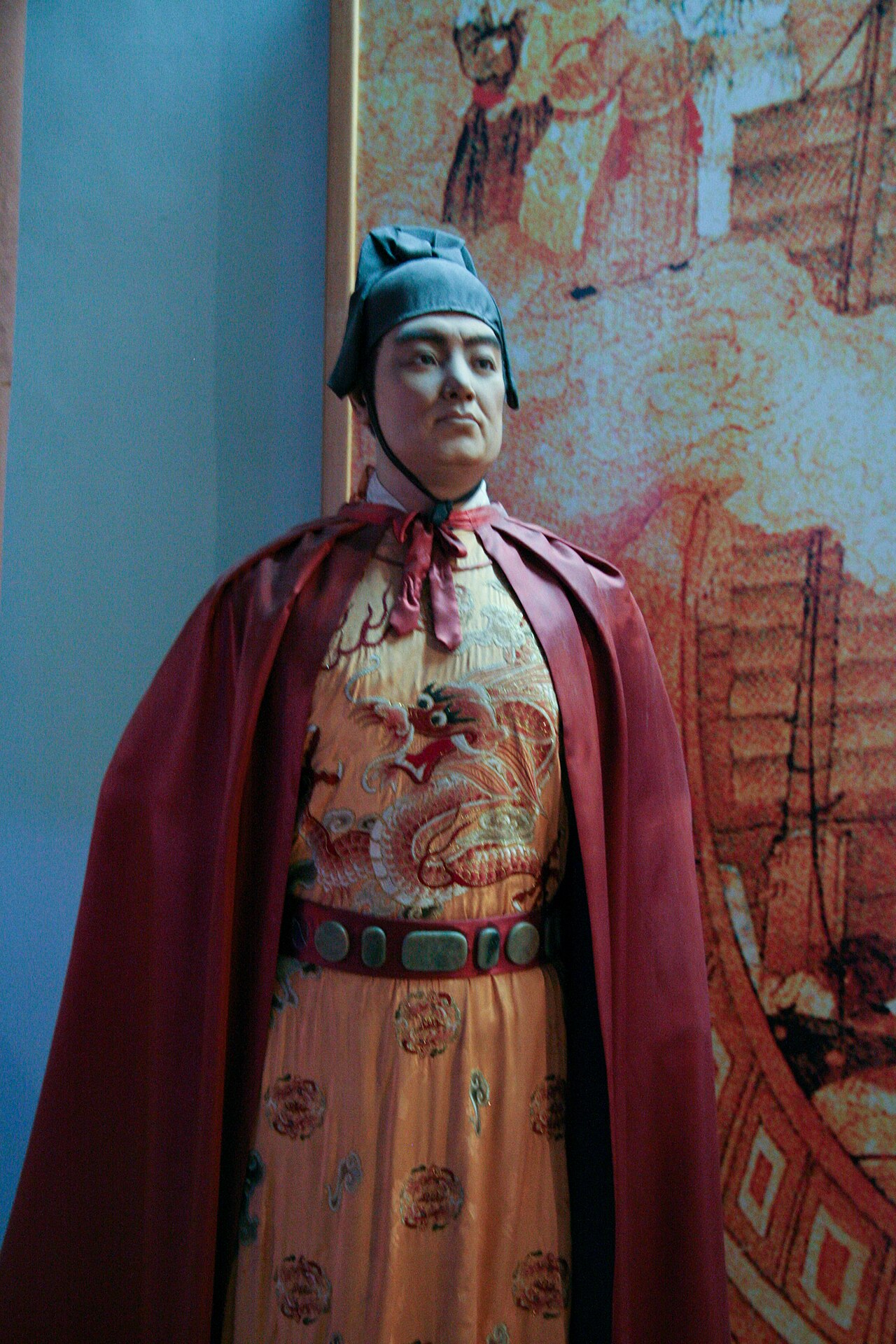
The scale of the treasure fleet was almost beyond comprehension. According to Ming dynasty records, the largest baochuan measured approximately 120 meters in length and 50 meters in beam — dimensions that would make them the largest wooden ships ever built. For comparison, Columbus's Santa Maria, which would not sail for another eighty-seven years, was roughly 25 meters long. Even accounting for likely exaggeration in the Chinese sources, archaeological evidence from the Longjiang shipyard in Nanjing — including a massive rudder post over 11 meters long — confirms that these were vessels of extraordinary size (Dreyer, 2007).
The fleet was a floating city. Beyond the treasure ships, it included horse transports, supply ships, troop carriers, water tankers, and patrol boats. The ships featured watertight compartment construction — a technology that European shipbuilders would not adopt until the nineteenth century — as well as balanced rudders, magnetic compasses, and sophisticated sail rigs that allowed them to tack against the wind. Chinese naval technology in the early fifteenth century was centuries ahead of anything in Europe or the Islamic world.
Navigation relied on a combination of magnetic compass bearings, star charts, and detailed sailing directions recorded in documents that Zheng He's navigators compiled and updated on each voyage. The fleet also carried Arabic-speaking interpreters and diplomats who facilitated communication in the Indian Ocean world, where Arabic served as the lingua franca of maritime trade. The logistical achievement of provisioning nearly 28,000 men for voyages lasting two years or more was itself a feat of organizational genius unmatched in the premodern world.
To the Ends of the Earth
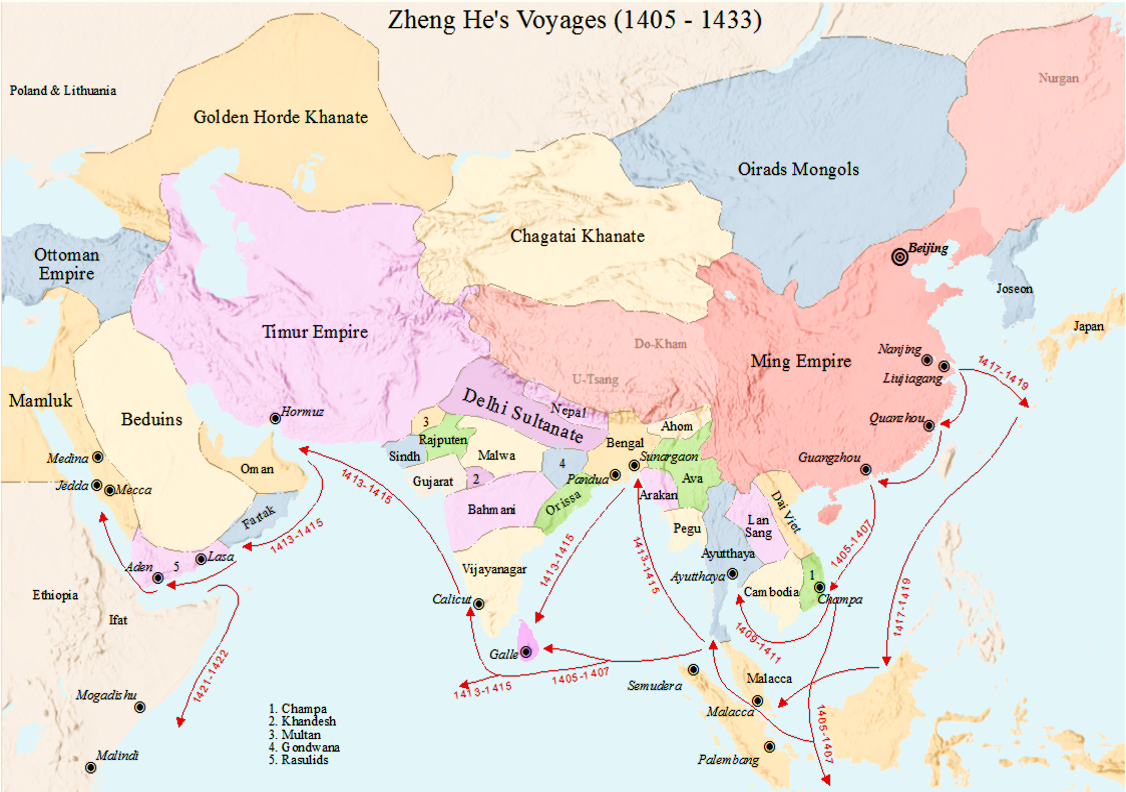
The seven voyages followed an expanding arc across the maritime world. The first three expeditions (1405–1411) focused on Southeast Asia and India, establishing Chinese diplomatic presence at major trading ports from Java to Calicut. The fourth voyage (1413–1415) pushed further, reaching Hormuz at the entrance to the Persian Gulf. The final three voyages (1417–1433) extended the fleet's reach to the coast of East Africa, visiting Mogadishu, Malindi, and possibly as far south as Mozambique (Mills, 1970).
At each port of call, the pattern was similar. Zheng He would present lavish gifts to local rulers, invite them to send tribute missions to the Ming court, and engage in ceremonial exchanges that reinforced the hierarchical diplomatic order the emperor envisioned. The fleet was not primarily a commercial venture — the Ming court disdained mere trade as beneath imperial dignity — but commerce inevitably followed. Chinese porcelain, silk, and ironware flowed into Indian Ocean markets, while exotic goods including spices, precious stones, incense, and rare animals flowed back to China.
The voyages were not always peaceful. In 1407, Zheng He's forces defeated a pirate fleet led by Chen Zuyi in the Strait of Malacca, capturing the pirate king and shipping him to Nanjing for execution. In 1411, the fleet intervened in a civil war in Ceylon, capturing the hostile king Alakeshvara and installing a more cooperative ruler. These military actions demonstrated that the treasure fleet was not merely a diplomatic mission but a projection of overwhelming force — a reminder that Chinese goodwill, while generous, was not optional.
"To see a thousand miles further, climb one more floor."
Wang Zhihuan, "Climbing Stork Tower"Diplomacy of Awe
The treasure fleet's diplomatic strategy was fundamentally different from the European colonialism that would follow. Zheng He did not claim territories, establish colonies, or impose Christianity. He sought acknowledgment of Chinese superiority within the tribute system — a framework in which foreign rulers sent symbolic gifts to the emperor and received far more valuable gifts in return. It was, in effect, diplomacy through generosity, backed by the implicit threat of the largest fleet on earth.
The most famous diplomatic trophy was a giraffe, presented to the Yongle Emperor in 1414 by the ruler of Malindi (in modern Kenya). The court identified the animal as a qilin — a mythical creature whose appearance was believed to signal the reign of a virtuous and heaven-favored ruler. The emperor publicly downplayed the comparison, but the propaganda value was enormous. Paintings of the giraffe-qilin circulated widely, reinforcing the narrative that the Yongle reign had received cosmic validation (Duyvendak, 1949).
The tribute missions that Zheng He's voyages generated brought ambassadors from across the Indian Ocean world to the Ming court. At its peak, the system encompassed more than sixty states, from Japan and Korea to the Swahili coast. Foreign envoys were housed, fed, and showered with gifts at imperial expense. The system was economically irrational — China consistently gave more than it received — but it served its purpose of placing the Ming emperor at the symbolic center of the known world, the axis around which all other kingdoms revolved.
The Great Withdrawal
Then, almost as suddenly as they had begun, the voyages stopped. Zheng He died on the seventh voyage in 1433, probably near Calicut on the Indian coast. His body was reportedly buried at sea, though a cenotaph in Nanjing marks his memory. But the end of the voyages was not merely the death of their commander — it was a deliberate policy decision by the Ming court that would reshape the trajectory of world history.
The Confucian bureaucracy had always opposed the voyages. They were ruinously expensive, the officials argued, and they served the vanity of eunuchs rather than the welfare of the people. The treasure ships consumed timber that could build flood-control infrastructure. The voyages drained the treasury while northern frontiers remained vulnerable to Mongol incursions. After the Yongle Emperor's death in 1424, the bureaucrats gained the upper hand. Maritime expeditions were curtailed, then prohibited. In 1500, it became a capital offense to build a ship with more than two masts (Levathes, 1994).
The great shipyards fell silent. The treasure ships rotted at their docks. Naval records were destroyed — some historians believe deliberately — by officials who wanted to ensure the voyages could never be repeated. China turned inward, reinforcing the Great Wall, focusing on agriculture, and eventually imposing the haijin — a series of maritime bans that restricted coastal trade and prohibited private overseas voyages. The greatest naval power in the world dismantled its own fleet and walked away from the sea.
The Road Not Taken
The significance of China's maritime withdrawal becomes clear only in hindsight. In 1433, when Zheng He's last fleet returned to China, Portuguese sailors had barely reached the coast of West Africa. It would be another sixty-five years before Vasco da Gama rounded the Cape of Good Hope and entered the Indian Ocean — waters that Chinese ships had dominated for decades. Had the Ming continued their maritime program, the history of European colonialism, the Atlantic slave trade, and the global distribution of power might have unfolded very differently.
Counterfactual history is inherently speculative, but the contrast is instructive. European expansion was driven by commercial hunger, religious zeal, and interstate competition — forces that the unified Chinese empire, with its Confucian disdain for commerce and its self-image as the center of civilization, did not share. Zheng He's voyages were expressions of imperial prestige, not precursors to colonialism. China sought acknowledgment, not extraction. It wanted tribute, not territory. The voyages were magnificent, but they lacked the economic logic that would have sustained them (Finlay, 1991).
Yet the memory of Zheng He has never entirely faded. In Southeast Asia, Chinese communities still venerate him as a cultural hero. In modern China, he has been rehabilitated as a symbol of peaceful engagement with the world — a counter-narrative to Western colonialism. His story reminds us that the age of exploration was not exclusively European, and that the shape of the modern world was not inevitable but contingent on decisions made by specific people at specific moments. The Ming court chose to turn inward. The consequences of that choice echoed across five centuries.
Quiz
What was the primary purpose of the Treasure Fleet's voyages?
What was Zheng He's background before becoming an admiral?
Why were the Treasure Fleet's voyages eventually halted?
Which technology was NOT used by the Treasure Fleet?
What was a significant outcome of the voyages in terms of international relations?
How did the Ming dynasty view trade during the voyages?
What was unique about Zheng He's appointment as the fleet's commander?
What was the fate of the Treasure Fleet after Zheng He's death?
Write your thoughts, then get feedback from Jason — you can turn any answer into a full discussion.
9. Why do you think the Ming dynasty chose to focus on diplomatic prestige rather than economic profit during Zheng He's voyages?
10. How might history have been different if the Ming dynasty had continued its maritime expeditions?
Frequently Asked Questions
Common questions about Zheng He and the Voyages of the Treasure Fleet
Who was Zheng He and why is he famous?
Zheng He was a Chinese Muslim eunuch admiral who commanded seven massive naval expeditions between 1405 and 1433, decades before European explorers like Columbus or Vasco da Gama set sail. His treasure fleet of over 300 ships and 28,000 men visited more than 30 countries across Southeast Asia, India, the Persian Gulf, and East Africa, making it the largest maritime expedition in history until modern times.
How big were Zheng He's treasure ships compared to Columbus's ships?
Zheng He's largest treasure ships (宝船, bǎochuán) were reportedly over 120 meters long with nine masts, dwarfing anything in the European fleet. By comparison, Columbus's flagship the Santa Maria was only about 19 meters long. Even accounting for possible exaggeration in Chinese records, archaeological evidence confirms that Ming dynasty shipyards produced vessels far larger than any European ship of the same era.
Why did China stop Zheng He's voyages?
After Zheng He's death around 1433, the Ming court abruptly ended the maritime expeditions due to a combination of Confucian scholar-official opposition, the enormous cost of the fleet, and a strategic pivot toward defending the northern land border against Mongol threats. The decision to turn inward is considered one of history's great turning points, as it ceded maritime dominance to European powers just as the Age of Exploration was beginning.
Did Zheng He reach Africa?
Yes, Zheng He's fleet reached the eastern coast of Africa, visiting ports in modern-day Kenya, Somalia, and Mozambique during the later voyages. The fleet brought back exotic goods and animals, including giraffes that the Chinese court interpreted as the mythical qilin. Archaeological finds of Chinese porcelain and coins along the East African coast confirm the extent of these maritime contacts.
What was the purpose of Zheng He's treasure fleet voyages?
Unlike European voyages of exploration that sought trade routes and colonial territories, Zheng He's expeditions were primarily diplomatic missions designed to project Ming dynasty prestige and expand the Chinese tribute system. The fleet carried lavish gifts of silk, porcelain, and gold to demonstrate China's wealth and generosity, expecting foreign rulers to acknowledge the emperor's supremacy in return.