
Podcast


Podcast: The Song Dynasty Economic Revolution
Listen to Jason & Amy discuss The Song Dynasty Economic Revolution
New here?
The Case for Revolution
When historians speak of economic revolutions, they typically mean the transformation that began in eighteenth-century Britain — the marriage of steam power, factory production, and global capital that remade the world. But a growing body of scholarship argues that the true first economic revolution occurred eight centuries earlier, in Song dynasty China. Between 960 and 1279 CE, the Song presided over changes so sweeping in agriculture, commerce, urbanization, and financial innovation that they constituted a fundamental break with everything that came before.
The numbers alone are staggering. China's population roughly doubled during the Song, from approximately 50 million to over 100 million — a growth rate that required and was sustained by radical increases in agricultural productivity. Government tax revenues increased tenfold. Iron production reached levels that England would not match until the eighteenth century. The percentage of the population living in cities surged past ten percent, a threshold that Europe would not cross for another five hundred years (Elvin, 1973).
What makes the Song transformation qualify as a revolution rather than mere growth is its systemic character. Changes in agriculture enabled urbanization; urbanization created demand for manufactured goods; manufacturing required financial instruments to manage increasingly complex transactions; and sophisticated finance, in turn, enabled further investment in agriculture and trade. Each element reinforced the others in a self-sustaining cycle that economists would recognize as the signature pattern of modern economic development.
The Rice Revolution
The foundation of everything was rice. In the early eleventh century, the Song court imported fast-ripening rice varieties from the Champa kingdom in what is now Vietnam. These Champa rice strains matured in as few as sixty days rather than the usual one hundred and fifty, allowing farmers in the Yangtze River delta and further south to harvest two and sometimes three crops per year from the same plot of land. The effect on food production was transformative — and it was no accident. The Song government actively promoted the new varieties, distributing seeds and publishing illustrated agricultural manuals (Bray, 1986).
Combined with advances in irrigation technology — including the widespread adoption of the chain pump and the construction of elaborate terrace systems on hillsides — the new rice varieties turned southern China into the most productive agricultural region on earth. The ancient saying 苏湖熟天下足 (When Suzhou and Huzhou have a good harvest, the whole empire has enough to eat) captured the reality: the lower Yangtze had become the granary of a civilization.
The agricultural surplus freed millions of workers from the land. For the first time in Chinese history, a substantial portion of the population could devote itself to craft production, trade, scholarship, and the arts. This was the demographic prerequisite for everything that followed — the great cities, the merchant fleets, the iron foundries, and the paper money that would make the Song economy unlike anything the world had ever seen.
"The people regard food as their heaven."
Ancient proverb, recorded in the Book of HanCities of a Million Dreams
The Song capital of Kaifeng, and later the southern capital of Hangzhou, were the largest and most commercially vibrant cities on the planet. Kaifeng's population exceeded one million by the early eleventh century — at a time when London had perhaps 15,000 inhabitants and Paris perhaps 20,000. Marco Polo, arriving in Hangzhou in the late thirteenth century shortly after the Song fell to the Mongols, called it "beyond dispute the finest and the noblest city in the world" (Polo, c. 1300).
These were not merely large cities; they were fundamentally new kinds of cities. Earlier Chinese capitals had been organized around rigid ward systems where commercial activity was confined to designated market areas and gates were locked at night. The Song broke this ancient pattern. Shops and restaurants spilled along every street. Night markets blazed with lanterns until dawn. Entertainment districts offered theater, puppet shows, storytelling, acrobatics, and tea houses that served as informal salons for poets and philosophers. The painter Zhang Zeduan captured this teeming vitality in his famous scroll painting Along the River During the Qingming Festival, one of the most celebrated works in Chinese art history (Ebrey, 1999).
The economic structure of these cities was remarkably modern. Guilds organized craftsmen by trade. Wholesale markets handled bulk commodities while retail shops served individual consumers. Restaurants offered specialized cuisines. A sophisticated credit system allowed merchants to deposit money in one city and withdraw it in another using paper instruments called flying money — the direct ancestor of the modern bank transfer. The division of labor, the specialization of production, the separation of wholesale and retail — these are the hallmarks of a commercial economy, and the Song Chinese developed them centuries before their European counterparts.
The Invention of Money
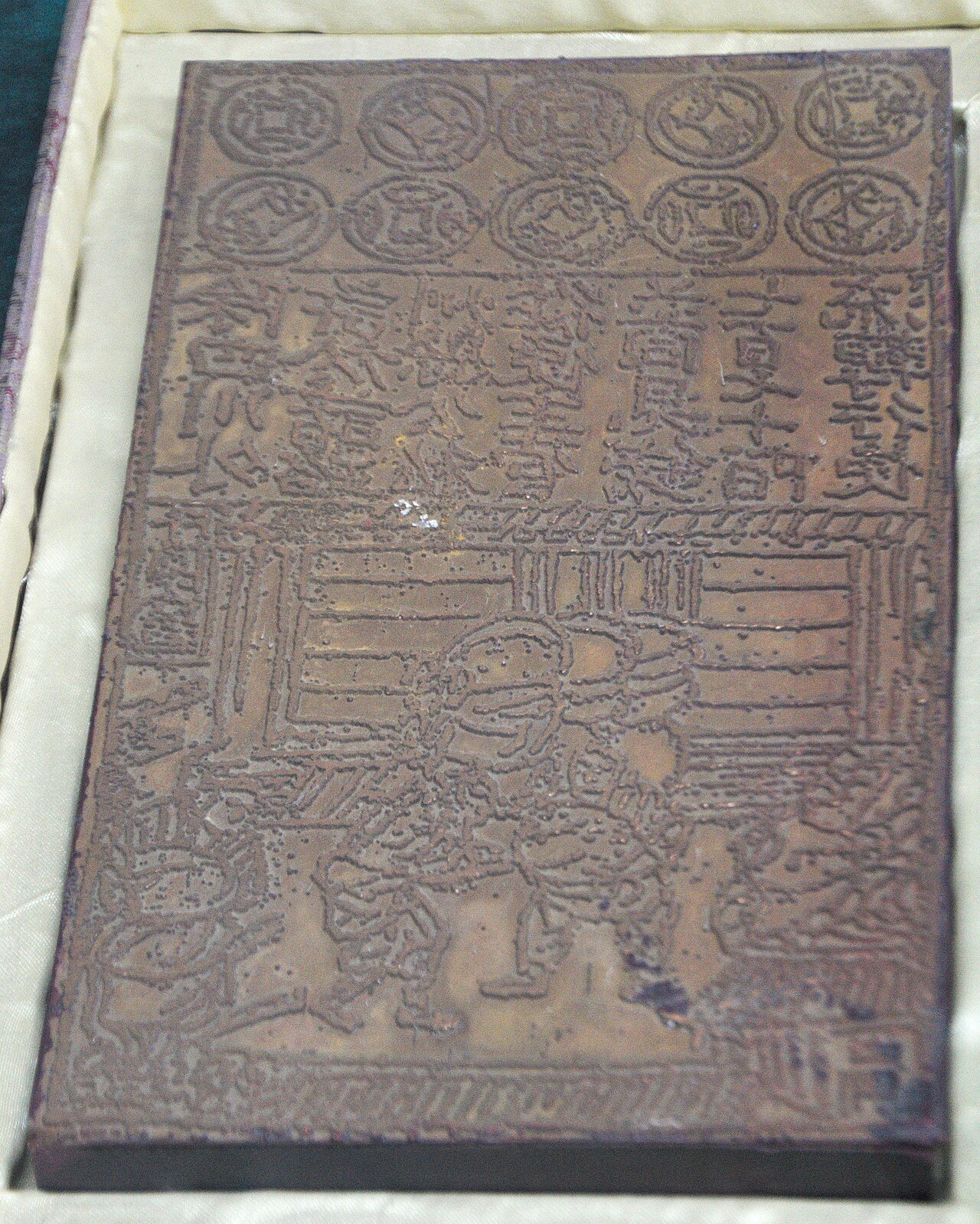
Perhaps the Song dynasty's most consequential innovation was also its most conceptually radical: paper money. Around 1024 CE, the Song government began issuing jiaozi — printed notes that represented a claim on a specified amount of coin or goods. It was the first government-issued paper currency in human history, and it required a cognitive leap that should not be underestimated. For the first time, a society agreed to treat a piece of printed paper as though it possessed intrinsic value — a feat of collective imagination that would not be repeated in Europe for another seven centuries (Von Glahn, 2016).
The jiaozi emerged from practical necessity. China's money supply relied on copper coins strung together in strings of one thousand, but copper was heavy and scarce. Merchants in Sichuan, who dealt in the even heavier iron coins used in that region, began issuing private promissory notes as a convenience. When fraud and defaults made the private system unstable, the government stepped in to regulate and then monopolize the issuance of paper notes, backing them with reserves of coin and salt.
The system worked brilliantly for decades, enabling a dramatic expansion of commerce. But it also introduced a danger that no previous civilization had faced: inflation through overprinting. Later Song governments, especially during the military crises of the Southern Song period, succumbed to the temptation to print money beyond their reserves. The resulting inflation eroded public trust in paper currency and contributed to economic instability — a pattern that every modern government would come to know intimately. The Song had discovered, centuries ahead of the rest of the world, both the immense power and the terrible risk of fiat currency.
"Let goods flow freely across the realm."
Song dynasty commercial maximMaritime Supremacy
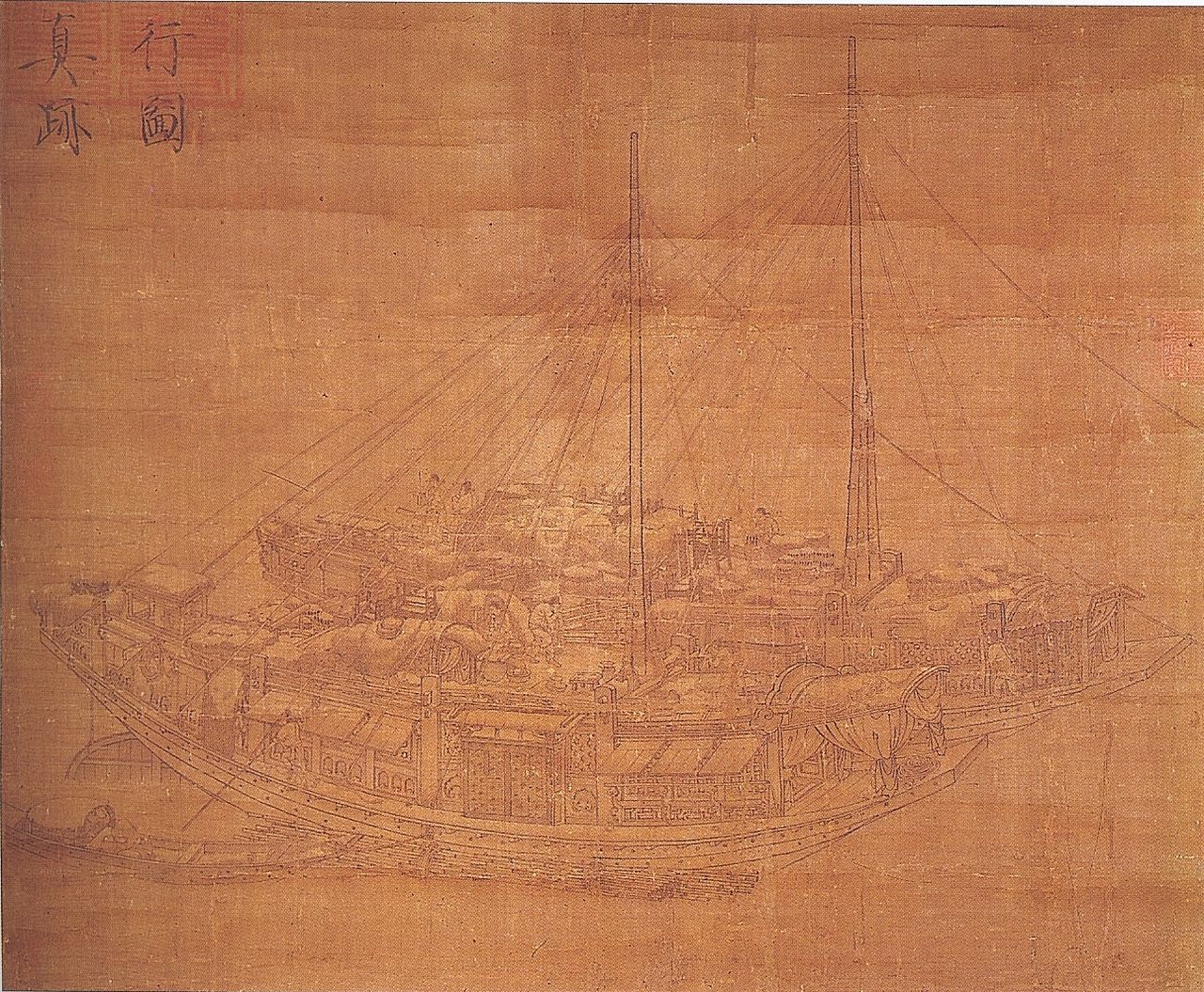
While overland trade along the Silk Road continued, the Song dynasty's greatest commercial achievement was the development of maritime trade on a scale the world had never seen. Song shipyards produced vessels of astonishing size and technological sophistication — multi-masted junks with watertight compartments, sternpost rudders, and magnetic compasses that could carry several hundred tons of cargo across open ocean. These were the largest and most seaworthy vessels afloat anywhere in the world (Needham, 1971).
From the great port of Quanzhou in Fujian province — which the Arab traveler Ibn Battuta would later call the largest port in the world — Song merchants traded with Japan, Korea, Southeast Asia, India, the Persian Gulf, and the east coast of Africa. Chinese ceramics from the Song period have been excavated at archaeological sites from Indonesia to Kenya. The government actively encouraged maritime commerce, establishing a sophisticated customs bureau, the Shibosi, that taxed imports, regulated foreign merchants, and maintained detailed records of trade volumes.
The scale of this trade was extraordinary. Song customs records indicate that maritime commerce generated revenue equivalent to roughly twenty percent of total government income — a figure that reflects the enormous volume of goods moving through Chinese ports. Exports included silk, porcelain, lacquerware, and tea. Imports included spices, ivory, precious woods, gems, and incense. The balance of trade was overwhelmingly in China's favor, drawing silver and gold into the Song economy from across the Indian Ocean world. China was, by any measure, the center of the global trading system.
Iron and Industry
The Song dynasty's industrial achievements were no less remarkable than its commercial ones. By the late eleventh century, China was producing an estimated 125,000 tons of iron per year — a figure that England would not reach until 1796, at the height of its own Industrial Revolution. Song foundries used coke (derived from coal) rather than charcoal as fuel, an innovation that Europe would not adopt for another seven hundred years (Hartwell, 1966).
This iron went everywhere. It was forged into weapons for the enormous Song military, which maintained standing armies of over a million soldiers. It was cast into agricultural implements that increased farm productivity. It was shaped into the anchors, nails, and fittings of the merchant fleet. It was used to construct the iron pagoda of Kaifeng, a thirteen-story tower that still stands today. The government maintained state-run foundries but also licensed private ironworks, creating a mixed economy that combined central planning with entrepreneurial initiative.
The coal and iron industries spawned secondary industries and technological innovations. Song engineers developed blast furnaces, hydraulic hammers powered by waterwheels, and techniques for producing steel by combining cast and wrought iron. The concentration of workers in mining and smelting operations created something resembling an industrial proletariat — wage laborers who owned no land and depended entirely on their earnings. This was a social formation that most historians associate with the modern era, yet it existed in Song China nearly a millennium ago.
"A craftsman who wishes to do good work must first sharpen his tools."
Confucius, Analects 15.10The Question That Haunts History
If the Song dynasty achieved so many of the preconditions for an industrial revolution — urbanization, commercialization, technological innovation, financial sophistication, and proto-industrial production — why did China not make the leap to sustained industrial capitalism? This question, sometimes called the "Needham Question" after the British historian of Chinese science Joseph Needham, has generated one of the most productive debates in comparative history.
Some scholars point to the Mongol conquest of the Southern Song in 1279, which disrupted the economic trajectory and imposed a foreign ruling class with different priorities. Others emphasize the strength of the Confucian bureaucratic state, which could mobilize resources for grand projects but also stifled the kind of competitive, decentralized innovation that drove European industrialization. Still others argue that China's very success was the problem: the agricultural productivity of the Yangtze delta was so high that there was less pressure to develop labor-saving machinery, the crucial driver of the British Industrial Revolution (Pomeranz, 2000).
The question itself may be misleading. It assumes that the European path to modernity was the only possible one, and that any civilization that did not follow it must have "failed" in some way. The Song economy was not a failed attempt at capitalism; it was a different kind of economic system, one that achieved extraordinary prosperity and sophistication on its own terms. What is beyond dispute is that for three centuries, Song China was the richest, most technologically advanced, and most commercially dynamic civilization on earth — and that its innovations in paper money, maritime trade, and industrial production shaped the world long after the dynasty itself had fallen.
Quiz
What was the primary agricultural innovation that contributed to the Song dynasty's economic revolution?
How did the Song dynasty's cities differ from earlier Chinese capitals?
What was a significant consequence of the Song dynasty's paper money system?
What technological advancement greatly enhanced Song dynasty maritime trade?
What percentage of China's population lived in cities during the Song dynasty?
What industry in the Song dynasty used coke as fuel, a practice not adopted in Europe for centuries?
What was a key feature of the economic structure in Song dynasty cities?
Which foreign region did the Song dynasty import rice varieties from?
Write your thoughts, then get feedback from Jason — you can turn any answer into a full discussion.
9. Why do you think the Song dynasty's use of paper money was considered a revolutionary concept for its time?
10. How might the Song dynasty's economic innovations have influenced modern economic practices?
Frequently Asked Questions
Common questions about The Song Dynasty Economic Revolution
Why was the Song dynasty important for the Chinese economy?
The Song dynasty (960-1279 CE) presided over what many historians consider the world's first economic revolution. China's population doubled to over 100 million, iron production reached levels England would not match until the 18th century, and urbanization rates surpassed ten percent centuries before Europe. The Song also invented paper money, developed sophisticated financial instruments, and created a thriving merchant class.
Did China invent paper money?
Yes, the Song dynasty invented the world's first government-issued paper currency, known as jiaozi (交子), in Sichuan province around 1024 CE. It emerged because merchants found it impractical to carry heavy iron coins for large transactions. The system worked well initially but later Song and Yuan dynasty governments over-printed money, causing inflation that foreshadowed problems with paper currencies that persist to this day.
How did rice farming change during the Song dynasty?
The Song dynasty experienced an agricultural revolution driven by the introduction of early-ripening Champa rice from Vietnam, which allowed farmers in southern China to harvest two or even three crops per year instead of one. Combined with new irrigation techniques and improved farming tools, this dramatically increased food production and freed labor for manufacturing and commerce, fueling urbanization and economic growth.
What inventions came from the Song dynasty?
The Song dynasty was one of the most inventive periods in human history. Key innovations included movable type printing (by Bi Sheng around 1040 CE), the magnetic compass for maritime navigation, paper money, advanced shipbuilding techniques, water-powered textile machinery, sophisticated blast furnaces for iron and steel production, and early forms of inoculation against smallpox.
Was Song dynasty China more advanced than medieval Europe?
By most economic and technological measures, Song dynasty China was significantly more advanced than contemporary medieval Europe. Song China had higher urbanization rates, greater iron production, more sophisticated financial systems, and superior maritime technology. Historians like Kenneth Pomeranz have argued that the "Great Divergence" between China and Europe did not occur until the 18th century, centuries after the Song period.