
Podcast


Podcast: Oracle Bones and the Birth of Chinese Writing
Listen to Jason & Amy discuss Oracle Bones and the Birth of Chinese Writing
New here?
The Divine Question
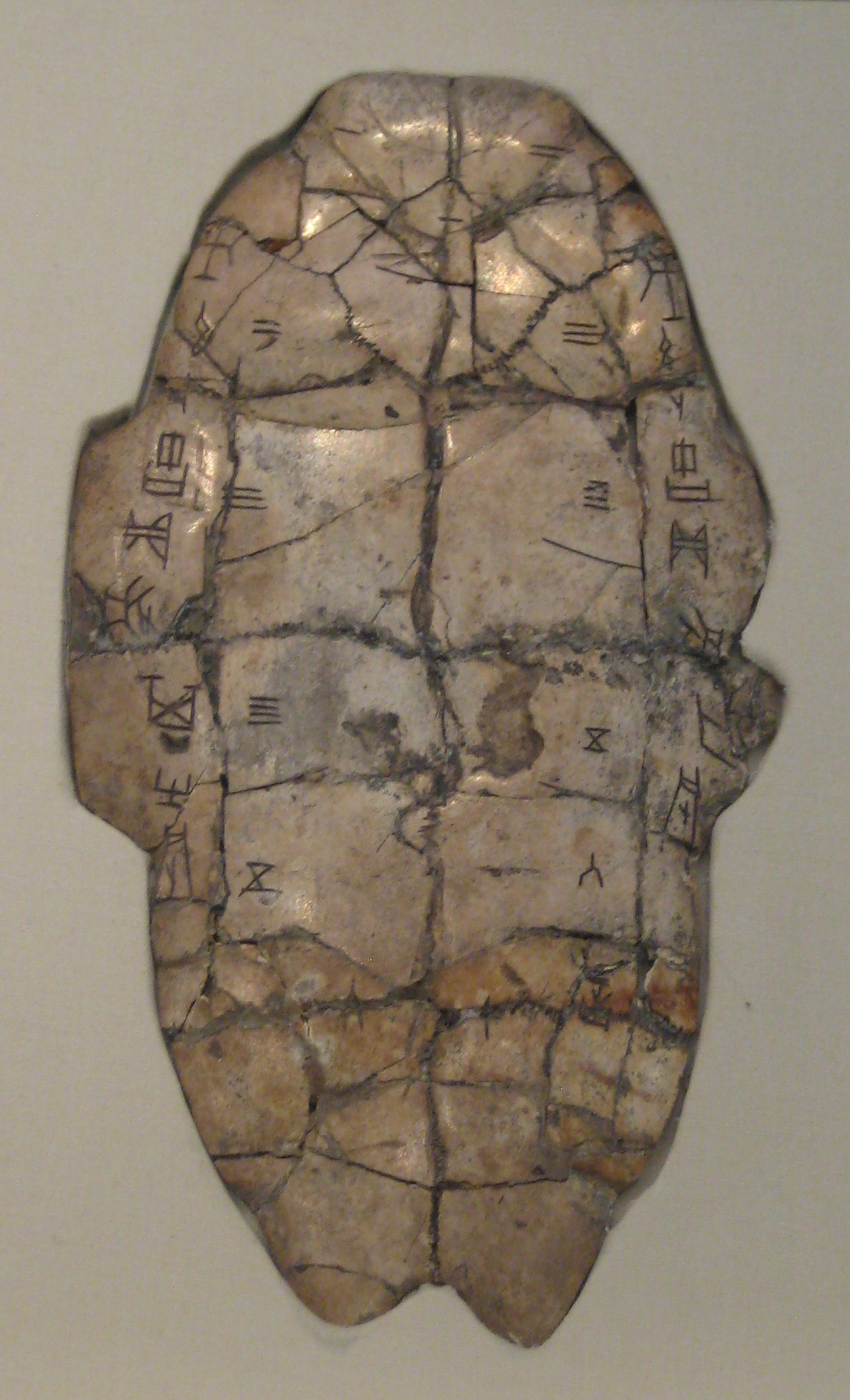
Long before paper, ink, or brush, the rulers of the Shang dynasty sought counsel from the invisible world. In a practice known as pyro-osteomancy, royal diviners would prepare the flat undersides of turtle plastrons or the polished shoulder blades of oxen, carefully drilling shallow pits into the bone's surface. A heated bronze rod was then pressed into these hollows until the bone cracked with a sharp snap. The resulting fracture pattern — a network of lines radiating from the point of heat — was read as the voice of ancestral spirits answering questions posed by the king himself. These were not trivial inquiries: the Shang court consulted the bones about the timing of military campaigns, the prospects for the harvest, the meaning of eclipses, the health of the royal consort, and the proper sacrifices to offer the dead.
The questions were inscribed directly onto the bone in a script we now call 甲骨文 (jiǎgǔwén) — literally "shell-bone writing." A typical inscription records the date according to the Shang sexagenary calendar, the name of the diviner, the topic of the question, and sometimes the king's own reading of the cracks. In certain cases, a later notation was added recording whether the prediction proved correct. This practice of verification reveals something striking about the Shang religious mind: divination was not blind faith but an empirical enterprise, tested against outcomes and refined over generations. The royal archive of inscribed bones functioned, in effect, as the earliest known database of state intelligence.
The ritual itself was embedded in a complex cosmology. The Shang believed that their deceased ancestors occupied a hierarchical spirit world that mirrored the court on earth. These ancestors could intercede with Di, the supreme deity, on behalf of the living — but only if properly honored with sacrifices of grain, wine, and sometimes human victims. The oracle bones were the medium through which the living negotiated with the dead, and the script carved upon them was sacred technology: a means of fixing divine speech into permanent form.
Discovery of the Dragon Bones
For centuries, farmers in the fields around Anyang, in modern Henan province, had been digging up fragments of inscribed bone and selling them to apothecaries under the name "dragon bones" (龙骨, lónggǔ). Ground into powder, they were prescribed as a remedy for malaria, knife wounds, and various ailments of the blood. The characters visible on the fragments were dismissed as natural markings or, at best, curiosities of no particular significance. Untold thousands of inscriptions — priceless records of Bronze Age civilization — were swallowed as medicine before anyone recognized what they were.
The turning point came in 1899, when the chancellor of the Imperial Academy in Beijing, a scholar named Wang Yirong (王懿荣), fell ill and was prescribed a dose of dragon bone. Wang was one of the foremost epigraphers of his era, a man trained to read ancient bronze inscriptions. When he examined the fragments in his prescription, he noticed that the scratches on their surfaces were not random: they were characters, written in an archaic but recognizable form of Chinese script. He immediately began purchasing every dragon bone he could find from Beijing's pharmacies, tracing the supply chain back to Anyang. His discovery was a thunderclap in the world of Chinese scholarship.
Wang Yirong did not live to see the full implications of his find — he died during the Boxer Rebellion in 1900. But his colleague Liu E continued the work, publishing the first collection of oracle bone rubbings in 1903. Systematic excavations at the Yinxu site near Anyang began in 1928 under the Academia Sinica, led by the pioneering archaeologist Li Ji. Over the following decades, more than 150,000 fragments were recovered, bearing tens of thousands of distinct inscriptions. The find confirmed beyond doubt that the Shang dynasty, long dismissed by skeptics as legend, had been a historical reality of formidable scale and sophistication.
"He who reviews the old and learns the new may be a teacher of others."
Confucius, Analects (论语)The Architecture of a Script

What makes oracle bone script extraordinary is not merely its age — Egyptian hieroglyphs and Sumerian cuneiform are older — but its direct, unbroken continuity with a script still used by over a billion people today. The characters inscribed on Shang dynasty bones three thousand years ago are the recognizable ancestors of the characters printed in this morning's edition of the People's Daily. No other writing system in active daily use can claim such a lineage.
The oracle bone script already displays the fundamental structural principles that govern modern Chinese characters. Pictographic characters depict objects through simplified drawings: the character for "sun" (日) appears as a circle with a dot or line in the center, the character for "moon" (月) as a crescent, and the character for "mountain" (山) as three peaks. Ideographic combinations express abstract concepts by juxtaposing meaningful elements: "bright" (明) places the sun beside the moon. Phono-semantic compounds — characters that combine a meaning component with a pronunciation hint — were already emerging in the Shang corpus, foreshadowing the dominant method of character formation in later centuries.
Scholars have identified approximately 4,500 distinct graphs in the oracle bone corpus, of which roughly 1,700 have been definitively deciphered. Many of the undeciphered characters are proper nouns — names of places, spirits, and individuals whose referents are lost. The deciphered portion, however, reveals a vocabulary of impressive range: words for colors, animals, weather phenomena, family relationships, body parts, agricultural activities, military ranks, and ritual obligations. The script was not a primitive proto-writing limited to tallying goods; it was a fully developed system capable of recording complex sentences with subjects, verbs, objects, and temporal markers.
A Civilization Revealed
The content of the oracle bone inscriptions has transformed our understanding of Shang civilization. Before their discovery, knowledge of the Shang came almost entirely from texts written centuries later — principally the Shiji (Records of the Grand Historian) by Sima Qian, completed around 94 BCE. The oracle bones provided direct, contemporaneous evidence, and in many cases confirmed the accuracy of later historical traditions with startling precision. The sequence of Shang kings recorded on the bones matched the genealogy preserved by Sima Qian almost exactly, vindicating a historian who had written more than a thousand years after the events he described.
The inscriptions reveal a society organized for war. The Shang king commanded armies numbering in the thousands and conducted campaigns against neighboring peoples whose names — the Qiang, the Gongfang, the Tufang — appear repeatedly in the divination records. Prisoners of war were sacrificed in elaborate rituals, sometimes in groups of hundreds. The bones record questions about the optimal number of captives to offer: "Should we sacrifice thirty Qiang?" "Should it be fifty?" These inscriptions, chilling in their bureaucratic precision, document a practice of mass human sacrifice on a scale unmatched in the ancient world.
But the bones also reveal a civilization capable of remarkable intellectual achievement. The Shang calendar was a sophisticated lunisolar system that tracked the phases of the moon while adjusting for the solar year through the insertion of intercalary months. Astronomical observations recorded on the bones include references to eclipses, novae, and unusual celestial phenomena. The Shang court maintained a corps of specialized scribes and diviners who underwent years of training, and the consistency of their script across generations suggests the existence of formal schools — institutions of learning operating more than a millennium before Confucius.
"Writing is likeness — it captures the form of things."
Xu Shen, Shuowen Jiezi (说文解字)From Bone to Brushstroke
The fall of the Shang dynasty around 1046 BCE did not end the tradition of inscribed divination, but the practice gradually waned under the succeeding Zhou dynasty, which favored a different method of prognostication — the casting of yarrow stalks, later codified in the Book of Changes (易经, Yìjīng). The medium of writing, however, shifted from bone to bronze. The great ritual vessels of the Western Zhou bear lengthy inscriptions cast into their surfaces, commemorating royal grants of land, appointments of officials, and treaties between noble houses. These bronze inscriptions (金文, jīnwén) use a rounder, more ornate form of the characters, reflecting the possibilities of casting metal rather than carving bone.
The next great transformation came with the unification of China under the Qin dynasty in 221 BCE, when Chancellor Li Si imposed a standardized script known as small seal script (小篆, xiǎozhuàn). This was a deliberate act of political uniformity — regional variants were suppressed, and every official in the empire was required to write in the same hand. The result was a more regularized, symmetrical set of characters that smoothed away the angular spontaneity of earlier forms. Within a century, the pressures of bureaucratic speed produced a further simplification: clerical script (隶书, lìshū), written with a flat brush on wooden or bamboo strips, became the workhorse of Han dynasty administration.
By the early centuries of the Common Era, the basic repertoire of Chinese calligraphic styles had emerged — regular script (楷书, kǎishū), running script (行书, xíngshū), and cursive script (草书, cǎoshū) — each representing a different balance between legibility and expressive freedom. Through all of these transformations, the underlying logic of the script remained intact. A character that began as a picture scratched into bone had become an abstract arrangement of brushstrokes, but its core structure — its radical, its phonetic component, its semantic field — was still recognizable across the centuries.
The Living Lineage
The discovery of oracle bone script did more than push back the frontier of Chinese history; it revealed the astonishing depth of a cultural continuity that has no parallel elsewhere on earth. The Greek alphabet descends from Phoenician, which descends from Egyptian — but no modern Greek reader can look at a hieroglyph and see a familiar letter. Chinese is different. A schoolchild in Shanghai today, learning to write the character 马 (mǎ, "horse"), is drawing a simplified descendant of the same character that a Shang diviner carved into bone in 1200 BCE. The simplification is dramatic — the oracle bone form is a recognizable picture of a horse with mane and legs — but the lineage is direct and documented at every stage.
This continuity carries profound cultural consequences. Because the script has never been replaced, modern Chinese readers can engage with texts from every period of their civilization's history in a way that speakers of alphabetic languages cannot. A literate Chinese person can read a Tang dynasty poem from the eighth century without translation — the characters are the same, even if the pronunciation has shifted. With some training, they can read texts from the Han dynasty, two thousand years ago. With specialized study, the oracle bones themselves become legible. The script functions as a bridge across time, connecting three millennia of thought, literature, and record-keeping into a single accessible tradition.
The oracle bones remind us that writing is never merely a technology; it is a worldview made visible. The Shang diviners who carved the first characters into bone were not simply recording information — they were fixing the voice of the divine into permanent form, creating a material link between the human and spirit worlds. That impulse to make the invisible visible, to transform sound and meaning into enduring marks, is the same impulse that drives every act of writing today. The oracle bones are where it began for the Chinese tradition, and their legacy is alive in every character written, typed, or displayed on a screen in the modern world.
"Words without literary form will not travel far."
Zuo Qiuming, Zuo Zhuan (左传)Quiz
What was the primary purpose of using oracle bones during the Shang dynasty?
Who is credited with recognizing the significance of the 'dragon bones' as ancient Chinese script?
What does the term 甲骨文 (jiǎgǔwén) refer to?
How did the discovery of oracle bones transform understanding of the Shang dynasty?
What is a unique feature of the oracle bone script?
What was one of the significant uses of oracle bones in Shang society?
What did the inscriptions on oracle bones reveal about Shang society?
How did the practice of writing evolve after the fall of the Shang dynasty?
Write your thoughts, then get feedback from Jason — you can turn any answer into a full discussion.
9. Why do you think the oracle bone script has such a significant impact on modern Chinese culture?
10. How might the discovery of oracle bones influence our understanding of ancient civilizations beyond the Shang dynasty?
Frequently Asked Questions
Common questions about Oracle Bones and the Birth of Chinese Writing
What are oracle bones and why were they important in ancient China?
Oracle bones are pieces of turtle shell and ox bone used by the Shang dynasty (c. 1250-1046 BCE) for divination. Royal diviners carved questions into the bones and applied heat until they cracked, interpreting the fracture patterns as answers from ancestral spirits. They are important because they carry the earliest known form of Chinese writing and provide direct evidence of Shang dynasty civilization.
How was oracle bone script discovered in modern times?
In 1899, a scholar named Wang Yirong noticed ancient Chinese characters on "dragon bones" he had been prescribed as medicine. For centuries, farmers near Anyang had been selling inscribed bone fragments to pharmacies, where they were ground into powder for remedies. Wang traced the supply back to Anyang, leading to systematic excavations that uncovered over 150,000 fragments.
Can modern Chinese readers understand oracle bone script?
With specialized training, modern Chinese readers can partially decipher oracle bone script because it is the direct ancestor of today's Chinese characters. Scholars have identified about 4,500 distinct graphs, of which roughly 1,700 have been definitively decoded. Many characters show clear pictographic origins that evolved into their modern forms over three millennia.
What did the Shang dynasty use oracle bones to predict?
The Shang court consulted oracle bones about a wide range of state matters, including the timing of military campaigns, harvest prospects, the meaning of eclipses, the health of the royal family, and the proper sacrifices to offer deceased ancestors. Some inscriptions even record whether the predictions turned out to be correct.
How is oracle bone script related to modern Chinese characters?
Oracle bone script (甲骨文) is the oldest known form of Chinese writing and the direct ancestor of modern Chinese characters. The script already displayed the structural principles used today, including pictographic, ideographic, and phono-semantic compound characters. This makes Chinese the only writing system in continuous daily use with a documented lineage spanning over 3,000 years.