
The dictionary is the largest thing on the site and the part that needs no account, no plan and no credits. 21,000+ entries, 12,000+ of them banded to an HSK 3.0 level. This article is about getting more out of an entry than the translation at the top of it.
Finding a word
- Search from anywhere — The magnifier in the header searches hanzi, pinyin and English at once.
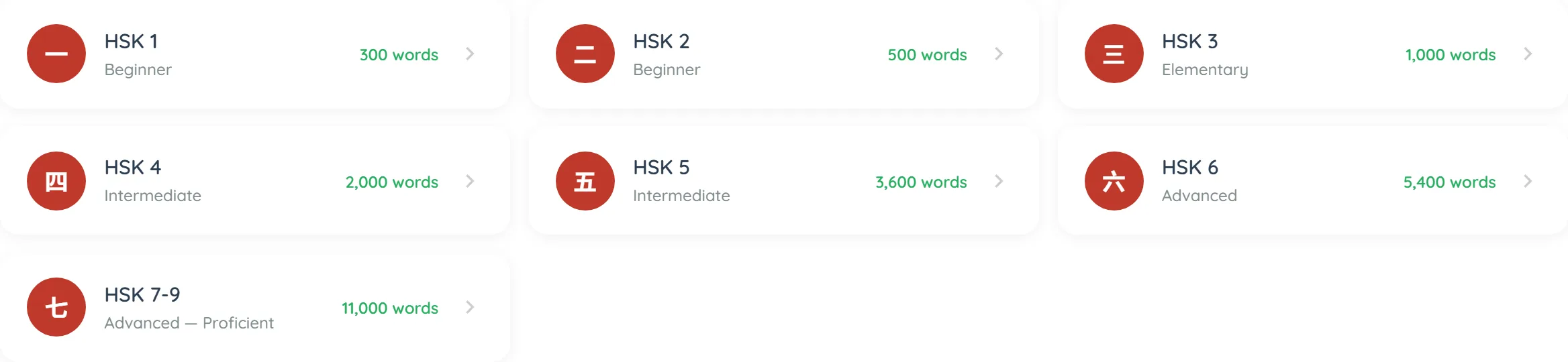
ni3,nǐ,niand "you" all find 你. - Or browse by level — The dictionary hub splits the whole corpus into HSK 1 through 7–9, so you can read a band rather than hunt a word.
- Or tap it where you found it — Any Chinese character anywhere on the site opens a card, and the card links through to the full entry.
What is in an entry
An entry is a page, not a line. Which sections appear depends on the word — a single character gets etymology and decomposition, a set phrase gets an idiom spotlight — but a well-populated entry can carry all of these:
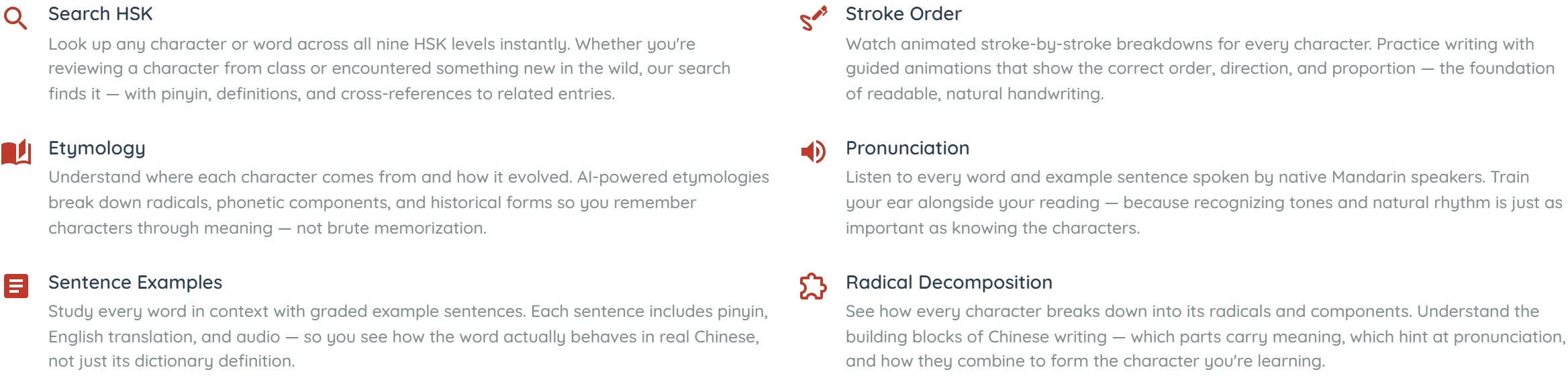
- Meanings — Every sense, not just the first, each with its own example sentences.
- Pronunciation — Tone-marked pinyin, the tone contour, and a native recording.
- Writing — Stroke-order animation you can replay and trace.
- Etymology and decomposition — Where the character came from and what it is built from — for single characters, the section that makes them stop being arbitrary.
- Confusions — The words this one gets mixed up with, and how to tell them apart. Often the most useful section on the page.
- Word family — Compounds built from this character, and words that contain it. One entry becomes twenty.
- Usage notes and cultural notes — When to use it, when not to, and what a native speaker hears that a dictionary gloss does not carry.
- A podcast — On many entries — a short spoken piece about the word. Free to play.
Getting more out of it
- Read the Confusions section first — If you already half-know the word, this is where the actual gap is. Knowing 会 is not the problem; knowing when it is not 能 is.
- Follow the word family — Learning 电 alone is one word. Following it into 电话, 电脑, 电影 is four, and they will stick better because they share a piece.
- Add it to flashcards from the entry — One tap. The word enters your review schedule rather than being something you looked up and forgot by evening.
- Say the examples out loud — The example sentences are graded to the word’s own level, so they are readable rather than aspirational.
Common questions
No. The whole dictionary is open — every entry, every field, every recording — with no sign-up and no plan. Only saving a word to flashcards needs an account, because it has to be saved somewhere.
October 9, 2026