
Speaking is the skill you cannot practise by reading about it, and the one most self-taught learners never start. The studio at /speaking gives you something to talk to that answers back, corrects you, and does not get bored — which removes the two real obstacles: no partner, and embarrassment.
Without a plan: A monthly AI credit allowance
Pro adds: A much larger monthly allowance, and pronunciation scoring on your own recordings
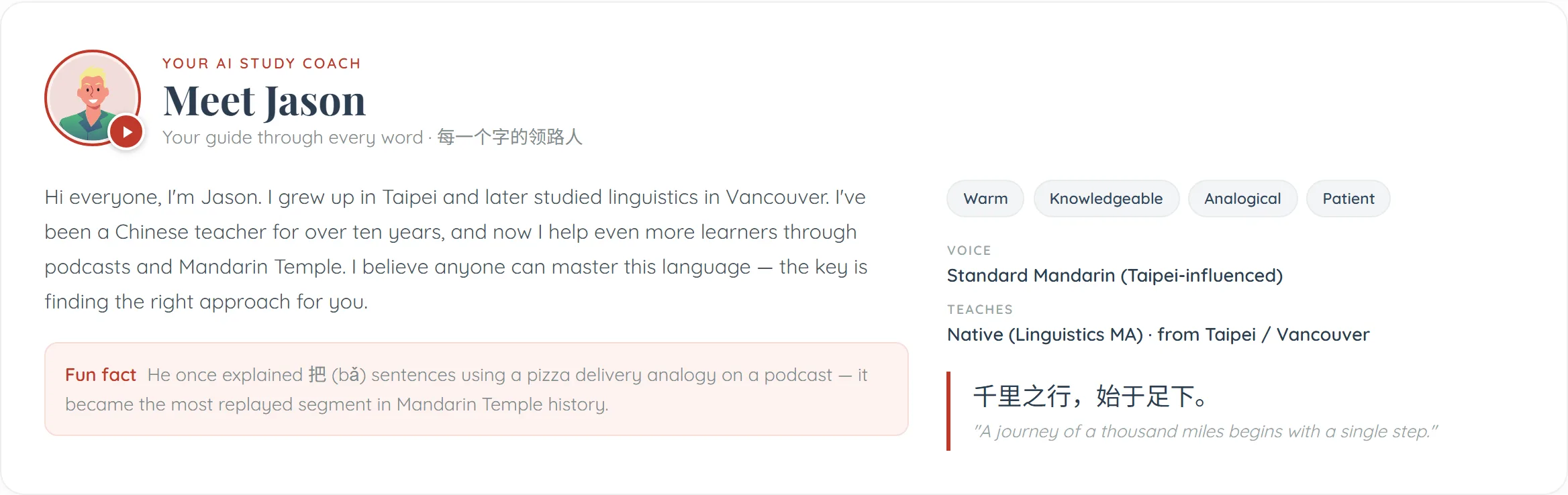
Talking to Jason
Type, speak, or share an image to start. The tutor holds a conversation at your level, keeps it going when you stall, and corrects without stopping the conversation dead every time you slip.
A message costs 1 credit, which is deliberate — practising should not feel like spending. A long session is still cheap.
The pronunciation trainer
/speaking/pronunciation is different from conversation. You listen to a native recording, record yourself, and get character-by-character feedback on your tones — not one score for the sentence, but which syllable went wrong and how.
That granularity is the whole value. "Your tones need work" is useless; "the third tone in 你好 is going down instead of dipping" is actionable. 4 credits an attempt.
Discussions
/speaking/discussions is the free-form space — a topic rather than an exercise. Use it when you want to talk about something instead of practising a structure.
What it costs
- A message to the tutor — 1 credit — Including roleplay replies and the grading of your side of one.
- Transcribing what you said — 3 credits — Turning your recording into text so it can be responded to.
- Pronunciation scoring — 4 credits — Per attempt, with per-character tone feedback.
- A spoken reply — by length — When the tutor answers out loud, the narration bills per character rather than at a flat rate.
A Pro plan grants 1,500 credits a month and Pro Plus 12,000, so a daily conversation habit sits comfortably inside either. The full list is in what each AI feature costs.
Getting value out of a session
- Pick a topic before you start — Open-ended conversation with no subject stalls in three turns. "Order food in a restaurant" does not.
- Say it out loud even when typing — Reading your own sentence aloud before sending recruits your mouth, which is the muscle you are here for.
- Let small mistakes go — Stopping to fix every particle turns a conversation into an exercise. Fluency and accuracy are trained separately.
- Take one thing to the pronunciation trainer — A phrase you fumbled. Four credits and per-character feedback beats another twenty turns of conversation for that specific problem.
Common questions
For the pronunciation trainer, yes — it has to hear you. Conversation works typed, so you can use the tutor on a machine with no mic or in a room where you cannot talk.