
The School plan has four dials — curriculum seats, platform seats, teacher seats and admin seats — and you set them all yourself. This article is what each costs, what counts against it, what happens when you go over, and the smaller Starter pack.
What the plan costs
- Base — $299/month, $2,990/year — 1 admin and 5 teacher seats included. Bulk import, cross-teacher analytics and branded join links.
- Curriculum seats — per student, per month — Graduated: $8 each for students 1–500, $7 for 501–2,000, $6 above that. Each price applies only to the students inside its band, so your first 500 always cost $8 each. A curriculum seat is HSK 1–9, the career modules and the full Learning Lab.
- Platform seats — $3/month — $30 a year. The Teaching Board, classes, homework and the Learning Lab, without the lessons or AI. A platform student still sees everything their teacher presents live.
- Extra teacher seat — $15/month — $150 a year.
- Extra admin seat — $20/month — $200 a year.
- Starter pack — $29/month per teacher — $290 a year. For 1 to 3 teachers and up to 50 students, who join free on platform seats; curriculum seats are $8 a month for any student the school wants to give one. Includes 1,000 AI credits a month per teacher for the school.
- Enterprise — on request — Over 1,000 students or several campuses: invoiced, with volume pricing, custom onboarding, reporting and a support SLA.
Paid yearly, every line costs ten times its monthly price. Monthly billing has a minimum term you choose — 6 or 12 months, at the same price.
A worked example
A school with 600 students and 7 teachers pays the $299 base, 500 students at $8, 100 at $7, and 2 extra teacher seats at $15: $5,029 a month, or $50,290 a year paid annually.
The calculator on the pricing page does this sum for any number, with the new-school discount shown separately.
What counts against each limit
- A student — An account in your school that is not staff, and anyone actively enrolled in one of your school’s classes — a student who joined with a class code counts the same as one you imported. Each student holds one seat, curriculum or platform; you move them between the two on the Students tab.
- Which seat a new student takes — A curriculum seat while you have one free, then a platform seat. Over both, nobody is turned away: the student gets a curriculum seat marked provisional for 14 days while you decide, and after that the newest provisional students move to platform seats unless you have added room. A student already on their own Pro or Family plan never uses a curriculum seat of yours.
- A teacher seat — Taken when a teacher accepts. Pending invitations do not count; removing a teacher frees theirs immediately.
- An admin seat — Taken by every admin, including you — and a pending admin invitation holds one too, so you cannot invite past what you have bought.
- A class — Nothing — classes are unlimited. Splitting a cohort into six circles costs you nothing.
When you go over
Students are never turned away. If more join than your plan covers — through a class code, say — everything keeps working; your admins get a notice, at most once a day, and a banner on the dashboard, so the plan can catch up. The one exception is a bulk import: an import that would take you past your plan is refused, so add the students first.
Seats are firm. Inviting a teacher or an admin past what you have bought is refused, with a link to add a seat.
Changing your numbers
From Billing in your institution dashboard, any time. You see the cost before you confirm it: an increase is charged now, prorated to the end of the period; a decrease is credited to your account, prorated, and taken off later invoices.
You cannot go below what you are using — 212 students will not fit a plan for 200, and the system will not choose who to remove. None of it touches student progress.
Paying a term up front — card or Alipay
From Billing you can prepay 6 or 12 months in one payment, by card or Alipay; 12 months is priced at the yearly rate. Your plan then draws on that payment instead of charging a card, and we email you 30 days before the term ends. A prepaid term keeps its seats for the term — set new numbers when you prepay the next one, or contact us mid-term. WeChat Pay and bank transfer are by invoice.
Schools on the 2025 Starter, Growth or Scale plans
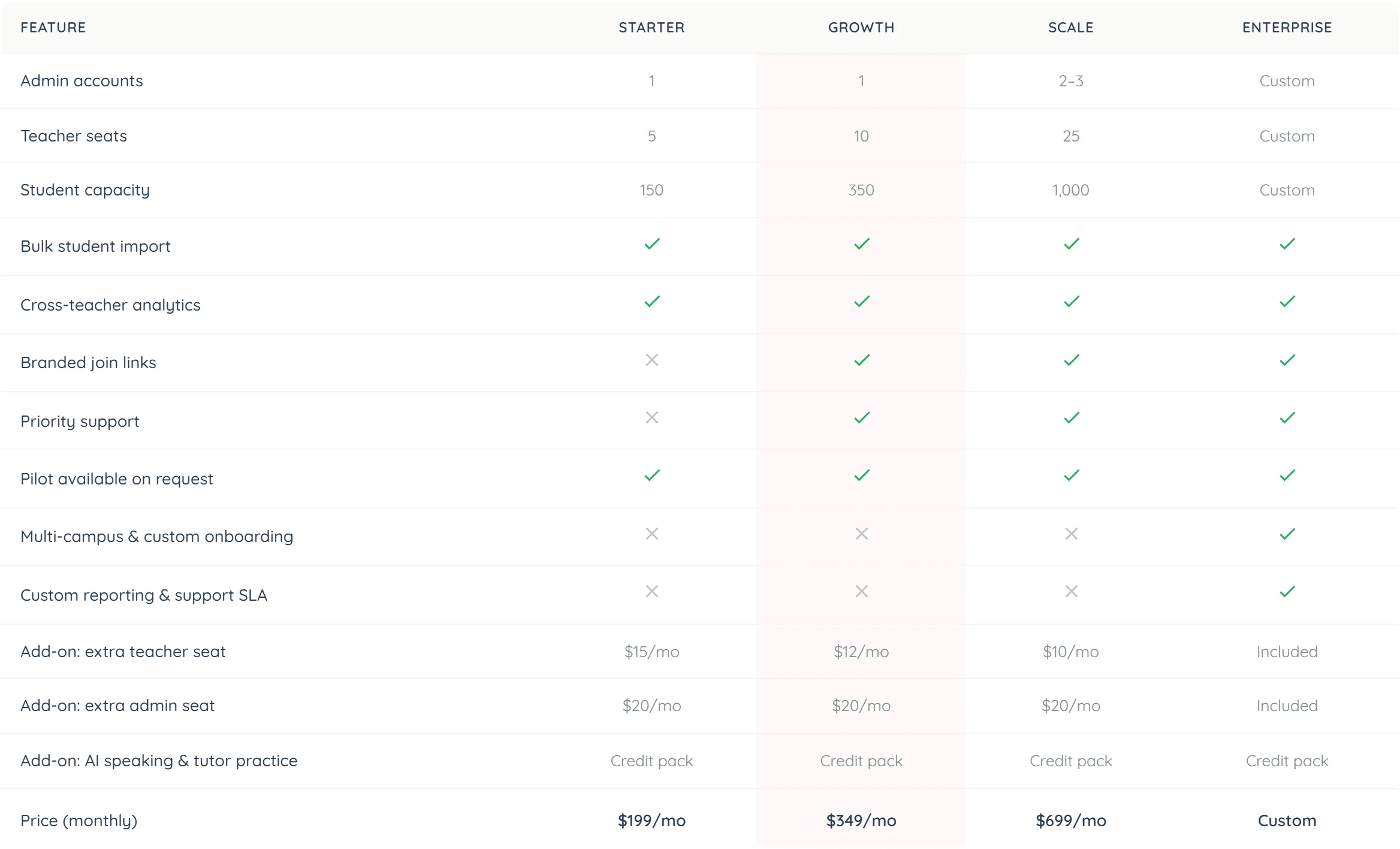
Those plans are no longer sold, but a school that has one keeps it — same price, same limits — for as long as it stays on it. You can switch to the School plan from Billing whenever you like; what you have already paid for the period is credited against it.
One AI balance for the school
Every member spends their own AI credits first. When those run out, your teachers — and students on a curriculum seat — draw on the school’s shared balance; platform seats never use AI. Creating a school class is paid from it too.
Top it up from Billing with a one-time pack (10k credits for $25, 50k credits for $110, 200k credits for $400), and set a monthly limit per student so one student cannot use it all. Billing shows what was used this month, by feature and by member — never what anyone asked.
Common questions
Students — the plan is priced by them. Teachers come with it: 5 seats included, and more cost $15 a month each.