
Starting one level too high is the most common reason people stall, and it rarely feels like the problem at the time — it feels like Chinese being hard. This article covers the placement test, what the nine HSK 3.0 levels actually mean, and how to change level later when you get it wrong.
The placement test
About three minutes, and adaptive — it adjusts to your answers rather than marching through a fixed list, so it narrows in quickly and stops once it is confident.
At the end you get a recommended HSK level and a short written explanation of why, with a link straight into the grammar for that band. Nothing is charged for taking it and you can retake it whenever you like.
What the levels mean
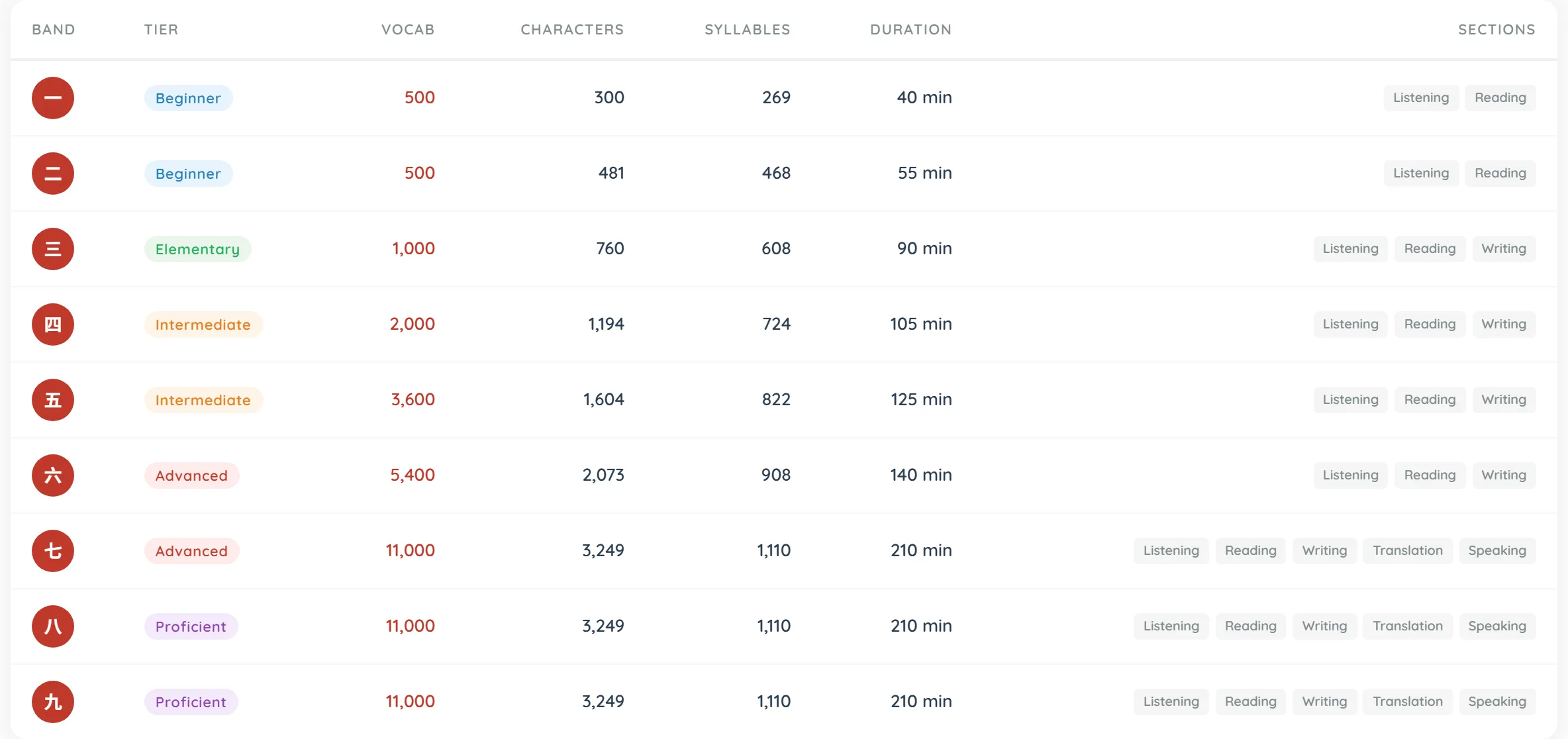
HSK 3.0 has nine levels. One to six are individual exams; seven, eight and nine are three grades of a single advanced paper. Each level names a cumulative vocabulary target, and the site bands every dictionary entry and every generated sentence against those targets.
- HSK 1 — 300 words — Beginner. Greetings, numbers, and basic conversation. Your first step into Mandarin.
- HSK 2 — 500 words — Beginner. Daily routines, shopping and directions, building on HSK 1.
- HSK 3 — 1,000 words — Elementary. Opinions, plans and past events, for richer everyday conversation.
- HSK 4 — 2,000 words — Intermediate. Expressing opinions, narrating experiences, discussing society at length.
- HSK 5 — 3,600 words — Intermediate. Reading newspapers and novels, following films, discussing culture with nuance.
- HSK 6 — 5,400 words — Advanced. Reading literature, following complex media, expressing yourself precisely.
- HSK 7–9 — 11,000 words — Mastery. Near-native command of literary and professional Chinese, graded across three bands.
Choosing between two levels
When the test puts you on a boundary, or you are genuinely unsure, take the lower one. Two reasons, and neither is about being cautious for its own sake.
A level you find slightly easy is finished quickly and gives you the vocabulary the next one assumes. A level you find slightly hard is abandoned. And because every lesson is checked against the vocabulary of its own band, a lower level is genuinely lighter rather than the same material with a different label on it.
Changing level later
Change it whenever you like, from your study plan or your account settings. Nothing is lost: progress, XP, streaks and flashcard scheduling all belong to your account rather than to a level, so moving up or down only changes what is recommended next.
The signals worth acting on are boredom in one direction and dread in the other. If a lesson never teaches you anything new, move up. If you are looking up more than a couple of words a sentence, move down.
Common questions
About three minutes. It is adaptive, so it converges on your level rather than working through a fixed list of questions, and it stops as soon as it has enough to answer.