
Podcast


Podcast: Qin Shi Huang and the Unification of China
Listen to Jason & Amy discuss Qin Shi Huang and the Unification of China
New here?
The Warring States
By the fifth century BCE, the old feudal order established under the Zhou dynasty had collapsed into a maelstrom of interstate violence that later historians would call the Warring States period (战国时代, Zhànguó Shídài). Seven major kingdoms — Qin, Chu, Qi, Yan, Han, Wei, and Zhao — competed for supremacy in a landscape of shifting alliances, espionage, and catastrophic battles that could field armies of hundreds of thousands. Diplomats traveled between courts offering strategies of alliance and betrayal. Philosophers debated the nature of good governance while cities burned. It was an age of extraordinary intellectual ferment — the "Hundred Schools of Thought" flourished in this crucible — but also of unrelenting bloodshed that would claim millions of lives over two and a half centuries.
The state of Qin, occupying the Wei River valley in the far northwest, had long been regarded by its eastern neighbors as a semi-barbarous backwater. But this marginal position proved advantageous. Shielded by mountains and gorges, the Qin homeland was difficult to invade, and its frontier culture fostered a martial toughness that the more refined eastern states could not match. Beginning in the fourth century BCE, a series of radical reforms transformed Qin from a feudal backwater into a ruthlessly efficient military-administrative machine. The architect of these reforms was a legalist statesman named Shang Yang, who abolished aristocratic privilege, imposed collective punishment on communities that harbored criminals, rewarded soldiers strictly by the number of enemy heads they presented, and reorganized the population into mutual-surveillance groups of five and ten households.
The reforms were brutal, but they worked. Within a generation, Qin had the most disciplined army, the most productive agriculture, and the most obedient population of any state in the Chinese world. Shang Yang himself was eventually executed by the Qin royal family he had served — torn apart by chariots — but his system survived him and became the foundation on which the empire would be built. By the time the young King Zheng ascended the Qin throne in 246 BCE at the age of thirteen, his kingdom already possessed the institutional machinery to conquer the world.
The Conquest
King Zheng came of age in a court riven by intrigue. His chief minister, Lü Buwei, may have been his biological father; his mother carried on an affair with a man who led a failed rebellion. Zheng survived these dangers, consolidated power, and by his late twenties had turned the full weight of the Qin military machine against the remaining kingdoms. The campaign of conquest was methodical and merciless. Han, the weakest of the rival states, fell first in 230 BCE. Zhao followed in 228 after a devastating siege. Wei capitulated in 225 when Qin engineers diverted a river to flood its capital. Chu, the largest and most culturally distinct kingdom, resisted for three years before its final army was destroyed in 223. Yan and Qi fell in 222 and 221 respectively.
In the space of a single decade, Zheng had accomplished what no ruler in Chinese history had ever achieved: the military unification of the entire Chinese cultural sphere under one sovereign. He marked the achievement by inventing an entirely new title for himself — 皇帝 (Huángdì), a compound that fused the words for "august" and "sovereign deity." No king, duke, or marquis had ever claimed such a designation. He was not merely a ruler of men; he was claiming a cosmic mandate. He declared himself 始皇帝 (Shǐ Huángdì) — the First Emperor — and proclaimed that his descendants would reign as the Second, Third, and onward through ten thousand generations.
The conquest itself was won not only by arms but by intelligence and subversion. Qin agents bribed ministers in rival courts, sowed discord between kings and their generals, and assassinated key figures. The philosopher Han Feizi, one of the greatest legalist thinkers, was lured to the Qin court and forced to take poison. The general Li Mu of Zhao, the one commander capable of stopping the Qin advance, was removed by his own king after Qin spies spread rumors of his disloyalty. The Warring States ended not with a single climactic battle but with a sustained campaign of military, diplomatic, and psychological warfare that dismantled each rival state from within and without.
One Script, One Empire
The First Emperor understood that military conquest alone could not hold his empire together. The six conquered kingdoms spoke mutually unintelligible dialects, used different writing systems, operated under different legal codes, and measured goods with incompatible weights and scales. Merchants traveling from the old state of Qi in the east to Qin territory in the west had to convert currencies, recalculate measurements, and sometimes learn entirely new scripts to conduct their business. An empire this fragmented could not be governed from a single center — not without radical standardization.
The program that followed was staggering in its ambition and thoroughness. Chancellor Li Si oversaw the creation of a unified script — small seal script (小篆, xiǎozhuàn) — and ordered that every regional variant be abandoned. Official documents, legal codes, and public inscriptions throughout the empire were to be written in this single standardized hand. Weights and measures were fixed to Qin standards: a single system of bronze balance weights was distributed to every market town. The currency was unified under the round copper coin with a square hole in its center — the banliang (半两) — a design that would remain the template for Chinese coinage for two thousand years. Even the axle width of carts was standardized so that wheel ruts on every road in the empire would match.
This was more than administrative convenience; it was a deliberate reshaping of culture in the image of the state. The standardization of writing, in particular, had consequences that long outlived the Qin dynasty itself. By forcing every literate person in the empire to use the same characters, the First Emperor ensured that Chinese civilization would possess a shared written language even when its spoken dialects diverged beyond mutual comprehension. A letter written in Guangzhou could be read in Beijing. An edict issued in the capital could be understood in every province. This linguistic unity — fragile in speech, adamantine in writing — became one of the defining features of Chinese civilization and one of the First Emperor's most enduring legacies.
"Unified writing for documents, unified gauge for carriages."
Book of Rites (礼记, Lǐjì)The Human Cost
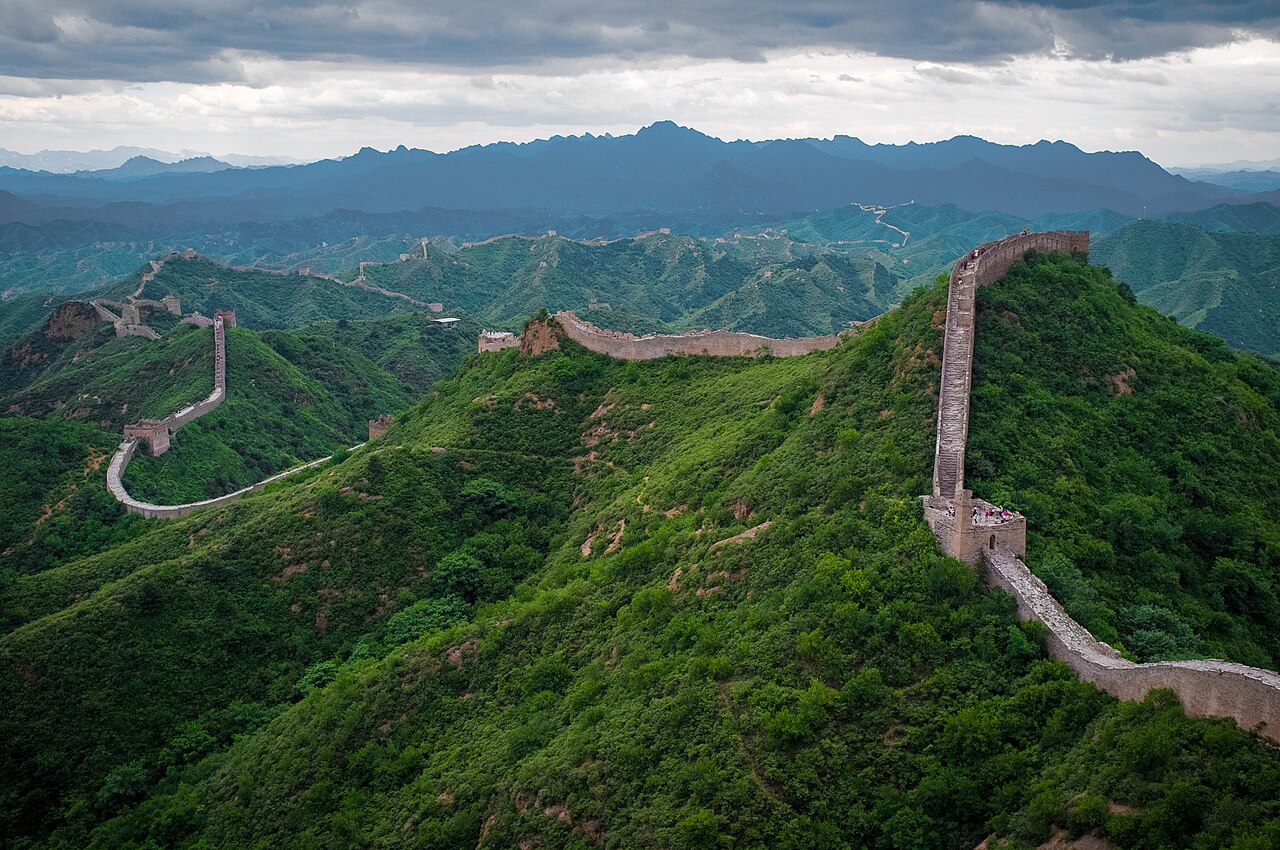
The price of unification was paid in human suffering on an almost incomprehensible scale. The First Emperor's great infrastructure projects — the roads, canals, palaces, and defensive walls that bound the empire together — were built by conscript labor drawn from the conquered populations. Ancient sources estimate that 700,000 laborers worked on the construction of the Epang Palace alone, and a similar number were dispatched to build and connect the northern frontier walls that would later become the Great Wall. Modern historians debate the precise figures, but no one disputes the essential picture: millions of peasants were torn from their fields and families and marched to construction sites where many would die from exhaustion, exposure, starvation, or the whips of overseers.
The Great Wall, in particular, became a byword for imperial cruelty. The folk tale of Meng Jiangnu (孟姜女), who wept so bitterly at the wall where her husband had died that her tears caused a section to collapse, revealing his bones, became one of the most enduring legends in Chinese culture. The story survives in opera, folk song, and children's literature to this day — a testament to the depth of popular resentment that the wall's construction inspired. Historical sources describe corpses being incorporated into the wall's foundations rather than buried, a detail that may be apocryphal but captures the emotional truth of the enterprise.
The suppression of dissent was equally ferocious. In 213 BCE, on the advice of Li Si, the First Emperor ordered the burning of all books in private possession except those dealing with medicine, divination, and agriculture. Texts of history, philosophy, and poetry — the accumulated intellectual heritage of the Hundred Schools — were consigned to the flames. The following year, according to the historian Sima Qian, 460 scholars were buried alive for criticizing the emperor's policies. The precise number and circumstances remain debated, but the episodes reveal a regime that regarded independent thought as an existential threat to be met with lethal force.
The Eternal Army
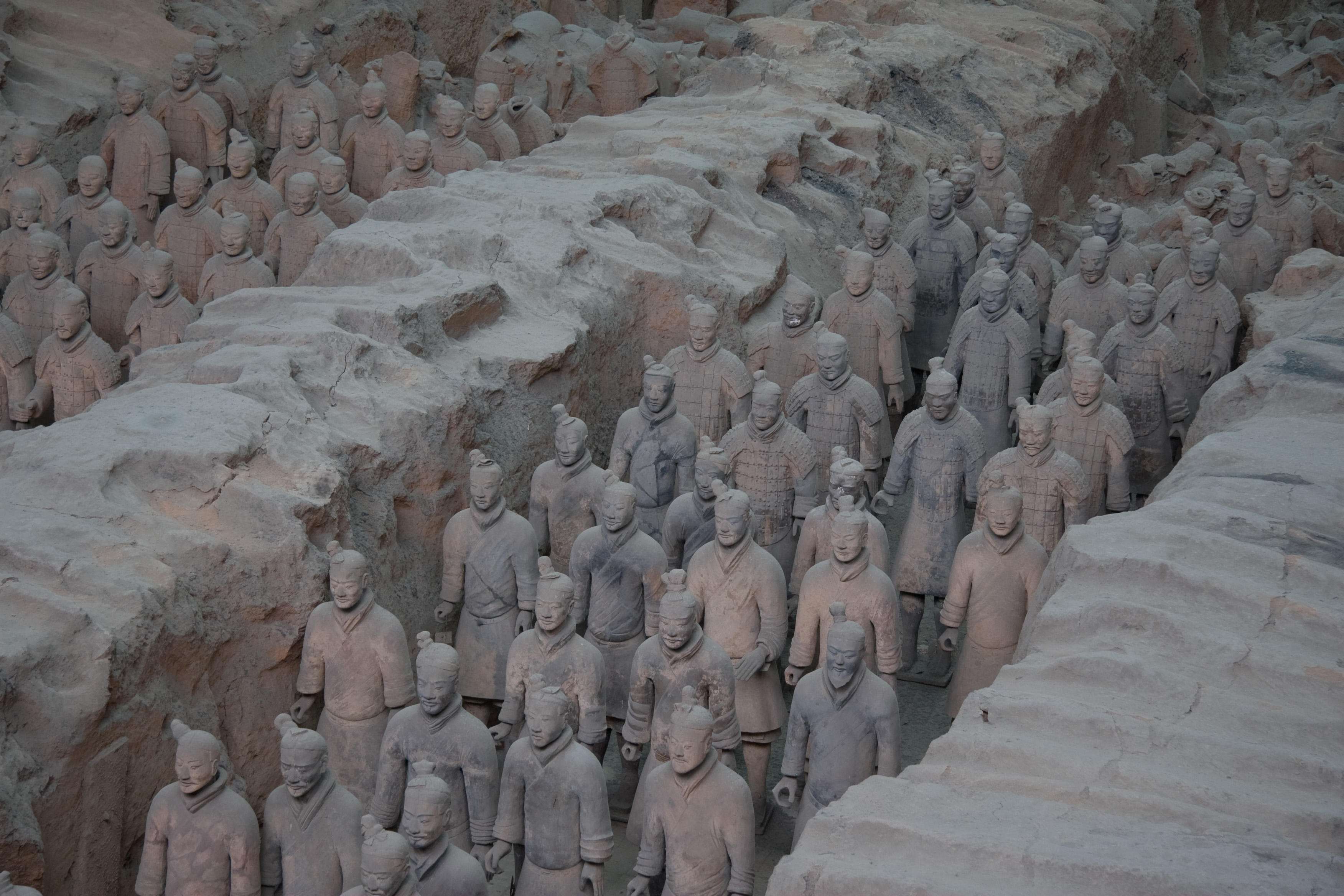
In 1974, farmers digging a well near the city of Xi'an in Shaanxi province broke through into one of the most astonishing archaeological sites ever discovered: a vast underground complex containing an army of life-sized terracotta warriors arrayed in battle formation, standing guard over the tomb of the First Emperor. The find was accidental and world-changing. Subsequent excavation revealed three major pits containing an estimated 8,000 soldiers, 130 chariots with 520 horses, and 150 cavalry horses — each figure individually sculpted with distinct facial features, hairstyles, armor details, and expressions. No two warriors are alike. The army was equipped with real bronze weapons — swords, crossbows, spearheads — many of which were still sharp after two millennia, preserved by a chromium oxide coating that modern metallurgists did not rediscover until the twentieth century.
The terracotta army is only one element of a funerary complex that may extend over fifty-six square kilometers. The central burial mound, which has never been fully excavated, is described by Sima Qian as containing a miniature replica of the empire, with rivers and seas of flowing mercury, a ceiling set with pearls to represent the stars, and crossbow traps to deter grave robbers. Remarkably, modern geochemical surveys have confirmed abnormally high levels of mercury in the soil around the mound, lending credibility to an account written more than a century after the emperor's death. The decision not to excavate the central chamber — made by the Chinese government to preserve its contents until archaeological technology can guarantee their safety — means that the greatest secrets of the tomb remain hidden.
The warriors themselves reveal the sophistication of Qin-era manufacturing. The figures were produced using a modular system: standardized body components — torsos, arms, legs, heads — were mass-produced in molds and then assembled in different combinations, with individual details added by hand. This approach, combining industrial efficiency with artisanal customization, allowed the workshops to produce thousands of unique figures in a manageable timeframe. The same logic of standardized, interchangeable parts that the First Emperor applied to his empire's script, currency, and axle widths was applied, with characteristic Qin thoroughness, to his own immortality.
The Fall and the Idea
The First Emperor died in 210 BCE during a tour of the eastern provinces, possibly from mercury poisoning — an irony if true, since he had been consuming mercury-based "elixirs of immortality" prescribed by court alchemists. His death was concealed by the eunuch Zhao Gao and the chancellor Li Si, who forged an imperial edict ordering the emperor's eldest son and chosen heir, Fusu, to commit suicide. The compliant younger son, Huhai, was installed as the Second Emperor, a puppet controlled by Zhao Gao. The deception worked in the short term but destroyed the dynasty. Huhai proved incompetent, Zhao Gao murdered Li Si and eventually the emperor himself, and by 206 BCE the empire was engulfed in a peasant rebellion that swept the Qin from power.
The dynasty that replaced it — the Han — would last four centuries and give its name to the ethnic majority of China. But the Han emperors did not dismantle the Qin system; they inherited it. The centralized bureaucracy, the standardized script, the network of roads and walls, the system of prefectures and counties governed by appointed officials rather than hereditary lords — all of these Qin innovations became permanent features of the Chinese state. The Han rulers softened the harshest Qin policies, replacing legalist severity with a Confucian veneer of benevolence, but the institutional architecture remained fundamentally unchanged.
This is the paradox of Qin Shi Huang: the dynasty he built was among the shortest in Chinese history, yet the state he designed proved among the most durable. Every subsequent dynasty — Han, Tang, Song, Ming, Qing — governed through institutions whose basic outlines the First Emperor had drawn. The idea that China should be a single, unified state, administered by a centralized bureaucracy using a common script, has survived civil wars, foreign conquests, and revolutions. It remains the foundational assumption of Chinese governance today. The First Emperor was a tyrant, but he was also, in a sense that he would have relished, immortal.
"The great trend of the world: long divided, it must unite; long united, it must divide."
Luo Guanzhong, Romance of the Three Kingdoms (三国演义)Quiz
What was the Warring States period characterized by?
Which state was considered semi-barbarous by its eastern neighbors?
What title did King Zheng create for himself after unifying China?
What was a key method used by Qin agents to defeat rival states?
Why was the standardization of the script significant for the First Emperor's rule?
What does the story of Meng Jiangnu symbolize in Chinese culture?
What was discovered near Xi'an in 1974?
What paradox is associated with the Qin dynasty?
Write your thoughts, then get feedback from Jason — you can turn any answer into a full discussion.
9. Why do you think the First Emperor's standardization policies had such a lasting impact on Chinese civilization?
10. How might the story of the First Emperor influence modern perceptions of leadership and governance?
Frequently Asked Questions
Common questions about Qin Shi Huang and the Unification of China
How did Qin Shi Huang unify China?
Qin Shi Huang unified China through a combination of military conquest and administrative standardization. After defeating the six rival kingdoms by 221 BCE, he abolished feudalism, divided the empire into centrally controlled commanderies, standardized weights and measures, currency, the writing system, and even axle widths. These reforms welded a fractured collection of warring states into a single political entity.
Why was the Terracotta Army built?
The Terracotta Army was built to guard Qin Shi Huang in the afterlife. The emperor believed he would continue to rule after death and commissioned an entire underground army of over 8,000 life-sized clay soldiers, horses, and chariots to protect his tomb. Each warrior has individually sculpted facial features, making it one of the most extraordinary archaeological discoveries of the 20th century.
What did Qin Shi Huang standardize across China?
Qin Shi Huang imposed sweeping standardization across the empire, including a unified writing script (small seal script), a single currency, consistent weights and measures, and standard axle widths for carts to fit the empire's roads. He also built a network of roads and canals connecting the provinces and began linking existing defensive walls into what would become the Great Wall of China.
Was Qin Shi Huang a good or bad ruler?
Qin Shi Huang remains one of history's most debated figures. He achieved the monumental task of unifying China and created the administrative framework that endured for over two thousand years. However, his rule was marked by extreme brutality, including mass conscription, book burnings, the execution of dissenting scholars, and crushing forced labor projects that cost hundreds of thousands of lives.
How long did the Qin dynasty last and why did it fall?
The Qin dynasty lasted only 15 years (221-206 BCE), making it one of the shortest major dynasties in Chinese history. It collapsed just four years after Qin Shi Huang's death because his harsh Legalist policies, crushing taxation, and forced labor had generated enormous popular resentment. Widespread rebellions erupted, leading to civil war and the eventual rise of the Han dynasty.