
Podcast


Podcast: The Silk Road: How China Built the World's First Global Trade Network
Listen to Jason & Amy discuss The Silk Road: How China Built the World's First Global Trade Network
New here?
Zhang Qian and the Opening of the West
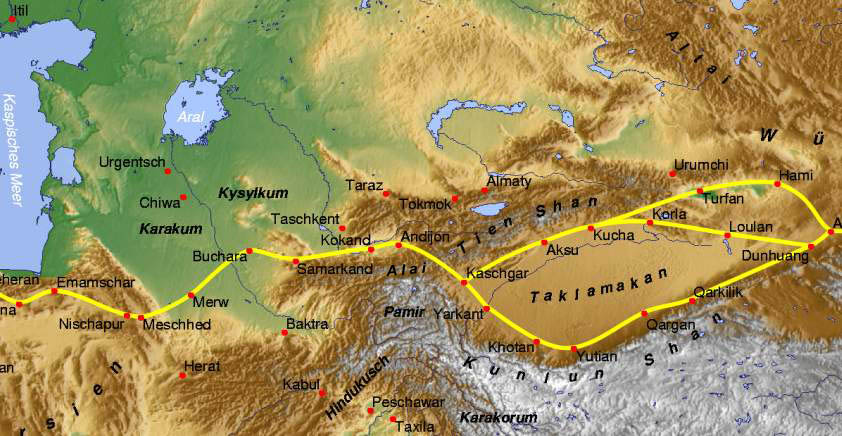
The story of the Silk Road begins with a diplomatic disaster that turned into one of history's great commercial triumphs. In 138 BCE, Emperor Wu of the Han dynasty dispatched Zhang Qian, a palace attendant, westward to forge an alliance with the Yuezhi people against the marauding Xiongnu nomads. Zhang Qian was captured by the Xiongnu almost immediately and held prisoner for over a decade. When he finally escaped and made his way back to the Han capital of Chang'an in 125 BCE, he had failed in his diplomatic mission — but he brought back something far more valuable: detailed knowledge of the lands, peoples, and trade goods of Central Asia (Hansen, 2012). His reports of the "heavenly horses" of Ferghana, the grapes and alfalfa of Bactria, and the sophisticated urban civilizations beyond the deserts electrified the Han court. Emperor Wu launched a series of military campaigns to secure the western corridor, establishing garrisons and relay stations along what would become the most consequential trade route in human history.
Zhang Qian's second mission, in 119 BCE, was explicitly commercial in nature. He traveled with a caravan of three hundred men, tens of thousands of cattle and sheep, and vast quantities of silk and gold intended as trade goods and diplomatic gifts. This time, he reached the kingdoms of Wusun, Dayuan (Ferghana), and Kangju, establishing the first formal trade agreements between China and Central Asian states. The routes he pioneered connected Chang'an to Kashgar, and from there branched north and south around the fearsome Taklamakan Desert — a name that later travelers grimly translated as "you go in and you don't come out" (Whitfield, 2004). These two branches reunited at Dunhuang in the east and at Kashgar in the west, forming the arterial highways of transcontinental commerce. Zhang Qian is remembered in Chinese historiography as the man who "opened the road" (凿空, záo kōng), a phrase the great historian Sima Qian used to describe how he carved a passage through previously impassable barriers of geography and ignorance.
The geopolitical consequences of Zhang Qian's missions were enormous. The Han dynasty invested heavily in securing the "Western Regions" (西域, xīyù), establishing the Protectorate of the Western Regions in 60 BCE to administer and defend the trade corridors. Military colonies were planted at oasis towns, and a sophisticated system of beacon towers and relay stations stretched from the capital to the frontier. These investments were not purely strategic — they reflected the court's recognition that trade with the West generated enormous revenues. Silk, which could be produced cheaply in China but was valued by weight in gold in Rome, was the original commodity that gave the route its name. But as Peter Frankopan argues in The Silk Roads, calling it a "silk road" is misleading, because the network carried everything from jade and lacquerware to ideas about religion, medicine, and statecraft (Frankopan, 2015). The Han court's willingness to project military power thousands of miles from its capital, purely to protect trade routes, was unprecedented in the ancient world and established a pattern that Chinese governments would follow for centuries.
The Treasures of the Road: Goods, Commodities, and Technologies
The Silk Road was never primarily about silk, despite its evocative name — a label coined only in 1877 by the German geographer Ferdinand von Richthofen. The roster of goods that moved along these routes reads like an inventory of everything precious in the ancient world. Heading west from China: silk in bolts, thread, and finished garments; porcelain and lacquerware; tea (increasingly after the Tang dynasty); paper and, later, the technology of papermaking; cast iron and steel; cinnamon and rhubarb. Heading east into China: horses from Ferghana and the Central Asian steppe; jade from Khotan; lapis lazuli from Afghanistan; glass from Rome and Syria; wool and linen textiles; gold and silver coins; coral, amber, and precious stones; and — transformatively — new crops including grapes, pomegranates, sesame, walnuts, cucumbers, and garlic (Liu, 2010). The sheer variety of trade goods meant that the Silk Road was not one market but hundreds of interlocking local, regional, and long-distance markets, each with its own dynamics of supply and demand.
Of all the goods that traveled the Silk Road, none had a more profound impact than the technologies and techniques that diffused in both directions. Chinese papermaking technology, which had been refined since the second century BCE, reached the Islamic world after the Battle of Talas in 751 CE, when Arab forces captured Chinese papermakers among the prisoners of war. Within a century, paper mills were operating in Samarkand, Baghdad, and Damascus, and within three centuries the technology had reached Europe — an event that historians regard as one of the most consequential technology transfers in human history (Bloom, 2001). Similarly, Chinese silk-reeling and weaving techniques gradually spread westward, though China maintained its near-monopoly on high-quality silk production for centuries through strict export controls that made smuggling silkworm eggs a capital offense. Moving in the other direction, glassmaking techniques from the Roman and Sasanian empires influenced Chinese artisans, and metalworking innovations from Central Asia improved Chinese bronze and iron production. The concept of the Silk Road as a conduit for technology transfer, not just commodity exchange, is essential for understanding its civilizational importance.
The economic scale of Silk Road trade, while impossible to quantify precisely, was clearly enormous. Roman writers like Pliny the Elder complained bitterly that Rome's appetite for Chinese silk was draining the empire of gold — he estimated that trade with India and China cost Rome one hundred million sesterces annually, a staggering sum that represented a significant fraction of the imperial budget. Archaeological evidence supports these literary complaints: hoards of Roman gold and silver coins have been discovered across Central Asia and even in southern China, testimony to the chronic trade imbalance that favored the East. The Tang dynasty capital of Chang'an, with a population exceeding one million by the eighth century, was arguably the world's most cosmopolitan city, home to communities of Sogdian, Persian, Arab, Indian, and even Byzantine merchants (Hansen, 2012). Its Western Market (西市, xīshì) was a vast emporium where one could buy anything from Persian carpets to African ivory, presided over by market officials who regulated weights, measures, and prices. This was globalization in its earliest form — slower than today's version, certainly, but no less transformative in its effects on the societies it connected.
"Is it not a joy to have friends come from afar?"
Confucius, Analerta (论语)Caravanserais, Merchants, and the Logistics of Long-Distance Trade
The practical mechanics of Silk Road trade were far more complex than the romantic image of a lone caravan plodding across empty deserts might suggest. In reality, very few individual merchants traveled the full length of the route. Instead, goods passed through a chain of intermediaries, each operating within a familiar regional segment. A bolt of silk might begin its journey in a weaving workshop in Hangzhou, travel by river and canal to Chang'an, pass through the Hexi Corridor to Dunhuang, cross the Taklamakan via either the northern or southern route to Kashgar, continue through Sogdian territory to Samarkand or Bukhara, and finally reach the Mediterranean coast after changing hands a dozen or more times. At each stage, middlemen added their markup, which is why silk that cost relatively little to produce in China could sell for astronomical prices in Rome (Whitfield, 2004). This relay system meant that most merchants operated within networks of trust that were geographically and often ethnically defined — Sogdian merchants dominated the Central Asian segments, while Indian traders were prominent on the southern routes.
The infrastructure that supported this trade was surprisingly sophisticated. Caravanserais — fortified inns spaced roughly a day's journey apart — provided shelter, water, fodder for animals, and secure storage for goods. The most elaborate caravanserais, particularly those built during the Islamic period, were architectural marvels with courtyards, stables, baths, mosques, and even small markets. Along the Chinese-controlled sections of the route, the government maintained a system of postal relay stations (驿站, yìzhàn) that served double duty as rest stops for merchants and communication nodes for official dispatches. The Tang dynasty maintained over 1,600 such stations, each staffed with horses, riders, and provisions. Merchants traveling these routes also relied heavily on the hospitality of Buddhist monasteries, which functioned as combination banks, hostels, and warehouses — monks lent money at interest, stored goods, and mediated commercial disputes (Liu, 2010). The symbiotic relationship between commerce and religion along the Silk Road was one of its defining features: merchants funded the construction of temples and monasteries, and religious institutions provided the infrastructure and trust networks that commerce required.
The greatest logistical challenge of Silk Road trade was not bandits or distance but the sheer hostility of the terrain. The route crossed some of the most forbidding landscapes on Earth: the Gobi Desert, where summer temperatures exceeded 50°C; the Taklamakan Desert, a shifting sea of sand where caravans could be buried by storms that lasted days; the Pamir Mountains, whose passes exceeded 4,000 meters in elevation; and the Hindu Kush, where avalanches and altitude sickness claimed lives every season. Camels — specifically the two-humped Bactrian camel, which could carry up to 250 kilograms and go for days without water — were the indispensable technology of overland Silk Road trade. A large caravan might include hundreds or even a thousand camels, accompanied by guards, guides, interpreters, and veterinarians (Frankopan, 2015). The risks were enormous, but so were the profits: successful merchants could earn returns of several hundred percent on a single round trip, making the Silk Road one of the most lucrative — and most dangerous — commercial enterprises in the premodern world.
Ideas on the Move: Religion, Art, and Cultural Exchange
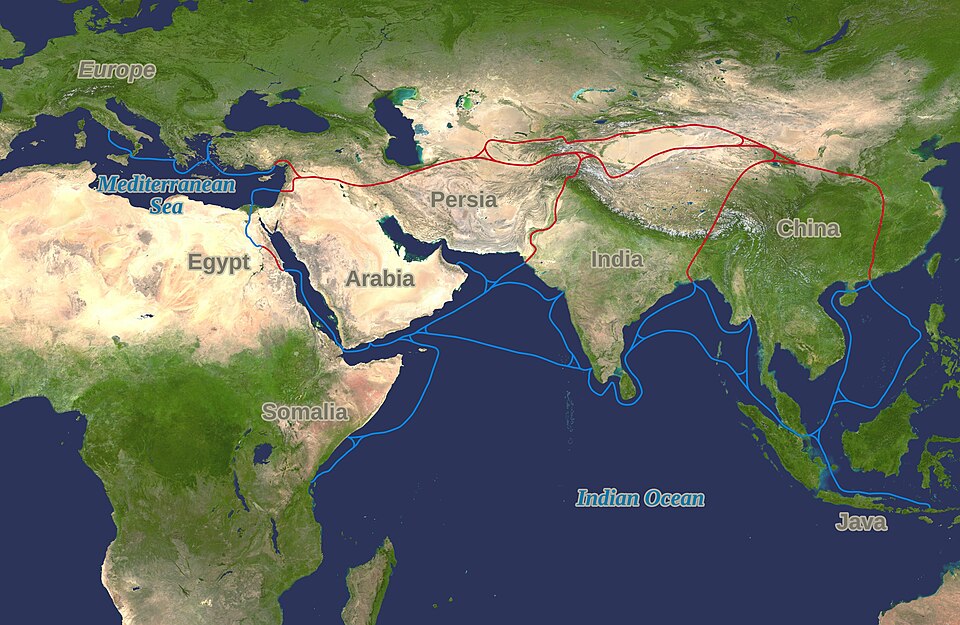
The most enduring legacy of the Silk Road was not the silk or the spices but the ideas that traveled alongside them. Buddhism provides the most dramatic example. Originating in the Ganges plain of India around the fifth century BCE, Buddhism reached China via Silk Road merchants and missionaries during the first century CE, carried along the same routes that bore bolts of silk and bars of jade. The transmission was gradual and complex: Buddhist texts were translated from Sanskrit and Pali into Chinese at translation centers in Dunhuang, Kucha, and Chang'an, a process that required decades of collaborative work between Indian monks and Chinese scholars. The famous pilgrim Xuanzang, who traveled the Silk Road to India and back between 629 and 645 CE, brought back 657 Buddhist texts and spent the rest of his life translating them — his journey later inspired the beloved novel Journey to the West (Hansen, 2012). The spread of Buddhism transformed Chinese art, architecture, philosophy, and social organization in ways that are still visible today, from the cave temples at Mogao and Longmen to the Chan (Zen) tradition that would later revolutionize Japanese culture.
Buddhism was not the only religion that traveled the Silk Road. Zoroastrianism, Manichaeism, Nestorian Christianity, Judaism, and eventually Islam all spread along these routes, creating a remarkable religious pluralism in the oasis towns of Central Asia. The Tang dynasty capital of Chang'an had Zoroastrian fire temples, Nestorian churches, Manichaean meeting halls, and Islamic mosques alongside its Buddhist monasteries and Daoist temples — a level of religious diversity that would not be matched by any European city for another thousand years. This pluralism was made possible by the commercial culture of the Silk Road, which required merchants of different faiths and ethnicities to cooperate, and by the generally tolerant policies of Chinese dynasties that recognized the economic benefits of welcoming foreign communities (Whitfield, 2004). The famous Nestorian Stele, erected in Chang'an in 781 CE and rediscovered by Jesuit missionaries in 1625, records in both Chinese and Syriac the arrival and flourishing of Christianity in China — testimony to the extraordinary cultural openness that trade fostered.
Artistic exchange along the Silk Road was equally profound. The Gandhara school of Buddhist art, which flourished in what is now Pakistan and Afghanistan from the first to the fifth century CE, fused Greek sculptural techniques — inherited from Alexander the Great's conquests — with Indian Buddhist iconography, creating a style that profoundly influenced Chinese Buddhist art. The cave paintings at Dunhuang's Mogao Grottoes, painted over a period of nearly a thousand years from the fourth to the fourteenth century, display an astonishing fusion of Chinese, Indian, Central Asian, and even Western artistic traditions. Musical instruments traveled the route as well: the pipa (琵琶), which became one of the most important instruments in Chinese music, originated in Persia and reached China via the Silk Road during the Han dynasty (Frankopan, 2015). The exchange was never one-directional — Chinese painting techniques influenced Persian miniature painting, and Chinese ceramic technology transformed pottery production across the Islamic world. The Silk Road was, in the deepest sense, a highway of civilization, and the cultural wealth it generated far exceeded the material wealth of its caravans.
"A journey of a thousand miles begins with a single step."
Laozi, Dao De Jing (道德经)The Maritime Silk Road: From Guangzhou to the Indian Ocean
While the overland Silk Road captured the imagination of later historians, the maritime routes that connected China to Southeast Asia, India, the Persian Gulf, and East Africa were equally important — and in many periods, carried far greater volumes of trade. The Maritime Silk Road emerged during the Han dynasty, when Chinese ships began sailing from the ports of Guangzhou (Canton) and later Quanzhou to Southeast Asia and beyond. By the Tang dynasty, Guangzhou had a thriving community of Arab, Persian, Indian, and Southeast Asian merchants, overseen by a Superintendent of Maritime Trade (市舶使, shìbósǐ) who collected customs duties and regulated foreign commerce (Clark, 1991). The Song dynasty, which lost control of the overland routes when northern China fell to the Jurchen Jin dynasty in 1127, invested even more heavily in maritime trade, developing Quanzhou into the world's busiest port — the great traveler Ibn Battuta, visiting in the 1340s, declared it the largest harbor he had ever seen, a judgment he applied to no other port in his vast travels.
The ships that plied the Maritime Silk Road were technological marvels. Chinese junks, with their watertight compartmentalized hulls, stern-mounted rudders, and multiple masts with battened sails, were the most advanced ocean-going vessels in the world for much of the medieval period. The magnetic compass, invented in China during the Song dynasty and applied to navigation by the twelfth century, gave Chinese mariners a crucial advantage in open-ocean sailing. The largest Chinese ships could carry over 500 tons of cargo and accommodate several hundred passengers — dwarfing the vessels of contemporary European and Arab fleets. The goods carried by maritime trade overlapped with but also differed from the overland routes: ceramics, which were too heavy and fragile for camel transport, became a major maritime export, and Chinese porcelain from the Song and Yuan periods has been found in archaeological sites from Japan to Zimbabwe (Liu, 2010). Spices — pepper, cloves, nutmeg, cinnamon — traveled northward from Southeast Asia, while Chinese silk and porcelain flowed south and west. The maritime route also carried bulk commodities like timber, metals, and foodstuffs that were impractical to transport overland.
The apex of China's maritime ambitions came with the extraordinary voyages of Admiral Zheng He between 1405 and 1433. Commanding fleets of up to three hundred ships — some of them "treasure ships" (宝船, bǎochuán) that may have exceeded 100 meters in length — Zheng He sailed to Southeast Asia, India, the Persian Gulf, and the east coast of Africa, projecting Ming dynasty power across the Indian Ocean. These were not voyages of exploration in the European sense but demonstrations of imperial prestige and exercises in tribute diplomacy: Zheng He distributed lavish gifts, collected exotic tribute (including the famous giraffe that was presented to the Yongle Emperor as a qilin), and established Chinese authority over existing trade networks (Dreyer, 2007). The abrupt cessation of these voyages after 1433, and the Ming court's subsequent turn toward isolationism, remains one of the great counterfactual questions of world history. Had China continued its maritime expansion, the encounter between East and West might have unfolded very differently — but the inward turn reflected deep tensions within Chinese statecraft between the interests of coastal merchants and the Confucian bureaucratic elite, who viewed commerce with suspicion and maritime ventures as wasteful extravagance.
"The whole world bustles for profit; the whole world hustles for gain."
Sima Qian, Records of the Grand Historian (史记)Decline, Rediscovery, and the Silk Road's Modern Legacy
The overland Silk Road did not die in a single moment but rather declined gradually over several centuries, the victim of multiple converging forces. The Mongol Empire, paradoxically, represented both the Silk Road's greatest flourishing and the beginning of its end. Under Mongol rule in the thirteenth and fourteenth centuries, the entire length of the overland route fell under a single political authority for the first and only time in history, creating what historians call the Pax Mongolica — a period of unprecedented ease of travel and commerce across Eurasia. Marco Polo's famous journey to the court of Kublai Khan was possible only because Mongol rule had made the roads safe. But the Black Death, which spread along these same trade routes from Central Asia to Europe in the 1340s, devastated populations across Eurasia and severely disrupted commerce (Frankopan, 2015). The subsequent collapse of the Mongol Empire into warring successor states made overland travel dangerous again, and the rise of the Ottoman Empire in the fifteenth century — culminating in the fall of Constantinople in 1453 — placed a powerful intermediary between Europe and China that raised the costs of overland trade.
The final blow to the overland Silk Road came not from political disruption but from technological revolution. The development of European oceanic navigation in the fifteenth and sixteenth centuries — Portuguese voyages around Africa to India, Spanish voyages across the Atlantic, Dutch and English entry into the Indian Ocean — created sea routes to Asia that were faster, cheaper, and could carry far greater volumes of cargo than any overland caravan. A single Portuguese carrack could carry more goods than a caravan of a thousand camels, at a fraction of the cost per ton-mile. By the seventeenth century, the economic logic of maritime trade had rendered the overland routes commercially marginal, though they continued to carry local and regional traffic. The great oasis cities of the Silk Road — Samarkand, Bukhara, Kashgar, Dunhuang — declined from cosmopolitan commercial centers to dusty provincial towns, their former glory preserved only in crumbling ruins and the manuscripts buried in sealed caves (Whitfield, 2004). The famous Library Cave at Dunhuang, sealed around 1000 CE and rediscovered by the Daoist monk Wang Yuanlu in 1900, contained tens of thousands of manuscripts in Chinese, Tibetan, Sanskrit, Sogdian, and other languages — a time capsule of Silk Road civilization that scholars are still studying today.
The Silk Road's modern legacy extends far beyond historical scholarship. China's Belt and Road Initiative (一带一路, Yídài Yílù), launched by President Xi Jinping in 2013, explicitly invokes the Silk Road as a model and inspiration for a new era of Eurasian connectivity. The initiative — which encompasses infrastructure projects, trade agreements, and diplomatic relationships spanning more than sixty countries — represents China's most ambitious foreign policy undertaking since the treasure voyages of Zheng He. Critics argue that it is a vehicle for Chinese geopolitical influence and debt diplomacy, while supporters see it as a return to the cosmopolitan, trade-centered vision that made the original Silk Road one of humanity's greatest achievements (Frankopan, 2015). Whatever one's judgment of the Belt and Road Initiative, its very existence testifies to the enduring power of the Silk Road as both historical reality and cultural myth. The idea that trade creates connections that transcend political, linguistic, and religious boundaries — an idea that Zhang Qian stumbled upon in the deserts of Central Asia over two thousand years ago — remains as compelling today as it was in the age of camels and caravanserais.
Quiz
Who was Zhang Qian and what was his contribution to the Silk Road?
What was the primary commodity that initially gave the Silk Road its name?
Which technology transfer from China had a profound impact on the Islamic world and Europe?
What was the role of caravanserais along the Silk Road?
Which religion reached China via the Silk Road during the first century CE?
What was a significant logistical challenge of the Silk Road trade?
What was the impact of the Mongol Empire on the Silk Road?
What was the primary reason for the decline of the overland Silk Road?
Write your thoughts, then get feedback from Jason — you can turn any answer into a full discussion.
9. How did the Silk Road facilitate cultural exchange between different civilizations?
10. In what ways does the modern Belt and Road Initiative reflect the historical Silk Road?
Frequently Asked Questions
Common questions about The Silk Road: How China Built the World's First Global Trade Network
What was the Silk Road and why was it important?
The Silk Road was a vast network of trade routes connecting China to the Mediterranean world, spanning over 4,000 miles. It was important because it facilitated not only the exchange of goods like silk, spices, and precious metals, but also the transmission of ideas, religions, technologies, and cultural practices between Eastern and Western civilizations.
What goods were traded on the Silk Road besides silk?
Beyond silk, merchants traded a remarkable variety of goods including spices, tea, porcelain, jade, gold, silver, glassware, wool, horses, and gemstones. The route also carried less tangible but equally valuable exchanges such as papermaking technology, gunpowder, mathematical concepts, and religious texts.
How did the Silk Road affect Chinese culture and economy?
The Silk Road transformed China into the anchor of a global trade system, generating enormous wealth for Chinese dynasties and merchant classes. It also introduced foreign religions like Buddhism and Islam to China, brought new agricultural products and artistic styles, and established China as a dominant force in international commerce for centuries.
When did the Silk Road start and end?
The Silk Road began to take shape during the Han Dynasty around 130 BCE when Zhang Qian was sent on diplomatic missions to Central Asia. While land-based trade gradually declined after the 15th century as maritime routes became dominant, the Silk Road continued to function in various forms for nearly 1,600 years.
How did China protect trade along the Silk Road?
Chinese dynasties invested heavily in military garrisons, watchtowers, and fortifications along key sections of the route, particularly through the Hexi Corridor and the Tarim Basin. The Tang Dynasty was especially effective at maintaining security, establishing a system of relay stations and diplomatic relationships with Central Asian states to ensure safe passage for merchants.